
A Pedagogy of Hope: Pagán and Pietri in Nitza Tufiño’s Tenderete
So as an artist, I’m glad that I always chose that I had to fight either [with] the pen or the brush . . . 1
—Nitza Tufiño
To survey Nitza Tufiño’s (b. 1949, Mexico City, Mexico) oeuvre over the last five decades, spanning drawing, painting, printmaking, public art, and more, is to witness Puerto Rican history and culture, and its inseverable link with diaspora, Afro-Caribbean epistemologies, and a political consciousness shaped by over five hundred years of colonial oppression and collective resistance. An artist, activist, and educator, Tufiño was raised between Mexico City, New York, and San Juan. Her practice is inextricably linked with what anthropologist Arlene Dávila describes as the Nuyorican art movement’s (c. 1960s–1980s) “politically engaged, global cultural sensibility” and what scholar Sebastián Pérez characterizes as “the overlapping of Mexican and Puerto Rican labor migrations and art practices.”2 Throughout her career, Tufiño has dedicated herself to what she terms arte comprometido—socially committed art—documenting stories of her family and community through a hybridity of visual media.
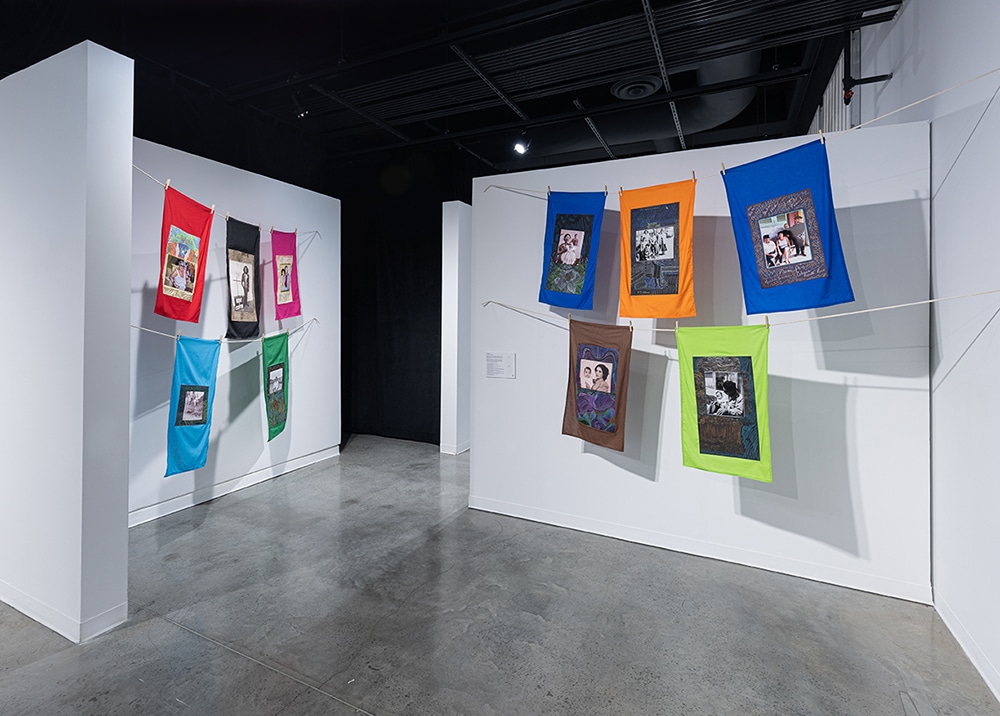
Her longest-running series, Tenderete (1974–present) consists of mixed-media pieces sewn to fabric that operate as a counter-archive of New York City’s Puerto Rican diaspora, her Mexi-Rican heritage, and their impacts in shaping her aesthetic language. Counter-archives disrupt what education historian Mahdi Ganjavi describes as “the ruling relations of power” to generate “alternative ways of remembering, preserving, and accessing information.”3 Constructed from working-class, marginalized, or suppressed realities, Tenderete offers what Brazilian educator Paolo Freire terms a “pedagogy of hope”—an education in our ontological need for both hope and struggle to concretize our desired future.4 The two works from Tenderete discussed here feature posthumous portraits of Nuyoricans deeply committed to sociopolitical struggle: Dylcia Pagán (1946–2024), activist and political prisoner, and Pedro Pietri (1944–2004), poet and cofounder of the Nuyorican Poets Café.
Born out of limited funds, space, and time, Tenderete emerged early in the artist’s career when Tufiño was supporting herself while raising her first child. “You still want to do something,” she explained, “so you find a way.”5 For Tufiño, that meant honoring working-class vernacular using the tenderete, or clothesline. Her adoption of this object resonates with artist, curator, and author Amalia Mesa-Bains’s concept of a “domesticana” sensibility by subverting material historically tied to female domestic labor in order to give visibility to its cultural value.6 This sensibility continues with Tufiño’s use of a sewing machine to collage her photographic portraits onto vibrantly colored fabrics whose proportions resemble a tea towel. While media ranging from paper, colored pencil, graphite, and marker appear in varying combinations, a machine-sewn zigzag stitch remains constant throughout the series.
This mélange of visual elements generated by her lens and hand points to art historian Rebecca VanDiver’s observation that “collage possesses a formal similarity to the diasporic condition itself.”7 Not only does the material hybridity of each piece in the series speak to this condition, but so do the ways in which Tenderete can be installed by expanding, contracting, or stacking each clothesline. Individually hung by two wooden clothespins, the adaptability and slight kineticism of Tenderete invites new constellations to take shape, while adapting to the space in which it lives—an apt metaphor for the diasporic condition.
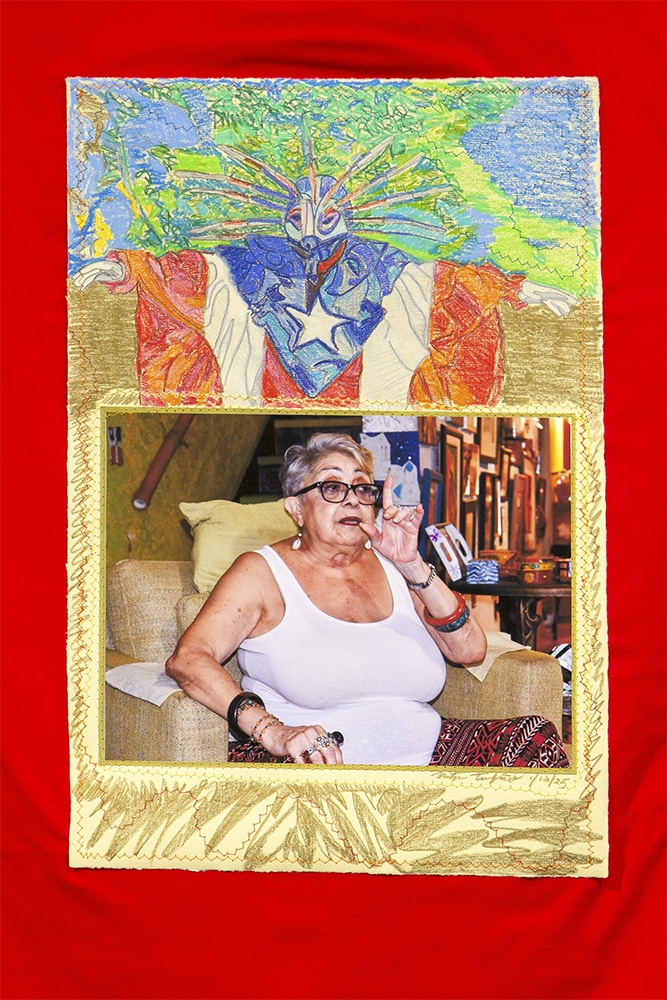
In Dylcia Pagán con Vejigante, Loíza, PR (2025), Tufiño bridges diasporic, political consciousness across time by juxtaposing Pagán’s photograph with a drawing of a vejigante. An amalgamation of African, Taíno, and Spanish influences, the vejigante arose in medieval Spain to represent the defeated, vilified Moors and was later adopted as a Puerto Rican symbol of resistance to colonial erasure and cultural dispossession.8 Tufiño strongly associates the European demonization of the vejigante with the colonial dehumanization of the Puerto Rican psyche: “They tell you that you’re wrong, wrong, wrong,” she says, “and then later you discover that it’s not wrong . . . there’s nothing wrong with you. You understand. It’s a colonial mentality.”9 Here Tufiño’s vejigante is adorned with a Puerto Rican flag whose blue chromatic variation registers a spectrum of political stances within Puerto Rico’s contested sovereignty.10 This opposition of azure and navy—independence versus statehood—is emblematic of Pagán’s role within Puerto Rico’s political struggle. For Pagán, the cost of her convictions for Puerto Rico’s independence would be a fifty-five-year sentence in federal prison on seditious conspiracy charges due to her connection to Fuerzas Armadas de Liberación Nacional (FALN), though she was never convicted of any crimes that resulted in death or injury. Forged in the Puerto Rican diaspora, this anti-colonial, clandestine group claimed responsibility for 120 bombings from 1974 to 1983 in pursuit of Puerto Rican independence.
Granted clemency by President Bill Clinton (in office 1993–2001) in 1999 after serving nineteen years, Pagán eventually rematriated to Puerto Rico and would spend the last decade of her life in Loíza—a town most associated with Afro-Puerto Rican traditions and the style of vejigante mask seen in Tufiño’s drawing.11 As the vejigante draws our eye down, Pagán appears below it, posed expressively in mid-conversation. Tufiño shares that outside of the picture plane sits Alba I. Rivera Ramírez (1985–89), a statehood supporter and former member of Puerto Rico’s senate and house: “I decided to get them both together because she’s [Dylcia] the extreme of something and Albita is the extreme of something, but they [both] want the betterment for Puerto Rico.” She continues, “we never give ourselves the chance for other people on the opposite spectrum to have that conversation . . .”12 This anecdote reflects the power of Tufiño’s counter-archive to reclaim Pagán’s humanity by recasting her as a vejigante committed to the struggle of, and the hope for, a Puerto Rico yet to come.
In Pedro Pietri, Rent-A-Coffin, Manhattan (2024), Tufiño pays homage to the artivist and poet laureate of the Nuyorican movement seen here at home holding a ski-capped skull alongside one of his signature performance props. Pietri’s “Rent-A-Coffin” briefcase was used to disperse poetry pamphlets and condoms throughout his community, as writer Michael Frierich notes, “to advocate publicly for Nuyoricans, queer people, and downtown artists during one of the darkest and deadliest periods in New York City’s history.”13 Functioning as a memento mori, the work pays tribute not only to Pietri’s memory, but to New York City’s Black and Puerto Rican enclaves. These communities are at the mercy of “organized abandonment,” as coined by prison educator Ruth Wilson Gilmore, with a racialized reality that Pietri’s practice deeply engaged with and documented.14
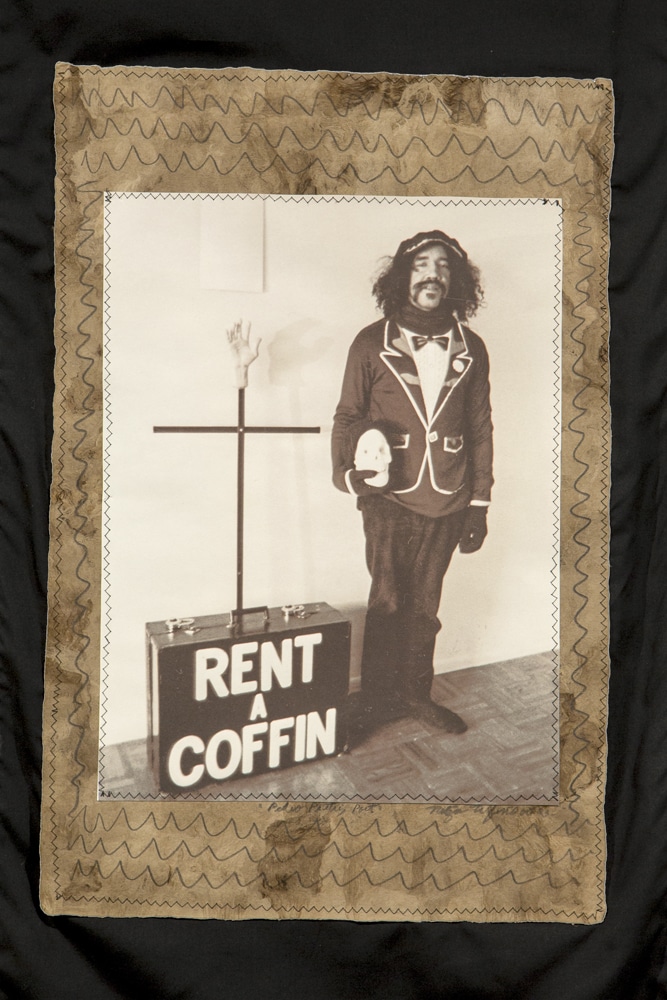
Tufiño reinforces Pietri’s “El Reverando” persona by sewing his image atop a piece of amate paper. Banned under Spanish colonization, amate is a sacred material tied to Indigenous rituals, tributes, and the creation of codices, among other uses.15 “It’s very hard to find,” she tells me, “and I felt that it was like an homage due to Pedro.” She goes on to share that Pietri allowed very few people to photograph him at home, making her one of the few documentarians of his private life—a witness to a sacred time and an intimate space.16 Over a decade after this photograph was taken, Pietri would be diagnosed with inoperable stomach cancer, leading him to fly back and forth from New York to Mexico to seek alternative cancer treatments.17 Tufiño sanctifies Pietri’s spirit through her use of amate, while reconnecting with the material culture of her Mexican heritage. Her devotional image memorializes not only Pietri, but also all those “who died yesterday today / and will die again tomorrow / Always broke / Always owing / Never knowing / that they are beautiful people,” as written in his signature poem Puerto Rican Obituary.18 Tenderete uplifts Pietri’s literary practice as another form of counter-archive—a testament to the generative ouroboros of hope and struggle in solidarity—serving as a last act of both reverence and care for her dear friend.
Tenderete documents the interconnectedness of both art and political education as expressed through Tufiño’s Mexi-Rican visual culture. The two works discussed here offer us an education in how instrumental the actions of Dylcia Pagán and Pedro Pietri were to the development of Nuyorican political consciousness and its resistance to hopelessness in the face of the greater colonial project. Pagán and Pietri’s inclusion in the Tenderete series further cements how instrumental these figures are to the greater history, interrogation, and reimagining of Puerto Rican studies. Whether Tufiño chooses to fight with the pen, the brush, or the sewing machine, her legacy is one of deep entanglement with hope and struggle—the critical tools needed to learn from our past, while creating for our future.
Endnotes
- Nitza Tufiño, “I See My Light Shining: Interviews. Denice Frohman Collection,” Oral history interview by Denice Frohman, Baldwin-Emerson Elders Project, August 19, 2023, https://eldersproject.incite.columbia.edu/interviews/nitza-tufino. ↩︎
- Arlene Dávila and Yasmin Ramirez, “Introduction,” in Nuyorican and Diasporican Visual Art: A Critical Anthology, eds. Arlene Dávila and Yasmin Ramirez with Néstor David Pastor, Gabriel Magraner, and Nikki Myers (Duke University Press, 2025), 6, https://doi.org/10.2307/jj.22730454.4; Sebastián Pérez, “Beyond Borinquen: The Afterlives of Puerto Rican Nationalism in Diaspora, 1980 to the Present” (PhD diss, Yale University, 2019), 102, https://americanstudies.yale.edu/graduate/recent-dissertations. ↩︎
- Mahdi Ganjavi, “Activating Personal Counter-Archives: The Case of the Amir Hassanpour Fonds,” The American Archivist 86, no. 2 (2023): 327, https://doi.org/10.17723/2327-9702-86.2.325. ↩︎
- Paulo Freire, Pedagogy of Hope: Reliving Pedagogy of the Oppressed, trans. Robert R. Barr, notes by Ana Maria Araújo Freire (Bloomsbury Academic, 2021), 17. ↩︎
- Nitza Tufiño, interview with the author, January 4, 2026. ↩︎
- Amalia Mesa-Bains, “‘Domesticana’: The Sensibility of Chicana Rasquache,” Aztlán 24, no. 2 (November 1999): 161, https://doi.org/10.1525/azt.1999.24.2.157. ↩︎
- Rebecca VanDiver, “The Diasporic Connotations of Collage: Loïs Mailou Jones in Haiti, 1954–1964,” American Art 32, no. 1 (2018): 47, https://www.journals.uchicago.edu/doi/10.1086/697715. ↩︎
- See Eli Tucker-Raymond, Enid M. Rosario-Ramos, and Maria L. Rosario, “Cultural Persistence, Political Resistance, and Hope in the Community and School-Based Art of a Puerto Rican Diaspora Neighborhood,” Equity & Excellence in Education 44, no. 2 (2011): 272, doi.org/10.1080/10665684.2011.563678. ↩︎
- Tufiño, January 4, 2026. ↩︎
- See Justin Agrelo, “The Puerto Rican Flag’s Evolving Colors Say a Lot About the Island’s Relationship With Its Colonial Rulers,” Mother Jones, January/February 2020, motherjones.com/politics/2020/01/puerto-rico-flag-gag-law-resistance-flag-colonialism/. ↩︎
- See Trip Gabriel, “Dylcia Pagán, Imprisoned Puerto Rican Nationalist, Is Dead at 77,” The New York Times, July 11, 2024, nytimes.com/2024/07/11/us/dylcia-pagan-dead.html; For visual references of Loíza’s vejigante traditions see Nicole Wines and Francisco G. Gómez, “Documenting Living Culture – Los Vejigantes de Puerto Rico,” Raíces Cultural Center Digital Archive, archive.raicesculturalcenter.org/collections/show/1. ↩︎
- Tufiño, January 4, 2026. ↩︎
- Michael Friedrich, “The Lost and Found Archives,” The Paris Review, November 25, 2019, theparisreview.org/blog/2019/11/25/the-lost-found-archives/. ↩︎
- See Ruth Wilson Gilmore’s concept of organized abandonment in Golden Gulag: Prisons, Surplus, Crisis, and Opposition in Globalizing California (University of California Press, 2007), 178. ↩︎
- Rosaura Citlalli López Binnqüist, “The Endurance of Mexican Amate Paper: Exploring Additional Dimensions to the Sustainable Development Concept” (PhD diss., Twente University Press, 2003), 6, https://ris.utwente.nl/ws/files/279526376/thesis_Lopez_Binnquist.pdf. ↩︎
- Tufiño, January 4, 2026. ↩︎
- See David Gonzalez, “Pedro Pietri, 59, Poet Who Chronicled Nuyorican Life,” The New York Times, March 6, 2004, nytimes.com/2004/03/06/arts/pedro-pietri-59-poet-who-chronicled-nuyorican-life.html. ↩︎
- Pedro Pietri, “Puerto Rican Obituary,” Poetry Foundation, 2015, https://www.poetryfoundation.org/poems/58396/puerto-rican-obituary. ↩︎
Cite as: Teréz Iacovino, “A Pedagogy of Hope: Pagán and Pietri in Nitza Tufiño’s Tenderete,” in X as Intersection: Writing on Latinx Art, September 14, 2026, accessed [DATE], https://uslaf.org/essay/a-pedagogy-of-hope/.
Teréz Iacovino is an artist, curator, and educator, who now serves as director of the Katherine E. Nash Gallery at the University of Minnesota. Her practice is continually shaped by the artists she works with, the students she mentors, and her experience as a Latina and first-generation graduate working in academia. She is co-editor of Vaiven: 21st-Century Art of Puerto Rico and Its Diaspora (University of Minnesota Press, 2025) and a contributor to Nuyorican and Diasporican Visual Art: A Critical Anthology (Duke University Press, 2025). Her curatorial work has been supported by The Andy Warhol Foundation for the Visual Arts, the National Endowment for the Arts, the Elizabeth Firestone Graham Foundation, the Jacques and Natasha Gelman Foundation, and the Harlan Boss Foundation for the Arts, among others.