Learning in Procession: Charo Oquet and the School of Rará
Santa Marta la Dominadora has protected Charo Oquet since she painted her first canvas.1
—Alanna Lockward
In the contemporary context of intensified production and circulation of images, the work of Dominican artist Charo Oquet articulates itself as a radical pedagogy by mobilizing Afro-Caribbean ritual practices—particularly those surrounding Rará/Gagá—within artistic dispositifs that engage bodies, sound, and collective participation. Her work situates publics within experiences where relation, memory, and transformation are activated through shared action. These actions convert artistic space, ranging in her practice from galleries to the street, into a field of learning in which knowledge circulates through rhythm, listening, and movement in real time. Public appearances organize conditions for knowledge to emerge from the interaction between participants and spectators. In this way, her work unfolds a pedagogy that operates through a historical sensibility, reconfigures perception, and produces situated forms of understanding social bonds. Doesn’t this practice become especially urgent in a region where everything that does not fit official narratives continues to be subject to erasure, suspicion or attack?2
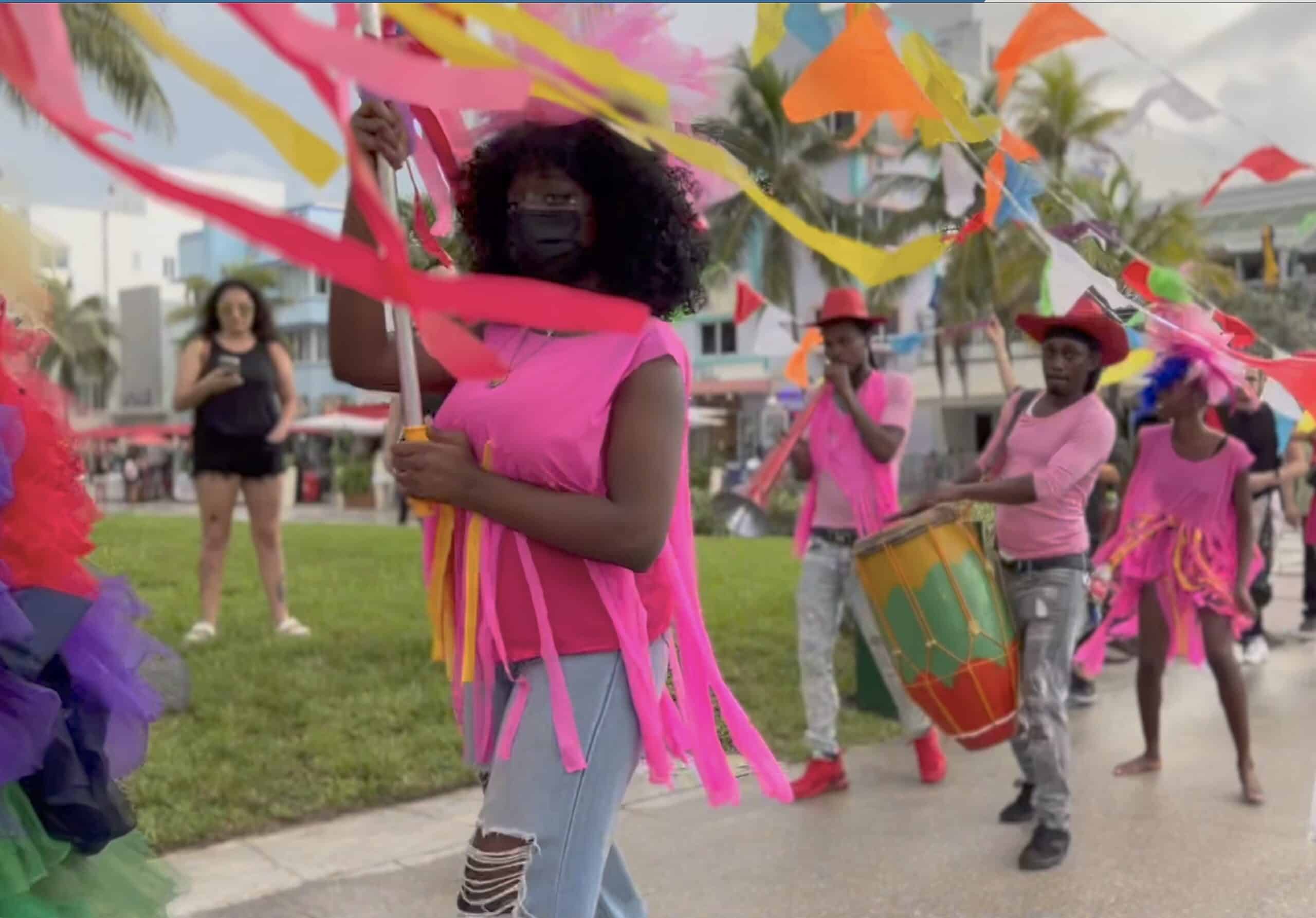
This impulse reaches one of its clearest formulations in Rara: Public Spirituality for Better Days, a multidisciplinary project that links installation, video, photography, sculpture, and performance with Afro-Indigenous fertility rites and spiritual encounters.3 Staged across different moments and locations, its activations in the streets of Miami Beach and at the Institute of Contemporary Art, Miami (ICA), during the summer of 2017 are particularly relevant for our inquiry. The project underscores an operation in which fiction and documentation merge to produce a third expressive realm: objects appear as conduits of energy; artistic research takes the form of a profound dialogue; and Rará is defined as a collective prayer whose power grows with each body that joins it. The work questions the place of shamanism within a society traversed by technological networks, economic systems, and electronic media, and proposes a reflection on the contemporary meaning of belonging and collective action.
It is necessary to distinguish between the terms Rará and Gagá. In Haiti, Rará names a processional practice of music, movement, offering, and ritual sociability associated with Lent and Holy Week. In the Dominican Republic, it carries a similar spiritual connotation but is referred to as Gagá. It appears primarily in batey contexts and among Dominican-Haitian communities linked to the sugar industry from the sixteenth century to the present. Each term carries a specific political history.4 In Dominican territory, Gagá has borne the weight of suspicion, inferiorization, and erasure, precisely because it concentrates Afro-Caribbean memories, Haitian proximities, and religious practices that exceed the hegemonic national script. Anthropologist June C. Rosenberg describes it as a religious and social complex articulated in sugar-mill zones by communities subjected to precarity, legal insecurity, and structural exclusion.5 Researcher Marcio Veloz Maggiolo insisted, in the prologue to one of Rosenberg’s publications, that Gagá must be understood outside the folkloric and carnivalesque framework.
From this anthropological perspective, the scope of Oquet’s work becomes clearer. Her practice enters a zone marked by structural racism and by the denial of Blackness that has shaped much of the modern Dominican imaginary. Gagá and Rará summon a history of crossings, migrations, labor violence, Black spiritualities, and border memories. Oquet returns all of this to the public sphere—where the most conservative and ultranationalist sectors of the Dominican Republic strive to erase it—with aesthetic intensity and political density. Her work performs an anti-racist critique by bringing into view what the dominant narrative has expelled from the set of elements considered in the construction of national identity: the Afro-Dominican density of culture, the constitutive proximity to Haiti, the strength of Dominican-Haitian communities, and the persistence of ritual knowledges as a form of situated knowledge.
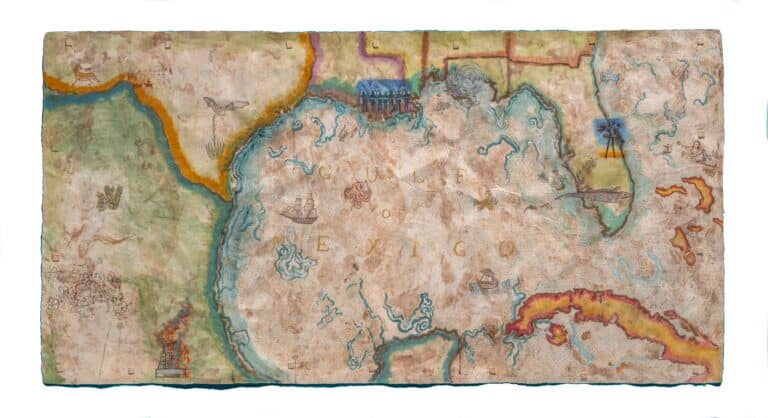
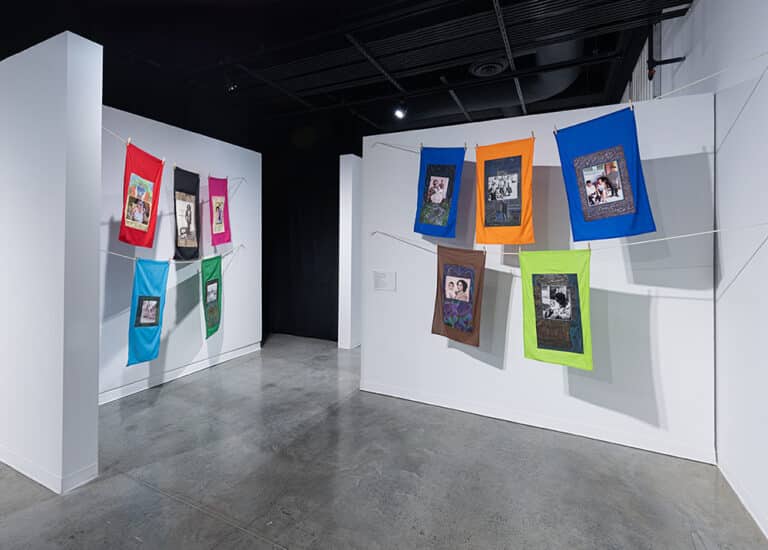
Formally, Rara: Public Spirituality for Better Days unfolds a visual field of extraordinary richness. The central installation gathers objects charged with energy, signs inspired by magical inscriptions such as vèvè—abstract forms linked to mythical concepts—and spatial assemblages that evoke altars, stations of transit, and centers of radiance. Everything appears arranged to intensify a presence in which matter acquires symbolic density and objects assume connective capacity. There is here an installation-based imagination, as both resource and artistic medium, that dazzles through its density and precision. Oquet organizes a landscape in which the sacred, the sculptural, and the performative summon one another. The scale of the project further expands this experience across different sites and media, so that the work breathes between exhibition space—as in its ICA presentation—public action, as seen in the Miami Beach activations, and also as documentation, image, and electronic circulation.
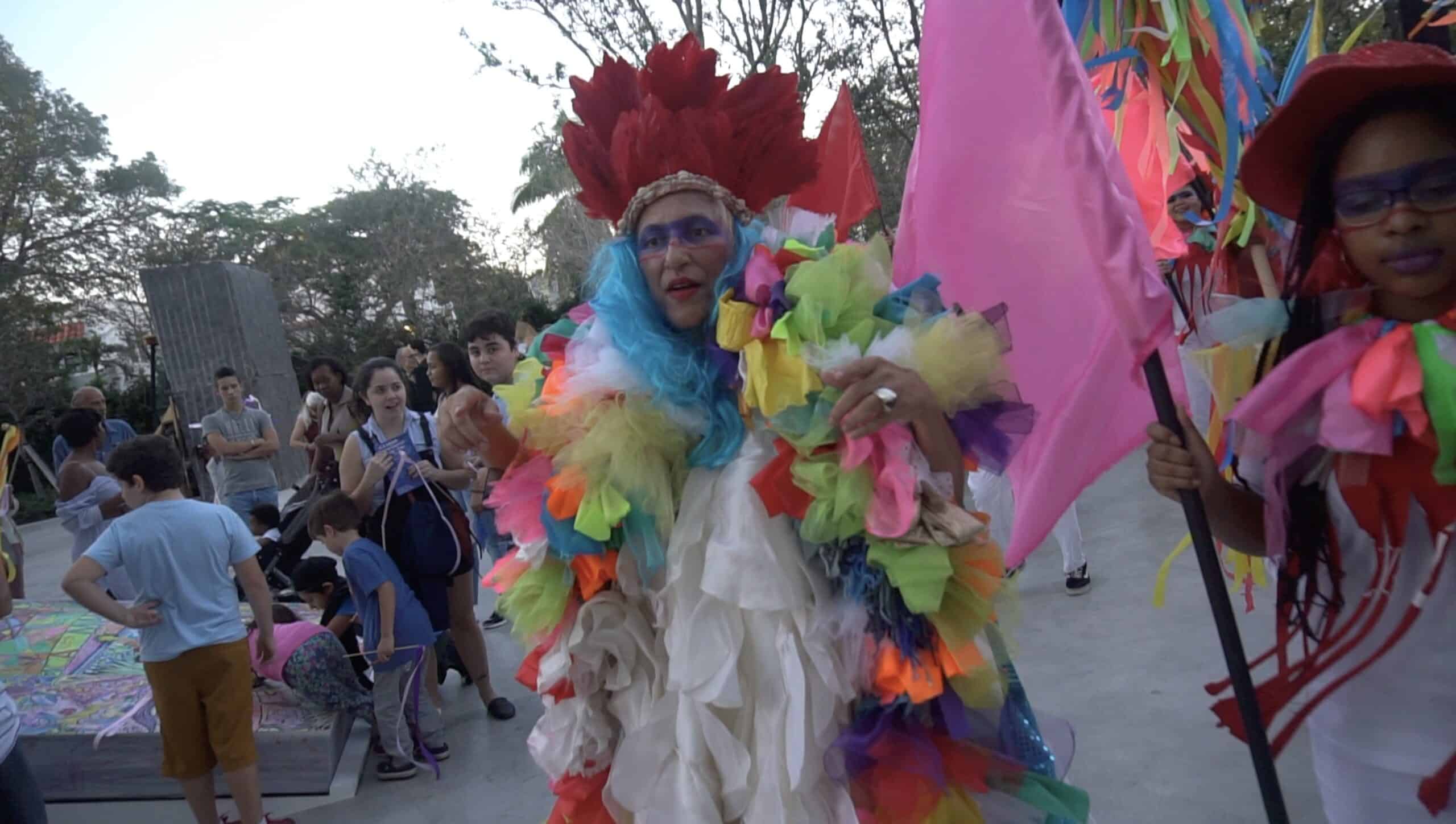
The work is presented through the appearance of Oquet, who emerges carrying objects she has created to visually evoke the Gagá procession: flags, fabrics, ribbons, rattles, feathers, and other elements that are progressively handed to the public, who adopt them and, in doing so, become part of a collective trajectory. Artists and cultural agents previously convened by Oquet also join, encouraging the integration of new onlookers. The experience unfolds as a musical drift of spontaneous sounds and improvised chants, configuring a shared movement that extends between one and two hours and acquires an openly cathartic character.
The sonic dimension plays a central role. Rhythm orders the experience, activates attention, and guides the participation of diverse publics engaging with the work. In this project, rhythm establishes patterns for progressive lessons within a possible and utopian pedagogical program. Understanding emerges from shared cadence, from ritual repetition, and from the energy of the group. The procession reorganizes public space by transforming its habitual use and turning it into a route of memory, encounter, and appearance. The body produces knowledge because it learns in motion, attuned to other bodies, traversed by sound and proximity.
When read through the theoretical frameworks bequeathed by Paulo Freire, this work activates key features of a popular pedagogy: dialogue, horizontality, collective construction of knowledge, and learning through shared experience. The project summons collaborators and publics into an experimental investigation. This formula is crucial. Oquet opens a situation in which meaning emerges through participation, listening, and reciprocity. Each viewer enters as an implicated body. Each participant contributes to expanding the scale of prayer and offering. Knowledge circulates in common. Hierarchy loses rigidity. Learning takes the form of a collectively constructed consciousness.
This dynamic is also where the work’s relational force resides. Oquet has spent years working with Arrayano communities and with contexts linked to bateyes, borderlands, and transnational movement. Miami Rara shares with these processes an insistence on activating forms of gathering and recognition in places where history produced separation, shame, or dispossession.6 Within this broader arc, the artist transforms aesthetic action into a space of transmission, care, and public visibility for Afro-Dominican and Dominican-Haitian genealogies. Her entire body of work appears organized by this same relational intention, as if, as Alanna Lockward clearly announces in the epigraph of this text, a higher will guided this production of knowledge.
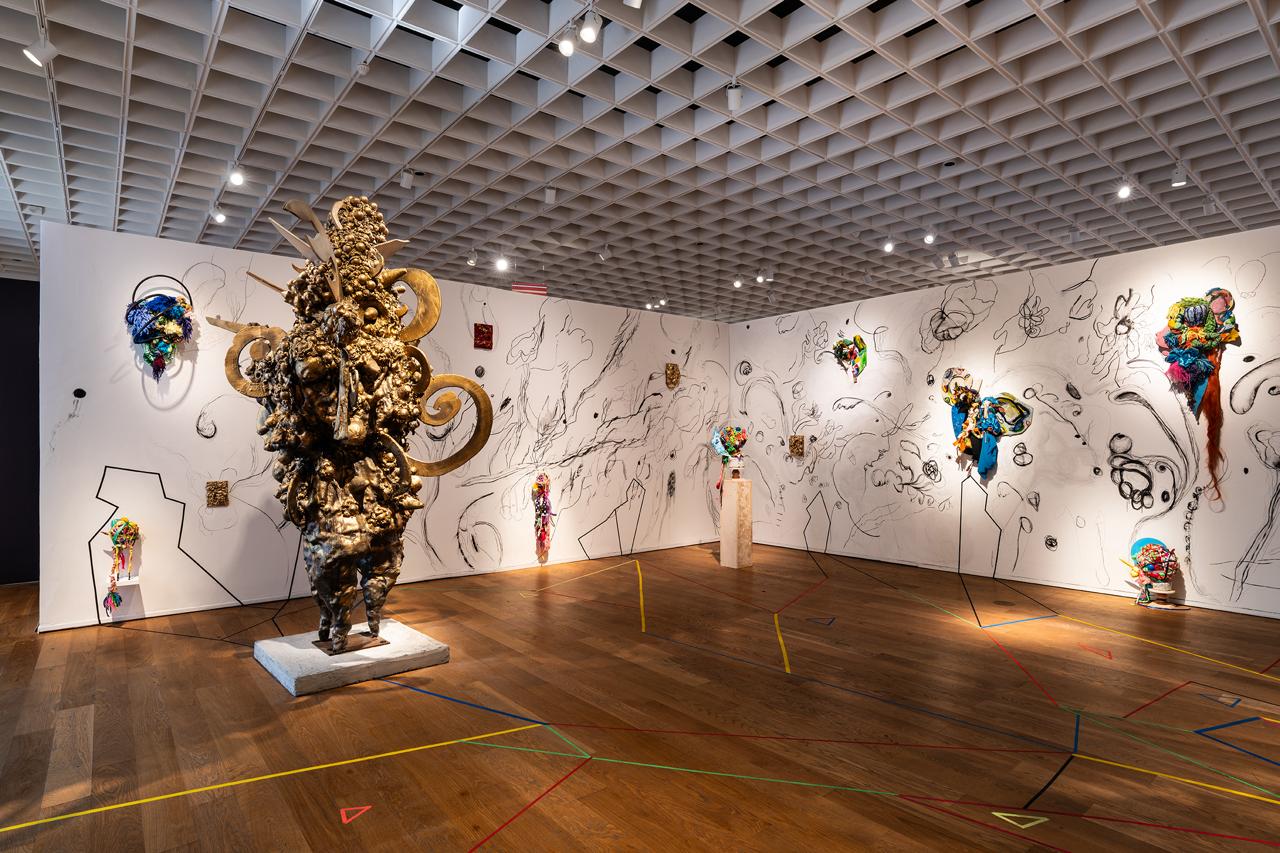
immersive installation, dimensions variable. Installation view of Florida Prize in Contemporary Art
on view at Orlando Museum of Art, May 30–August 23, 2026. Photograph by Zaire Aranguren.
The project’s spiritual dimension offers another key to reading it. The altars and spatial assemblages that appear in Miami Rara articulate a fertile relationship between the sacred and the contemporary. Jean-Hubert Martin has noted that altars and installations share a fundamental structure: both organize objects in space in order to produce meaning.7 In Oquet’s work, this affinity acquires immense power. The altar functions as a device of orientation, concentration, and passage. The installation functions as a relational space, a place of gathering, and a field of experience. Public spirituality thus emerges as a politics of presence. Its force does not depend on inward contemplation; it flourishes in the street, in the exhibition, in the gathering of bodies, in the circulation of signs, and in the possibility of activating community.
In the theoretical language of Caribbean thought offered by Édouard Glissant, this work is sheltered under a poetics of Relation.8 Oquet’s procession, closely emulating that of Rará, offers a model of the world composed of contact, opacity, coexistence, and resonance. Each body enters this model without dissolving its singularity. Learning in procession means learning to inhabit a world made of relations. It also means learning with joy; and here this carries deep political significance, as it sustains gathering, affirms collective dignity, and mobilizes desire and memory in contexts marked by exclusion and precariousness.
In my recent conversations with the artist, it has become clear to me that her years living outside the Dominican Republic, in New Zealand and in several cities across the United States, were diasporic experiences that sharpened her questions about race, coloniality, migration, and belonging. It was from outside the island, through contact with other realities also marked by colonial hierarchies and administered forms of exclusion, that certain convictions within her work acquired particular urgency. “That was when I began to think about us,” she told me.9 She was referring to Dominican-Haitian relations and to the African inheritance within our culture. That conversation illuminated, for my understanding, the deeper meaning of her work. Oquet found, in the line of inquiry to which she has devoted herself through a sustained artistic practice, a form of knowledge capable of sustaining life in places where the official language used to describe—or diminish—spiritualities such as these loses its substance. Hence, her work transforms Rará into a school in motion, a school of relation, of appearance, of historical consciousness, and of shared joy; a school that learns by walking.
Endnotes
- Alanna Lockward, “Los dominios de Santa Marta: Charo Oquet y su lección de paracélsica antillana,” Acento, July 31, 2012, https://acento.com.do/opinion/los-dominios-de-santa-marta-charo-oquet-y-su-lecccion-de-paracelsica-antillana-205353.html. ↩︎
- Roberto Ángel Salcedo, Minister of Culture, recently stated that “Our priority is what is one hundred percent Dominican,” aligning with a growing national sentiment. Reported by AltantoTV, https://www.instagram.com/reels/DKISPLyCtMn/. ↩︎
- Rará/Gagá refers to the broader Afro-Caribbean ritual tradition. Throughout this essay, the titles of Oquet’s works, Miami Rara and Rara: Public Spirituality for Better Days, retain the artist’s preferred spelling, without the accent. ↩︎
- A batey is a settlement associated with Caribbean sugar plantations, particularly in the Dominican Republic, where cane workers reside. It is characterized by historical conditions of marginalization, as well as by distinct community dynamics and cultural practices. ↩︎
- June C. Rosenberg, El gagá: religión y sociedad de un culto dominicano. Un estudio comparativo (Santo Domingo: Editora de la UASD, 1979). For Marcio Veloz Maggiolo’s prologue, see pages 9–11. ↩︎
- Arrayano is a term used in the Dominican Republic to refer to communities or individuals of Haitian descent historically linked to bateyes and to cultural practices such as Gagá, within contexts of mobility, sugar labor, and cross-border exchange. ↩︎
- Jean-Hubert Martin, “The World’s Altars and the Contemporary Art Museum,” Museum International 55, no. 2 (2003): 42–44. ↩︎
- Édouard Glissant, Poetics of Relation, trans. Betsy Wing (University of Michigan Press, 1997). By capitalizing Relation, Glissant treats it as an active entity rather than a passive connection. ↩︎
- Charo Oquet, interview with the author, December 5, 2025. ↩︎
Cite as: Luis Graham Castillo, “Learning in Procession: Charo Oquet and the School of Rará,” in X as Intersection: Writing on Latinx Art, September 14, 2026, accessed [DATE], https://uslaf.org/essay/learning-in-procession-charo-oquet-and-the-school-of-rara/.
Luis Graham Castillo is a Dominican curator, communicator, and cultural manager whose work challenges official narratives in the Dominican Republic and the Caribbean. He develops programs for independent and interlocal institutions that expand understandings of contemporary visual culture. Based in Santo Domingo, he also teaches at Altos de Chavón.