Outlaw Paper: Sandy Rodriguez’s Resistance Map of Gulf of Mexico
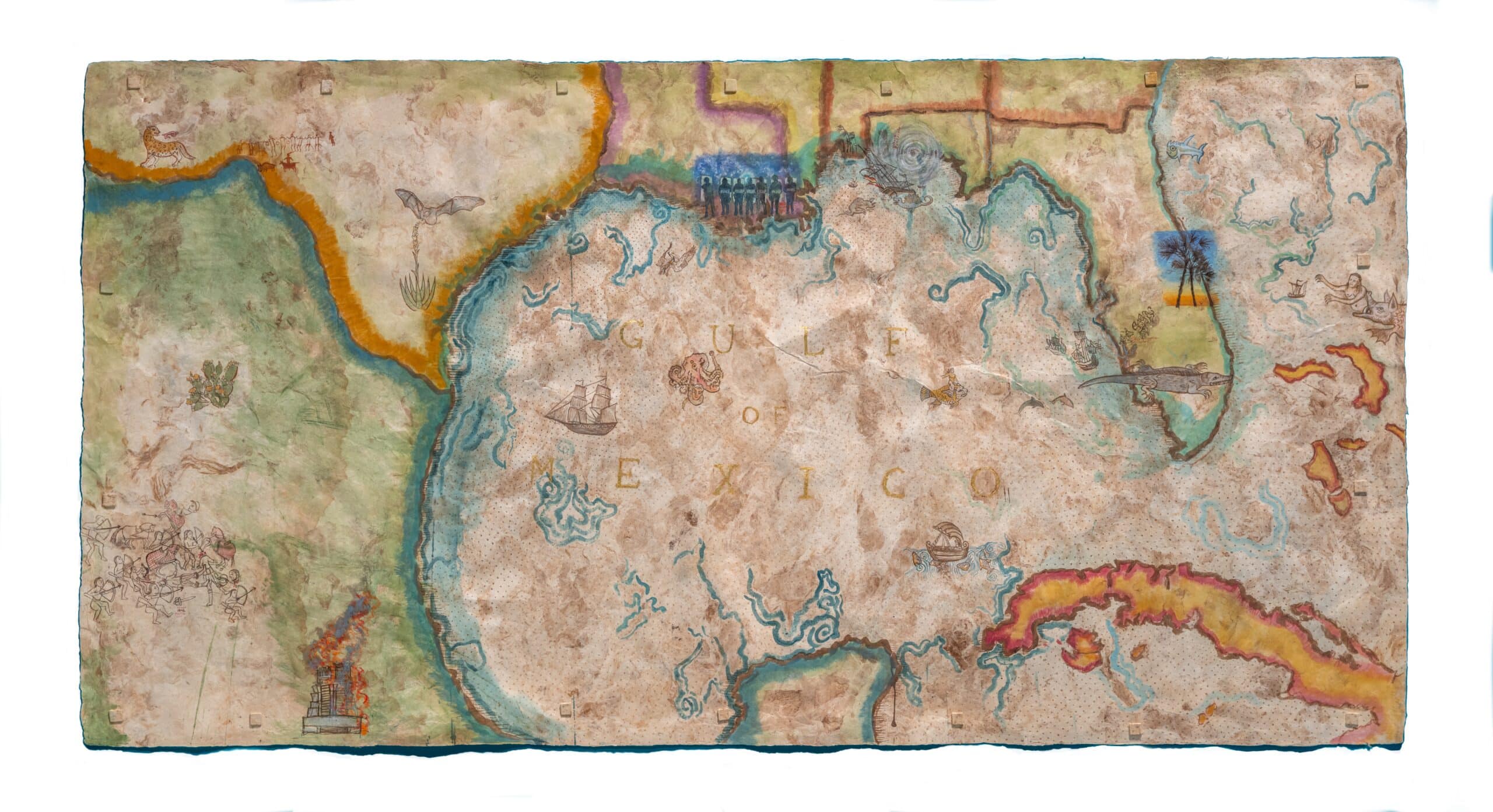
Chicana artist Sandy Rodriguez’s Resistance Map of Gulf of Mexico (2025) reimagines the region’s contested history and questions who holds the authority to name, map, and give meaning to a place. From the early sixteenth century onward, Spanish expeditions into Florida and the Gulf Coast transformed this borderland region into a site of ongoing colonial struggle, one that recent censorship measures and anti-DEI policies have extended to the present day. Blurring temporalities, Rodriguez’s work is not concerned with returning to an irrecoverable past; rather, it enunciates a transhistorical and multitemporal knowledge system.1 According to Rodriguez, “It is essential to look back at factual histories, paying close attention to those eras where our communities have been targeted, to understand how we protect each other, persist and thrive.”2 Through Rodriguez’s deep engagement with archival images and her alchemical production of precolonial pigments, the artwork functions as a site of historical inquiry and collective learning. The work resists colonial epistemologies, contemporary forms of censorship, and linear historical time, reconfiguring the map as an instrument of critical pedagogy and collective ancestral memory.3
Rodriguez draws on Gloria Anzaldúa’s concept of nepantla, a Nahuatl term describing the borderlands as a dynamic, fluid, liminal space where learning and unlearning occur, to mobilize mapping, material process, and archival engagement as pedagogical strategies.4 Rodriguez’s organic engagement with borderlands reflects her childhood. Raised between Tijuana and San Diego, where her family moved across the United States–Mexico border for generations, she developed an artistic practice attuned to hybridity, migration, and contested histories.
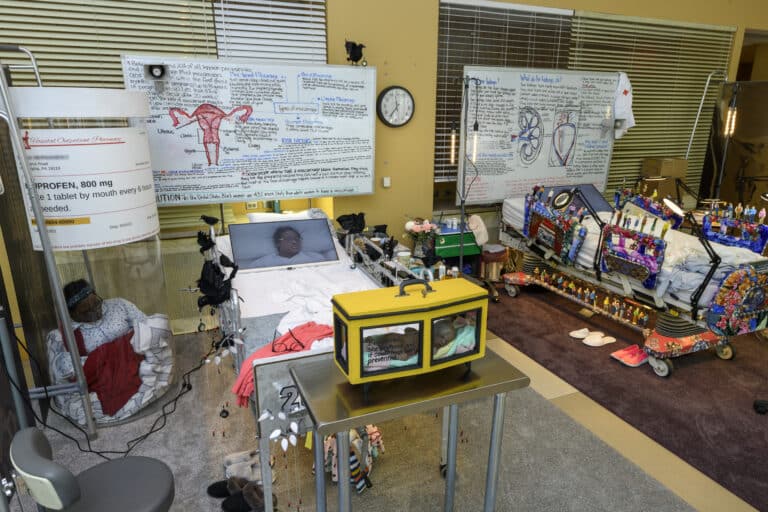
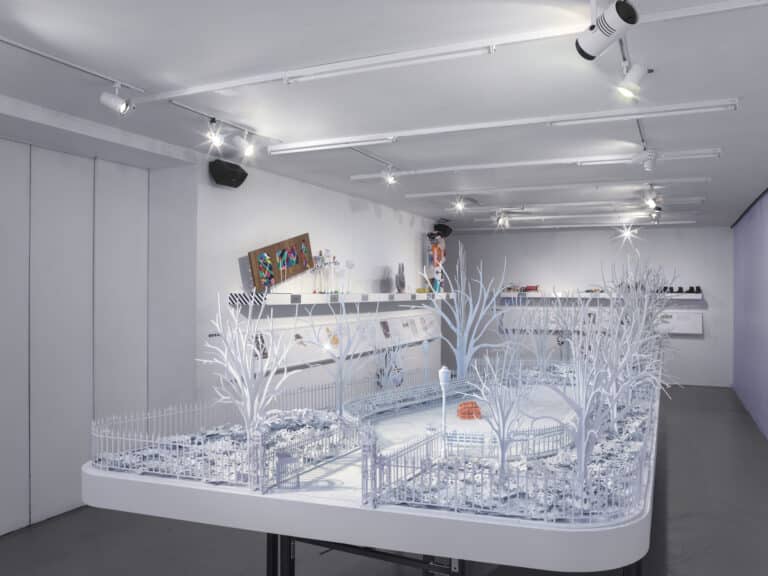
The Gulf of Mexico map was created for Currents of Resistance, Rodriguez’s 2025 solo exhibition at The John and Mable Ringling Museum of Art in Sarasota, Florida. According to the Ringling press kit, the exhibition “critically engages with climate change, social justice, and historical erasure, particularly in response to ongoing efforts to suppress these topics within Florida’s educational institutions.” This expansive exhibition included paintings, a film, and a reimagined cabinet of curiosities featuring paper sculptures of endangered animals alongside endemic plants historically used as pigments, medicine, and poison. Set against a volatile political backdrop of sustained attacks on academic freedom from Florida Governor Ron DeSantis and President Donald Trump, the exhibition featured the Resistance Map, distinct because it is the only one in her ongoing Codex Rodríguez-Mondragón series to depict the Southeast, with all her earlier maps addressing the history of the Southwest, Mexico, and the borderlands shared by the southwestern United States and northern Mexico.5
The composition depicts the Gulf of Mexico as a contested borderland that layers historical vignettes of colonial history, resistance, and mythological figures with contemporary political references across the geography of the Gulf Coast.6 The pivotal role this region played during the early colonial period cannot be overstated; according to historian Kevin Kokomoor, by the mid-sixteenth century, it was “the highway of the Spanish New World.”7
Mapping plays a crucial pedagogical role in Rodriguez’s work. Traditionally, maps have functioned as tools of colonial power, conquest, and territorial control. By reworking the visual language of cartography, Rodriguez transforms the map from a tool of domination into a space of critical inquiry. As art historian Erica Loic has noted, Rodriguez’s work is expansive, “representing multiple perspectives and histories simultaneously and mapping them onto its depicted terrains.”8 Her maps didactically reveal suppressed histories and challenge dominant narratives about territory, naming, and belonging. Her Gulf Map functioned as an augury of events to come. Shortly after the exhibition opened in 2025, the controversial proposal to rename the Gulf region became national news, even though the name has appeared on European maps since at least 1550 and has remained in common use for centuries.9
In a conversation with the artist, Rodriguez noted that she adapts a labor-intensive gilding technique of medieval manuscript illumination, originally practiced on parchment, applying twenty-three-carat gold leaf to illuminate “Gulf of Mexico” onto the highly porous amate paper at the center of the map.
Gold serves as a symbolic reference to the history of extractive mining in the Americas. Given the current political climate, the act of naming the Gulf of Mexico in this way becomes an act of resistance. Shortly after the artwork’s completion, Trump signed Executive Order 14172 directing the Interior Secretary to rename the Gulf of Mexico the “Gulf of America,” a gesture that illustrates the political and symbolic stakes of cartographic naming that the work itself interrogates.
Throughout her research-based practice, Rodriguez employs ancestral artistic methods to depict histories of social injustice and cultural resilience. Central to this practice is her use of amate, a sacred Mesoamerican bark paper handmade by Efraín Daza in San Pablito, in the Mexican state of Puebla, through the traditional process of boiling and stone-beating plant fibers.10 Long used in precontact Mesoamerican ceremonies and codices and later prohibited during the colonial era, amate-making was sustained clandestinely well into the twentieth century. In working with this material today, Rodriguez’s practice aligns within a lineage of Indigenous knowledge that colonial expansion sought to suppress but could not extinguish.11 Rodriguez characterizes amate as “outlaw paper,” noting that despite colonial prohibitions, its production persisted well into the twentieth century.12
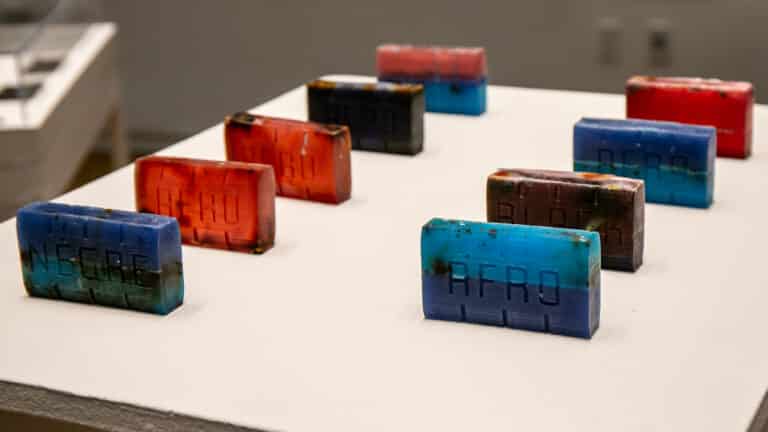
Her pigments are equally symbolic. Rodriguez fabricates her watercolor pigments by hand from organic materials including minerals, plants, and insects gathered during fieldwork. To make the paint for the Resistance Map of Gulf of Mexico, she incorporated ocean water collected from both coasts of Florida, a gesture she describes as capturing the life force of the ocean. Together, these materials connect the work physically and symbolically to the land it depicts, embedding decolonial ecological memory into the surface of the painting. She describes her paint making as “communing with ancestors through the act of pigment preparation.”13
Rodriguez reimagines mapping as a multitemporal framework rooted in Indigenous knowledge, collapsing geographic and temporal boundaries between Mexico and the United States. Art historian Tatiana Flores describes this as “countermapping,” challenging colonial spatial narratives by merging past and present,14 producing, as Loic notes, a visual field where colonial history, ecological memory, and contemporary resistance coexist as a multitemporal archive.
From the first Spanish slaving expedition into Florida and throughout its colonial history, the Gulf region was a consistent, unruly problem for the Spanish. Its tropical climate and the staunch resistance of its Indigenous inhabitants made its conquest long and arduous. As historian Erin Stone observes, the Spanish exercised only partial control over the region, allowing Indigenous communities to preserve autonomy well into the colonial era.15
The map includes pivotal events that unequivocally tether the history of Florida to Mexico, a fact obscured in contemporary telling of American colonial history where British settlements are the main focus. Some events painted onto the map include the burning of Tenochtitlán; the Mixtón War of 1540–1542 (a major Indigenous uprising in northern Mexico); and the Calusa resistance of 1521 at Fort Charlotte, when the Indigenous population forcefully opposed Ponce de León’s proselytizing expedition, undertaken under a royal mandate to establish a settlement and convert Indigenous populations to Catholicism. This confrontation forced the colonists to flee, and Ponce de León later died from an infected wound caused by a poisoned arrow made by a native plant that Rodriguez also references in her exhibition. This failed mission followed the template for the Spanish colonization of the “Americas” where forced territorial occupation and religious conversion were symbiotic tools. The Resistance Map of Gulf of Mexico also highlights the failed 1559 De Luna expedition, the largest Spanish attempt at colonization in Florida, which was thwarted by Indigenous resistance and a devastating hurricane. Depicted alongside colonial history are modern acts of political resistance like the 2020 nationwide racial justice demonstrations, specifically the one in Louisiana sparked by the police killing of George Floyd in Minneapolis. This intentional narration of Florida’s history as entwined with that of Mexico is pure pedagogy and a reflection of Rodriguez’s twenty-year career as a museum educator.
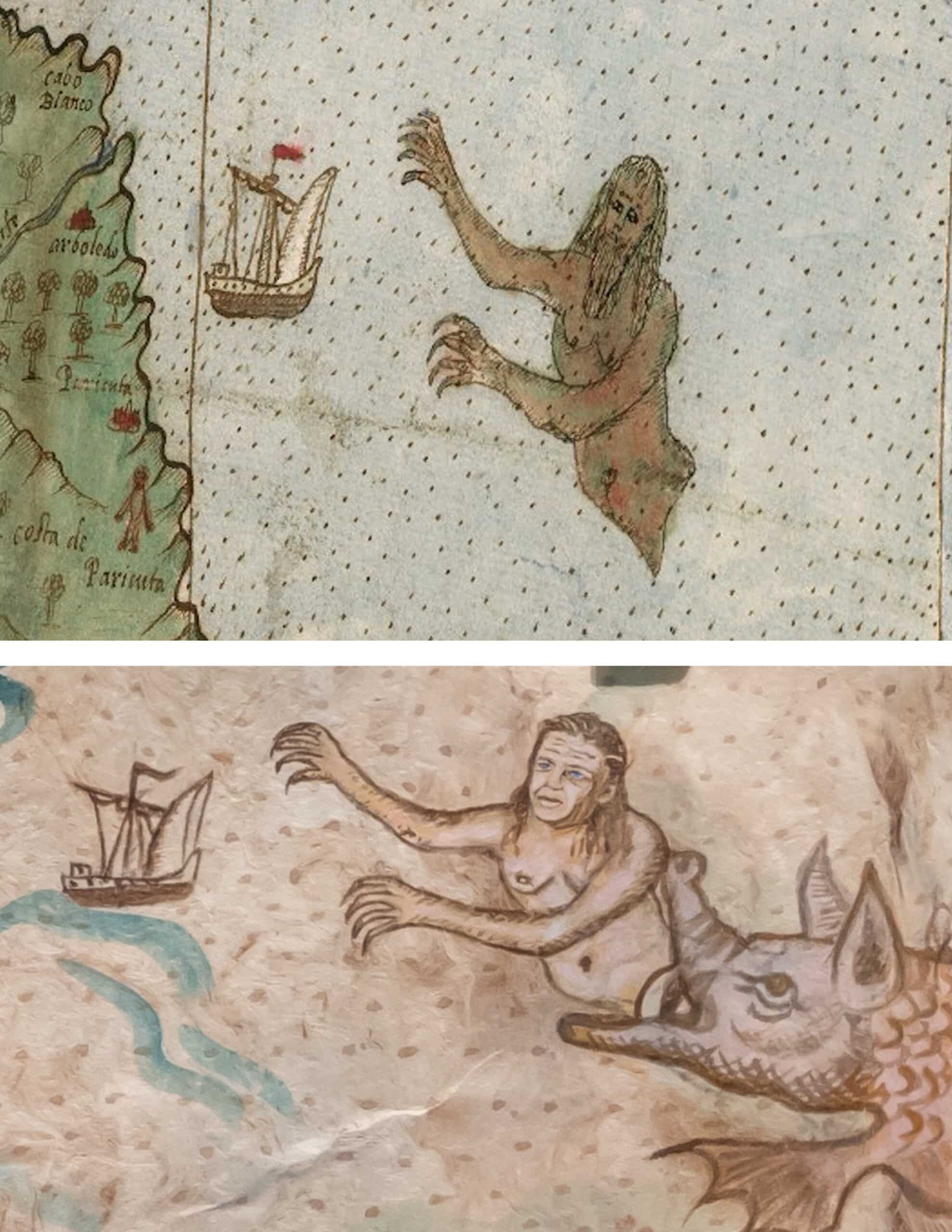
Rodriguez’s research-driven practice is intrinsically educational. As she states, “the audience is at the center of my artistic practice. I conduct several years of research in the field and archives to compose artworks that foster close looking, critical thinking and conversations in an informal education environment (the museum). There are a number of goals and objectives I need to define and address to decide which historic sources and materials will be legible to a range of types of learners to prompt dialogue and action.”16 In all her work, viewers encounter not just an image but accumulated layers of historical inquiry and continual references to archival sources, primarily the Florentine Codex, completed in 1577 under Franciscan friar Bernardino de Sahagún. Rodriguez reinterprets figures from colonial codices to make complex histories and political critiques legible, educational and, at times, humorous. Her wit comes across in a self-portrait depicting herself riding atop a mythological Nahuatl ocelomichi, a tigerfish which according to the artist “carries souls of the dead warriors” and is drawn from the Florentine Codex.
Located between the figures of Rodriguez and DeSantis is a massive alligator, or acuetzpalin,17 that traverses Florida east to west across the imperiled Everglades. In the colonial era, alligators were symbols of the wild and terrifying swamplands of the American South, and the antithesis of civilization. Though Rodriguez included the large reptile before the immigration detention facility nicknamed “Alligator Alcatraz” was constructed, the image has since gained a prescient resonance, appearing almost prophetic by linking environmental destruction, immigration policy, and the long history of Indigenous resistance in the Everglades.18
Throughout the Resistance Map of the Gulf of Mexico, Sandy Rodriguez transforms the map into a prescient site of critical pedagogy where Florida’s colonial past becomes part of a fluid, hybrid narrative linking historical violence, resistance, and contemporary struggles over memory and knowledge production. By blurring temporalities, Rodriguez’s pedagogical map of Florida, becomes “a response to recent state policies suppressing diversity, equity, and inclusion initiatives,”19 and reveals how colonial cartography and naming, as instruments of territorial control and dispossession, persist into the present. By combining archival research and multitemporal iconography, Rodriguez opens a space for reimagining ways of understanding time, land, and history; both in the past and, more importantly, in our fraught political present.
Endnotes
- Erika Loic, “The Once and Future Histories of the Book: Decolonial Interventions into the Codex, Chronicle, and Khipu,” Latin American and Latinx Visual Culture 4, no. 1 (2022): 16. ↩︎
- Sandy Rodriguez, personal communication with the author, 2025. ↩︎
- In a recent New York Times review, Rodriguez is described as a “painter but also, on some level, a scientist, an art historian, a botanist, an outdoorswoman—and maybe even an alchemist.” Ted Loos, “An Artist Devoted to the Origins of Paints,” Arts & Design section, April 20, 2026, https://www.nytimes.com/2026/04/20/arts/design/sandy-rodriguez-painting.html. ↩︎
- Gloria Anzaldúa, Borderlands/La Frontera: The New Mestiza (Aunt Lute Books, 1987). ↩︎
- For the artist’s discussion of earlier works in the series, see Sandy Rodriguez, “Codex Rodríguez-Mondragón, 2017–2023,” Aztlán: A Journal of Chicano Studies 49, no. 1 (2024): 207–226. See also Tatiana Flores and Sandy Rodriguez, “To Translate the Unfathomable: Tatiana Flores in Conversation with Sandy Rodriguez,” ASAP/Journal 9, no. 1 (2024): 1–16. ↩︎
- See Charlene Villaseñor Black, “Unfolding Decolonial Resistance: Healing and Hope in the Art of Sandy Rodriguez,” Aztlán: A Journal of Chicano Studies 48, no. 2 (2023): 1–18. ↩︎
- Kevin Kokomoor, La Florida: Catholics Conquistadores, and Other American Origin Stories (Pineapple Press, 2023), 31. ↩︎
- Erika Loic, “The Once and Future Histories of the Book,” 11. ↩︎
- For an earlier discussion of the prophetic dimensions of Rodriguez’s practice, see Ananda Cohen-Aponte and Ella Maria Diaz, “Painting Prophecy: Mapping a Polyphonic Chicana Codex Tradition in the Twenty-First Century,” English Language Notes 57, no. 2 (2019): 22–42. ↩︎
- See “Amate Papers,” Hiromi Paper Blog, last modified July 27, 2022, https://hiromipaper.wordpress.com/2022/07/27/amate-papers/. ↩︎
- Shreya Labh, “In Conversation with Chicana Artist Sandy Rodríguez on Remapping the Gulf Coast in Native Pigments,” Art Currently, 2025, https://artcurrently.com/in-conversation-sandy-rodriguez-native-pigments. ↩︎
- Shanti Escalante-De Mattei, “Chicana Artist Sandy Rodriguez Reimagines Colonial Maps in Currents of Resistance at the Ringling Museum,” ARTnews, April 2025, https://www.artnews.com/art-news/artists/sandy-rodriguez-ringling-museum-of-art-exhibition-1234746496. “The paper onto which she will transfer these paints also carries not just a special significance but ancestral knowledge. Handmade by Efraín Daza in San Pablito, Mexico, the amate paper she uses is a sacred Mesoamerican bark made by boiling and beating fibers with a stone. This precontact paper, once used by Aztec scribes, is a testament to Indigenous knowledge systems that have survived centuries of colonization. Rodriguez describes amate as “outlaw paper,” as its production was illegal during the colonial era and kept alive in secret well into the 20th century.” Veronica Pesantes, “In a Florida Exhibition, Sandy Rodriguez Examines the Hidden Histories of the Gulf of Mexico,” ARTnews, June 30, 2025, https://www.artnews.com/art-news/artists/sandy-rodriguez-ringling-museum-of-art-exhibition-1234746496. ↩︎
- Sandy Rodriguez, personal communication with the author, 2026. ↩︎
- Tatiana Flores and Michelle Ann Stephens, eds, Relational Undercurrents: Contemporary Art of the Caribbean Archipelago (Museum of Latin American Art, 2018), 22. ↩︎
- Erin Stone, “Historical Currents: Indigenous Resistance to the Conquest of Florida’s Gulf Coast,” in Currents of Resistance, exh. cat. (The John and Mable Ringling Museum of Art, 2025), 14. ↩︎
- Rodriguez, 2026. ↩︎
- Rodriguez cites several archival sources, including engravings published by Theodor de Bry in Grand Voyages (1591), after watercolors made by Jacques Le Moyne de Morgues. ↩︎
- Ana Goñi-Lessan, “Seminole Tribe of Florida Joins Opposition to ‘Alligator Alcatraz’ in Everglades,” Tallahassee Democrat, July 2, 2025, https://www.tallahassee.com/story/news/local/state/2025/07/02/seminole-tribe-calls-alligator-alcatraz-threat-to-sacred-lands-florida/84450024007/; cited in Alligator Alcatraz controversy materials and referenced in FINAL-Alligator-Alcatraz-Oversight-Bicameral-Letter, 2025. ↩︎
- Artist statement, Currents of Resistance, Ringling Museum. ↩︎
Cite as: Veronica Pesantes Vallejo, “Outlaw Paper: Sandy Rodriguez’s Resistance Map of Gulf of Mexico,” in X as Intersection: Writing on Latinx Art, September 14, 2026, accessed [DATE], https://uslaf.org/essay/outlaw-paper-sandy-rodriguez/.
Veronica Pesantes Vallejo is a Miami-based, Ecuadorian-born curator, writer, and educator with thirty years of expertise in Latinx arts and culture. A University of Chicago doctoral scholar, she has managed programs at the Solomon R. Guggenheim Museum, curated the first-ever Quito Design Week, and currently writes for The Art Newspaper and ARTnews, among others.