
Bearing Her to the Present:
Yelaine Rodriguez and the Un-Ghosting of Afro-Dominican Identity
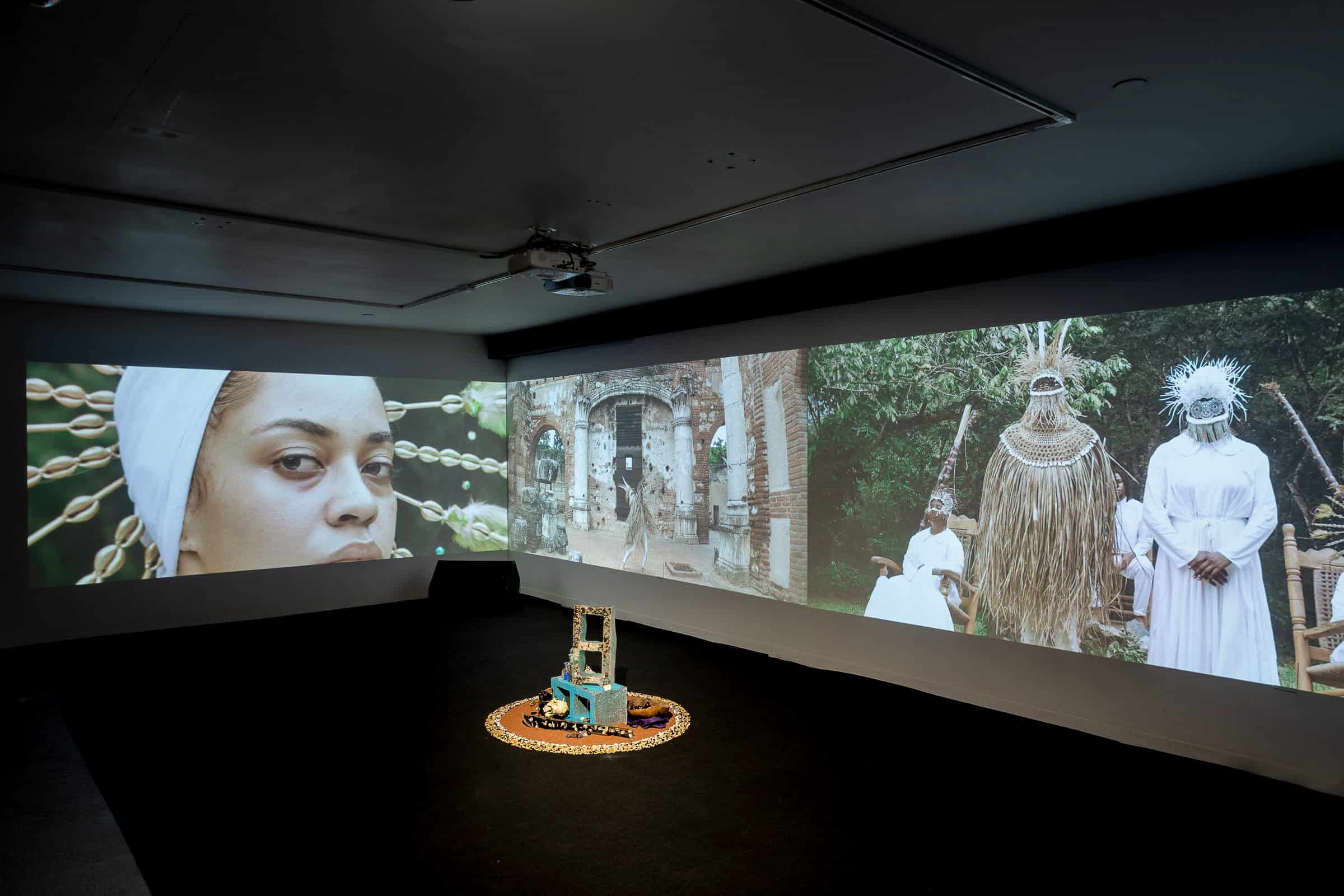
While birds fly above a Spanish colonial ruin in Santo Domingo, she stands firmly and embraces her hands tightly. African diasporic healing chants vibrate alongside sacred Palo drumming. Framed by brick arches, stone columns, and carved architectural fragments, this strong Black woman is dressed entirely in white with a mask and headdress and appears alongside the Yoruba deity Babalú-Ayé. Subdued but with a strong presence, they both emerge and fade away in a loop, like ghosts, in an enigmatic tropical landscape. They begin to dance, proclaiming the restorative qualities of African diasporic traditions—known for their use of healing circles, chanting, drumming, spiritual cleansings, Indigenous herbalism, and other communal activities.
The pair has been summoned by visual artist and scholar Yelaine Rodriguez. With a background in fashion, she is a conceptual and multidisciplinary artist who includes a range of disciplines in her works.1 The video Babalú-Ayé y La Negra del Hospital (2022), addresses a historical account that has been muted or ghosted—a concept developed by literary scholar Dixa Ramírez. In Colonial Phantoms: Belonging and Refusal in the Dominican Americas, from the 19th Century to the Present, Ramírez explains how the history of the Dominican Republic is permeated by an active process of ghosting that partially erased Black and Indigenous histories from the archive. Privileging Western colonial hegemony, ghosting allows for a limited or spectral understanding of these accounts, minimizing the contributions of Black and Indigenous people to the mainstream national discourse.2 But a ghost can be invoked, which is exactly what Rodriguez does in Babalú-Ayé y La Negra del Hospital. Combining archival research and spirituality, the artist calls upon a spectral being that refuses to be in the shadows.
Probing the connection between Afro-Caribbeans, the larger Caribbean diaspora, and Black spirituality, Rodriguez’s works are indebted to archival research. Babalú-Ayé y La Negra del Hospital was developed through the artist’s research in the CUNY Dominican Studies Institute, whose library houses the chronicles of conquistadores describing life in the Americas during the earliest periods of Western colonization. There, Rodriguez found information about the origins of the first hospital in the Americas, the Hospital San Nicolás de Bari. Located in the colonial zone of Santo Domingo, the hospital became a UNESCO heritage site in 1990, just two years before the five-hundred-year anniversary of the arrival of Christopher Columbus to the island in 1492. There, he established the first Spanish colony in the Americas. Although the hospital’s original construction date is 1503, through her research, Rodriguez came across a decree from 1696 by the Archbishop of Santo Domingo, mentioning that between 1497 and 1501, a Black woman established a hospital-like facility at the site where the ruins now stand.3 The official date that the hospital began to operate is 1522. It is unclear how or why the hospital was abandoned.4 Locals and tourists can visit the partially preserved ruins, but nowhere in the signage of the site is there a mention of the original founder, a Black woman. This is an important note, given that in the Dominican Republic, the legal transportation of enslaved women became official in 1504.5 The 1696 manuscript lacks information about the woman’s identity, origin, or legal status. Was she free or enslaved? Archivally, she is just, la negra. Her erasure portrays how the politics of mestizaje in Latinidad and Latin American discourses, as Tatiana Flores argues, dehumanize Black and Indigenous experiences, advancing Eurocentric identities.6
Inspired by this kind of historical omission, Babalú-Ayé y La Negra del Hospital was presented as a three-channel video installation.7 Rodriguez was born in the Bronx, New York, and grew up spending summers in the Dominican Republic and the school years in New York. She had previously visited the hospital ruin but was unaware that this UNESCO heritage site had Black origins. As Ramírez asserts, absences matter because “historical silences signal archival power at its strongest, the power to define what is and what is not a serious object of research and, therefore of mention.”8 The artist herself has declared that “Afro-Latinx erasure is part of the manifold colonial legacies that manifest not only externally but internally, within our own communities.”9 To reclaim the origins of this ruin, Rodriguez shot the video in the hospital, and incorporated a sculpture in the center of the installation. Resembling an altar, the sculpture is composed of blue-colored cinder blocks with cowrie shells and other Afrodiasporic ceremonial tools. Rodriguez uses spirituality, poetry, and dance to capture the connections that the hospital has with diasporic people. Creating an archive for Black and Caribbean communities, Rodriguez becomes an active participant in reclaiming ghosted narratives for internal and external restoration. Suggesting a complex understanding of the role that Black people played in Santo Domingo at the beginning of colonization, Rodriguez counters a historical silence and traumatic past with Afrodiasporic spirituality.
Babalú-Ayé y La Negra del Hospital makes visible people who mainstream narratives have ghosted. It bears witness in the present to the humanity of a Black woman and her community. The work engages the viewer with captivating landscape images, music, and elegant wearable art that conjure up the tropical environment. By illustrating how Black people in the colonies had roles beyond enslavement, Rodriguez reveals how they were creators of healing places and makers of community.10 This video features two main figures: Babalú-Ayé and a Black woman, who is the embodiment of the founder of the hospital. Jeremy Antonio Caro is Babalú-Ayé and the choreographer of the work, and Rayser Rafelina Campusano Rosario manifests La Negra del Hospital. In Afrodiasporic and Caribbean spirituality, Babalú-Ayé is an orisha that can both destroy and heal.11 Often syncretized with Saint Lazarus, Babalú-Ayé is associated with cowrie shells. The woman dances with the orisha, purifying the space from its colonial trauma. Midway in the video, the work features images of a community of Black people, all of whom worked on the film in various capacities, dressed in white and looking directly at the camera—artistic gestures that archive their presence and contribution to the work. One can also hear an original poem by Yaissa Jiménez created and recited for the work. The poem is layered with chanting from Enerolisa Núñez, a community elder dedicated to preserving and honoring salve, one of the most sacred Afro-Dominican musical traditions.
The group becomes a signifier for the Black diaspora, which here encompasses transatlantic communities affected by the trafficking of African people. Rodriguez highlights the intersections and solidarities among Afro-Caribbeans, Afro-Latin Americans, and Afro-Latinx groups.12 Reinforcing the cathartic and curative impetus, the poem states in Spanish, “inhalamos el nuevo terreno, la esperanza de la Negra nuestra prieta, tierra suya que venimos a reclamar.” Translated into English as “we inhale new soil, the hope of our Black woman, her earth we come to reclaim,” these words point to how the artist is reconstructing a new archive for all Black communities. Rodriguez envisions Afrodiasporic spirituality as a means to break free from colonial distress, creating an opening to forge a new future. Rodriguez uplifts the transformative qualities of Afrodiasporic spiritual practices that are often demonized in colonial Christian moral frameworks. The artist shows how the Afrodiasporic spiritual system aligns with the Christian doctrine of healing the soul, mind, and body.13 Babalú-Ayé and the hospital founder come into the realm of the living, dancing and reclaiming their roles in the archive for future generations.
Along with poetry, for Babalú-Ayé y La Negra del Hospital, the video’s music and wearable art points to the plurality and hybridity of the Black experience, challenging simplified depictions of Afro-Latinx identities. The music and clothing are inspired by Black spiritual practices that encompass Vodun, Yoruba customs, Cuban Santería, Brazilian Candomblé, and sound-calling from the Dominican Republic. The highly decorated masks used by the main figures are inspired by Candomblé. The outfit of Babalú-Ayé incorporates raffia, highlighting Yoruba traditions. Rodriguez is not interested in presenting Black religions in terms of purity or authenticity; rather, she embraces a hybrid and fluid notion of the Black Caribbean experience. Her works embody Martinican intellectual Édouard Glissant’s concept of poetics of Relation, which describes creole cultures as an ongoing process rather than a finished end.14 Rodriguez does not simplify Black culture or advocate for the total separation of Western traditions; rather, she offers a framework that encapsulates both. She is not calling for the destruction of the Western hospital ruin, rather stressing how this hospital originated with Black people. Against the extreme violence of colonization, the transatlantic slave trade, and the pain of continued erasure, Rodriguez deploys history, religion, poetry, and dance as a medicinal force for visibility and acknowledgment.
By unearthing stories that pertain to Black people, Rodriguez enriches Caribbean perspectives. She makes visible the specters of a place, using an interdisciplinary approach and disrupting a traumatic past. She offers strategies to navigate and rescue these histories. In works like Babalú-Ayé y La Negra del Hospital, the artist provides an example of the ways in which Black narratives have been erased from mainstream Caribbean culture. In this process, the work generates other questions, such as, what was the name of this woman? What was her world like in the early colonial period? Did she work with others? Though it is uncertain what religious or spiritual traditions the hospital’s founder practiced, Babalú-Ayé y La Negra del Hospital gives flesh, blood, and purpose to a woman and her story of cultural transformation.
Endnotes
- “In Conversation with Yelaine Rodriguez,” Glamcult, accessed January 5, 2026, https://www.Glamcult.Com/Articles/In-conversation-with-yelaine-rodriguez/. ↩︎
- Dixa Ramírez, Colonial Phantoms: Belonging and Refusal in the Dominican Americas, from the 19th Century to the Present (New York University Press, 2018). ↩︎
- “Somewhere between 1497 and 1501, a Black woman in the early village of Santo Domingo established the first hospital-like healing facility of the Americas,” Archivo General de Indias (AGI), Santo Domingo, 93, R.6, accessed January 5, 2026, via PARES, Portal de Archivos Españoles, as reproduced in Sixteenth-Century La Española: Glimpses of the First Blacks in the Early Colonial Americas, https://firstblacks.org/en/manuscripts/fb-primary-060-manuscript. ↩︎
- “Hospital San Nicolás de Bari (San Nicolas de Bari Hospital), Santo Domingo,” GPSmyCity, accessed January 5, 2026, from https://www.gpsmycity.com/attractions/hospital-san-nicolas-de-bari-(san-nicolas-de-bari-hospital)-34595.html. ↩︎
- In the Dominican Republic the legal establishment of slavery was possible due to a series of decrees from 1500 to 1510. The Decree of 1504 officially authorized the legal importation of African women to the island. For access to the digital version of the decree visit: https://firstblacks.org/en/manuscripts/fb-primary-016-manuscript. ↩︎
- Tatiana Flores, “Dialogues: Afro-Latinx Art and Activism,” Latin American and Latinx Visual Culture 3, no. 2 (2021): 46–49. ↩︎
- The project was first presented at Columbia University, whose support funded much of its production, but it was developed specifically for the 2023 exhibition Anti-Futurismo Cimarrón in Barcelona. The three-channel video installation marked the third iteration of the work and was part of the group exhibition celebrating Caribbean polyculturalism at Fridman Gallery in New York and curated by Maty Sall entitled, A Billion, Brilliant Points of Unity (2024). ↩︎
- Ramírez, Colonial Phantoms: Belonging and Refusal in the Dominican Americas, from the 19th Century to the Present, 9. ↩︎
- Yelaine Rodriguez, “Afro-Latinx at NYU: How Multiple Facets of Black Latinidad Are Claiming Space within Visual Culture,” Latin American and Latinx Visual Culture 3, no. 2 (2021): 51. ↩︎
- For the artist, this video installation is conceptually part of a bigger project composed of two cinematic works. Babalú-Ayé y La Negra del Hospital is the first part of that venture. The video work, Miss Doc (2024), is the other video, which focuses on the work of the first official Black doctor in the island, Dr. Sarah Lougen Fraser, who was the fourth licensed physician of Black descent in the United States. She moved to the Dominican Republic, influenced by a family friend, abolitionist Frederick Douglas. ↩︎
- Kiara Cristina Ventura, “Calling in the Spirit,” Aperture 241 (Winter 2020): 120–125. Ventura discusses Dominican artists in the United States, including Yelaine Rodriguez. ↩︎
- The Black diasporic experience, even though it shares a racialized history connected to the transatlantic slave trade, encapsulates a diverse range of cultures, economics, politics, and realities that go beyond skin color. The term Afro-Caribbean refers to people with cultural connections to the region spanning multiple languages including French, Dutch, English and others, as well as connections to Indigenous groups. Afro-Latin American refers specifically to individuals connected to the Spanish speaking Caribbean, while Afro-Latinx, a gender-neutral term, considers direct connections to the United States, where it is primarily used. Not every Black person from the region subscribes to every group. For example, a Black Brazilian who practices Afrodiasporic religions, might consider themselves Afro-Latin American, but not Afro-Caribbean or Afro-Latinx. Challenging the traditional Black and white racial binary in the US, Rodriguez’s work embraces all these subjectivities to portray the solidarities, connections, and realities of these experiences. ↩︎
- The artist further explored these themes in the exhibition she curated, Afro Syncretic (2019–2020), under the auspices of the Latinx Project of New York University. ↩︎
- Édouard Glissant, Poetics of Relation, trans. Betsy Wing (University of Michigan Press, 1997). Glissant capitalizes Relation to denote his philosophical concept of open-ended, relational identity rather than interpersonal relationships. ↩︎
Cite as: María Elena Ortiz, “Bearing Her to the Present: Yelaine Rodriguez and the Un-Ghosting of Afro-Dominican Identity,” in X as Intersection: Writing on Latinx Art, September 14, 2026, accessed [DATE], https://uslaf.org/essay/bearing-her-to-the-present-yelaine-rodriguez/.
María Elena Ortiz is a curator and writer at the Modern Art Museum of Fort Worth, specializing in Caribbean, Latin American, Latinx and Black diasporic contemporary art. Previously, as a curator at the Pérez Art Museum Miami, she founded the Caribbean Cultural Institute. Her exhibitions and writing challenge traditional historical narratives by centering diasporic experiences and global perspectives.