Material Memory: Francheska Alcántara’s Pedagogy of the Archive
Francheska Alcántara is an Afro-Caribbean artist whose sculptures and installations draw on the material cultures of their upbringing in the Dominican Republic: a place where improvisation and resourcefulness transformed everyday objects into instruments of survival and meaning. Alcántara works with paper bags, glycerin soap, thread, and herbs, materials that circulate through domestic and communal spaces rather than institutional ones, their forms shaped by their use in proximity to the body and by the rhythms of daily life. Rooted in these materials, their practice advances a model of memory transmission as a living, relational, and sensory process; one that conveys knowledge not through preservation in fixed repositories, but through sensory encounters and care. Alcántara’s work enacts a pedagogy grounded in lived knowledge and relational encounters, as demonstrated by close reading of Starry Ocean I (2021) and Horizons (2025). Alcántara’s practice constitutes an alternative infrastructure for memory: not an archive in the conventional sense, but a counter-archive whose organizing logic is the body, sensation, and care rather than classification and controlled access. Colonial deployments of archival infrastructure have historically equated memory with permanence and reduced cultural history to what can be classified, contained, and controlled. Alcántara’s work does not reject archival practice but proposes a different set of principles for what an infrastructure of memory can be. Sylvia Wynter names the broader structure that has underwritten those colonial deployments: the “overrepresentation of Man” as the universal human subject, a Western bourgeois norm that has historically determined whose knowledge counts, whose histories are preserved, and who is relegated to the margins of the human.1
Alcántara’s practice begins with attentiveness to what everyday objects already carry. As they explained in a 2025 interview, found objects “have already a story, and have already a particular energy,” and when they bring them into the studio, they work with that energy and add to it until the objects “transcend that and become something else.”2 This orientation toward material memory, rather than material form, defines both their process and their relationship to history. They do not hold any power over the objects from above but listen to them, allowing the material to determine the work’s direction and meaning. Their practice aligns with Diana Taylor’s concept of repertoire: the transmission of cultural knowledge through bodily practice and gesture rather than written record. Taylor draws a distinction between the archive, with its “supposedly enduring materials” such as texts and documents, and the repertoire of “embodied practice/knowledge” such as spoken language, ritual, and movement that persists through the body.3 Taylor’s distinction is useful here, but Alcántara’s work suggests something more than a simple valorization of repertoire over archive. By investing material objects—things that can be collected, held, and encountered across time—with the sensory and relational qualities typically associated with the repertoire, they propose that an infrastructure of memory can be built on those qualities rather than in opposition to them.
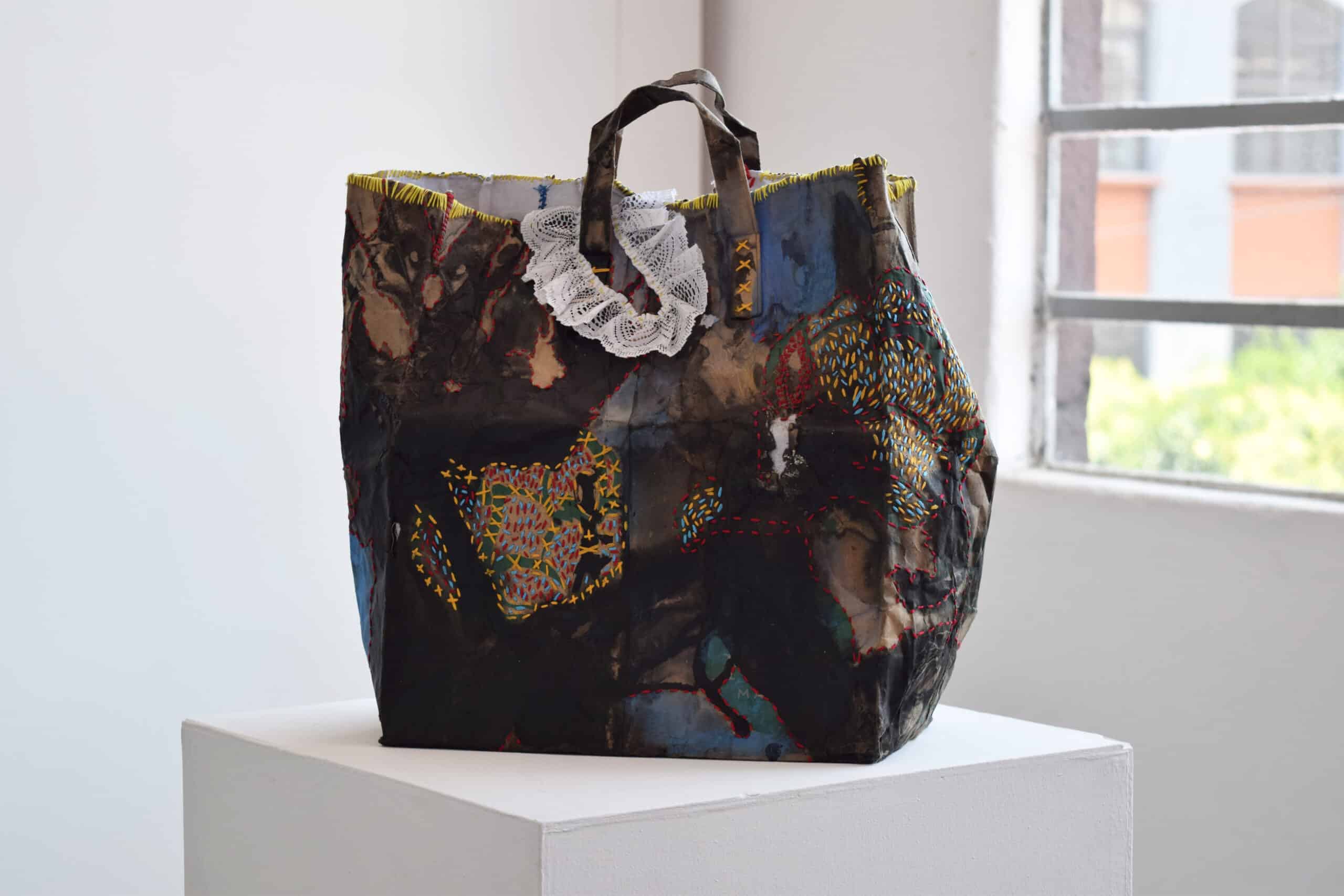
In Starry Ocean I, Alcántara transforms a discarded brown paper bag into a vessel that represents migration and memory. The bag is stitched together with thread and marked with ink and watercolor, bearing visible signs of handling and repair. Tears are sutured, seams remain exposed, and the surface is layered with marks that evoke ocean currents, constellations, and migration routes. Alcántara was drawn to brown paper because of its grit and availability, encountering many discarded bags on the streets near their studio in Richmond, Virginia. Working with these materials also felt less like making art and more like mending something real. As they described it, the work “feels sort of like an action of mending… and mending memory,” one that also performs a kind of piercing: “that could be painful, but in being painful, it’s also beautiful, and it’s also delicate.”4 The bag is not elevated into a precious artifact; it is allowed to retain its history as something used, weathered, and discarded. Alcántara’s stitching acknowledges rupture without erasing it, sustaining what remains rather than restoring an imagined wholeness.
The material fragility of the bag is central to its pedagogical force. It can tear again. This is intentional. During their research, Alcántara came across the history of the brown paper bag as a racial sorting tool in the United States, used to determine whether a person could pass as white. They had not grown up with that specific form of colorism, but found it resonant with, and distinct from, the colorism of their own upbringing, a society they describe as deeply colorist in its own way.5 The bag becomes a container, body, and landscape. It bears within its treated and painted surface what Caribbean philosopher Édouard Glissant calls the space of Relation: not origin or destination, but the ongoing entanglement of rupture, movement, and connection that structures diasporic life. For Glissant, identity is not rooted in a singular origin but “extended through a relationship with the Other.”6 The sea, as the site of the Middle Passage, of forced departure, is the founding space of that relational being. Starry Ocean I does not narrate a fixed journey; it holds movement itself, sees migration as something unresolved and relational, as something that must be tended rather than stored away. What the work models, then, is not an alternative to archival infrastructure but a different set of demands on it: that it remains open to use, to handling, to the sensory encounter that reactivates memory rather than simply preserving it.
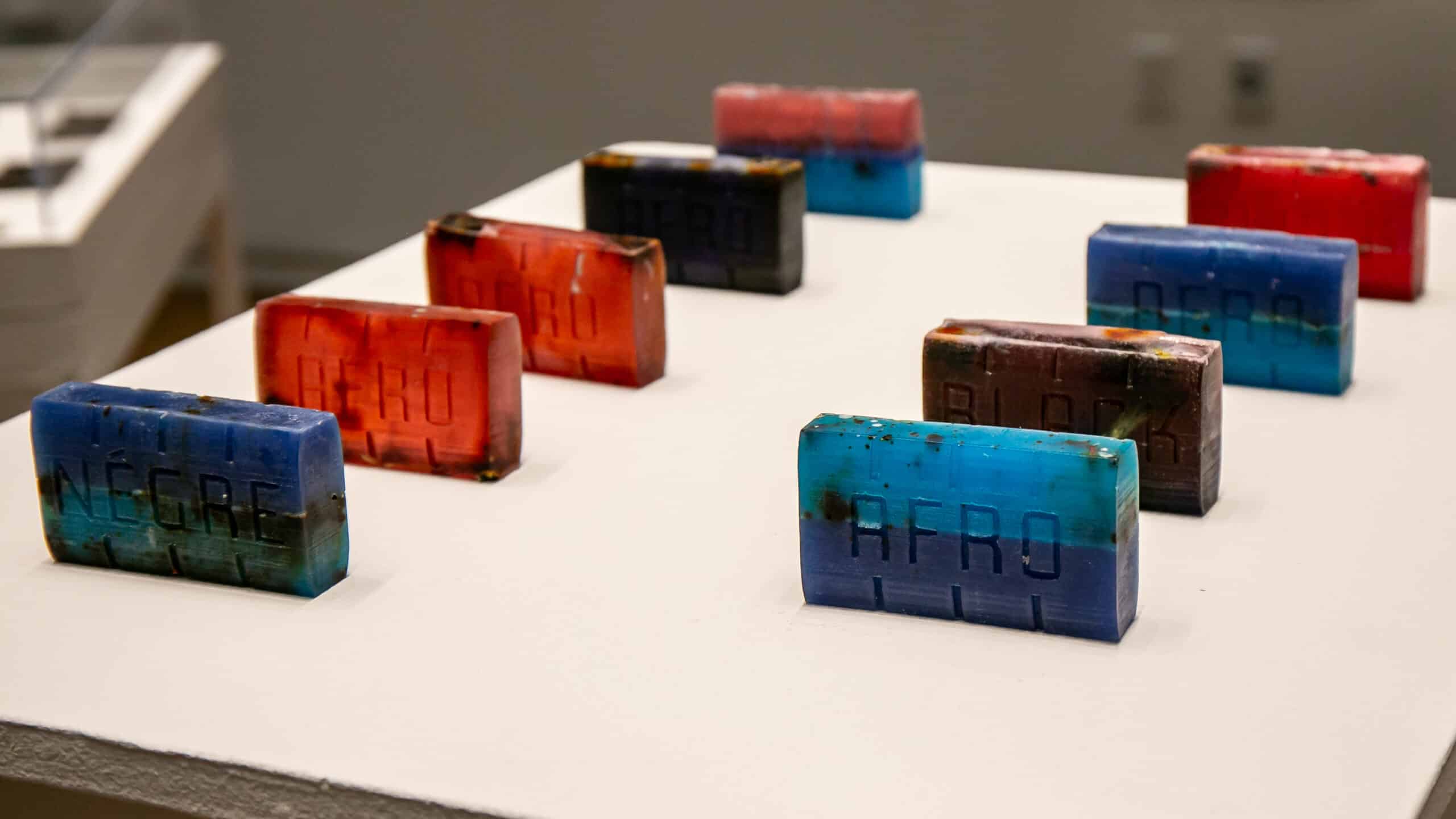
Where Starry Ocean I works through migration and stitched repair, Horizons turns to the politics of language, racial identity, and the body. The work consists of handmade bars of glycerin soap, nourishing, and scented with herbs and floral oils, embossed with the words “AFRO” and “NEGRE.” The choice of soap is biographical and critical in equal measure. Alcántara grew up using Jabón Hispano, a staple of Dominican households, known for its utility as a domestic all-purpose cleaner. The brand’s name encodes a colonial genealogy, the privileging of European heritage in the Dominican Republic’s self-representation. The soaps in Horizons directly counter that branding. By embossing them with “AFRO” and “NEGRE,” Alcántara reclaims identities that Dominican colorism has historically suppressed, situating these words within objects designed to make contact with the skin. This act of reclamation operates in direct dialogue with Frantz Fanon’s analysis of race as something imposed upon and through the body, what he calls the “racial epidermal schema,” the process by which colonial power inscribes racial hierarchy onto skin, reducing the person of color to an object defined entirely by the white gaze.7 Soap dissolves through use, and as it does, the stamped words fade and eventually vanish, but not without consequence. Residue remains on the hands. Scent lingers. The encounter is bodily and unavoidable, a form of knowledge transmission that bypasses interpretation and lodges in sensation.
The herbs embedded in the soap amplify this pedagogy. Associated with healing, protection, and ancestral knowledge in Caribbean and Afro-Latin traditions, they activate scent as a carrier of memory, expanding the reach of the work beyond the visible into the olfactory and tactile. Alcántara describes Horizons as a meditation on the horizon as a marker of infinity and possibility, a refusal of the fixity of colonial classification.8 The soap bars become unique bodies in this sense too, shaped by the maker’s hand, and resisting the standardized form of the commercial product they echo. This distinction is the heart of their archival politics. Saidiya Hartman offers a resonant framework here: beauty, she argues, is “not a luxury” but a “way of creating possibility in the space of enclosure, a radical art of subsistence.”9 Alcántara’s handmade soaps enact exactly this: a practice of care that creates possibility where mass-produced branding imposes constraints. Knowledge is not transmitted through texts or institutional authority but held in the soap’s scent, transmitted through touch, and sustained through repetition.
Across both works, Alcántara enacts a pedagogy of care that challenges prevailing assumptions about what memory infrastructure should do and who it should serve. The colonial deployments of the archives that have shaped modern institutions demand permanence, legibility, and hierarchical classifications, transforming cultural memory into something stabilized against the threat of change. Alcántara’s practice refuses every one of those demands, not by rejecting the idea of an infrastructure for memory, but by proposing one built on different terms. Paper tears. Soap melts. Scent fades. José Esteban Muñoz offers theoretical grounding for why this impermanence is not loss. He argues for ephemera—the “traces, glimmers, residues, and specks of things” that remain after a performance or encounter—as a legitimate and politically necessary form of evidence, one that preserves what institutionalized archives have been designed to exclude.10 Memory, in Alcántara’s work, must be tended repeatedly, returned to, handled with attention. When asked whether forgetting might be as important as remembering in their practice, Alcántara was clear: “It’s not about forgetting. I believe more in cycles, cycles that start, cycles that end. But that doesn’t mean you forget about the people, the things that were alive. What I’m trying to capture is not the forgetting, but the remembering.”11 Archival infrastructure need not be deadening; its liveliness depends on the terms under which it is built and used. Alcántara’s practice insists that the archive, an infrastructure for memory, is not something to be received passively, but something to be lived.
Endnotes
- Sylvia Wynter, “Unsettling the Coloniality of Being/Power/Truth/Freedom: Towards the Human, After Man, Its Overrepresentation — An Argument,” CR: The New Centennial Review 3, no. 3 (2003): 267. ↩︎
- Francheska Alcántara, interview with the author, December 17, 2025. ↩︎
- Diana Taylor, The Archive and the Repertoire: Performing Cultural Memory in the Americas (Duke University Press, 2003), 19. ↩︎
- Alcántara, December 17, 2025. ↩︎
- Alcántara, December 17, 2025. ↩︎
- Édouard Glissant, Poetics of Relation, trans. Betsy Wing (University of Michigan Press, 1997), 11. On Relation with a capital R, Glissant writes: “Rhizomatic thought is the principle behind what I call the Poetics of Relation, in which each and every identity is extended through a relationship with the Other.” On the abyss of the Middle Passage and the expanse of the sea as the origin of Relation, see also 5–8. ↩︎
- Frantz Fanon, Black Skin, White Masks, trans. Charles Lam Markmann (Grove Press, 1967), xvii and 112. ↩︎
- Alcántara, December 17, 2025. ↩︎
- Saidiya Hartman, Wayward Lives, Beautiful Experiments: Intimate Histories of Riotous Black Girls, Troublesome Women, and Queer Radicals (W. W. Norton, 2019), 33. ↩︎
- José Esteban Muñoz, “Ephemera as Evidence: Introductory Notes to Queer Acts,” Women & Performance: A Journal of Feminist Theory 8, no. 2 (1996): 10. ↩︎
- Alcántara, December 17, 2025. ↩︎
Cite as: Denisse Brito, “Material Memory: Francheska Alcántara’s Pedagogy of the Archive,” in X as Intersection: Writing on Latinx Art, September 14, 2026, accessed [DATE], https://uslaf.org/essay/material-memory-francheska-alcantaras-pedagogy-of-the-archive/.
Denisse Brito is a museum educator, community engagement professional, and scholar whose work explores multilingual museum practice, community-centered pedagogy, and archival justice. She is the Learning & Engagement Manager at the Center for Creative Photography at the University of Arizona. Her research examines language, memory, and belonging in museums and cultural institutions.