
Votive Pedagogy: Activating Historical-Spiritual Worlds in Santa Barraza’s retablos
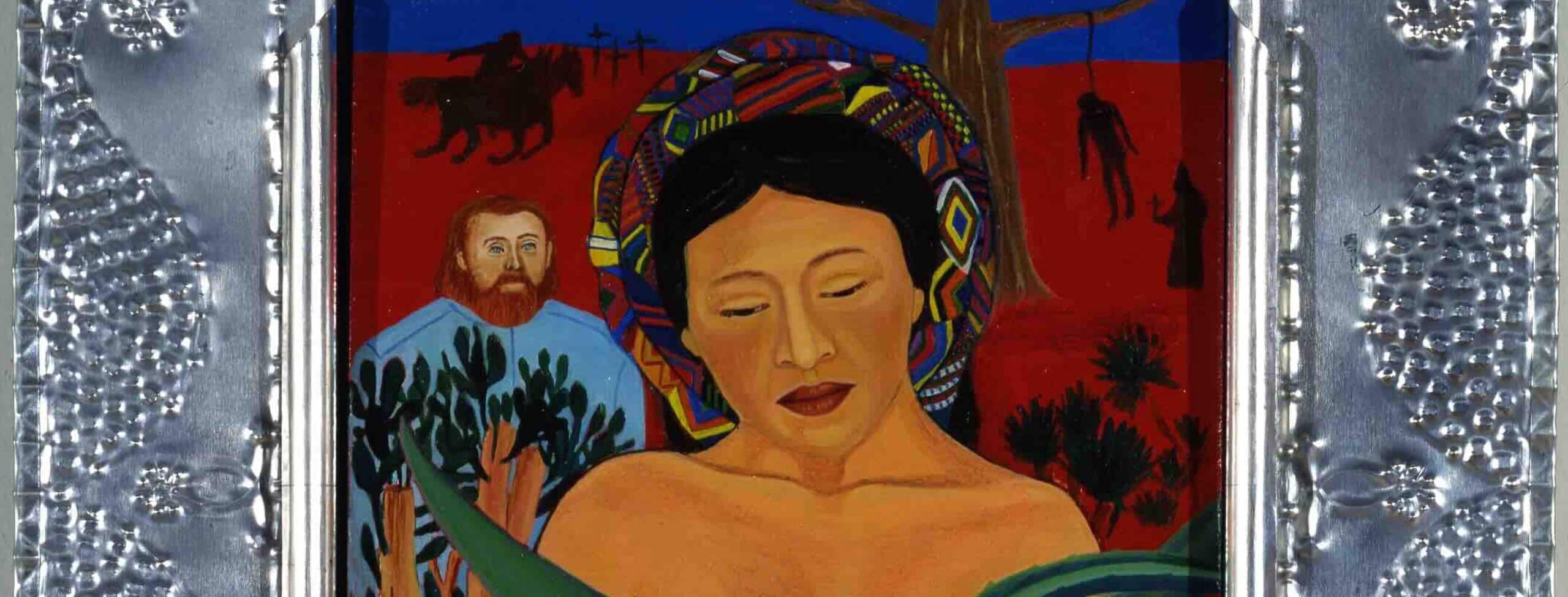
During the early 1990s, the Tejana artist Santa Barraza began creating brightly hued, modestly scaled paintings on metal that formally and conceptually emulated Mexican retablos, or votive paintings. While the majority of these retablo-inspired works featured sacred figures or those drawn from popular lore—Catholic virgins, Mesoamerican deities, La Llorona—or Barraza’s own family members, here I focus on two that depict historical personages: La Malinche (1991), an enslaved Indigenous woman whose linguistic acumen in Maya and Nahuatl positioned her to serve as the interpreter for conquistador Hernán Cortés during the Spanish conquest of Mexico; and Emma Tenayuca Retablo (1993), a Mexican American labor organizer from San Antonio, Texas who led a three-month-long pecan-shellers strike in which over ten thousand predominantly Mexican American women workers participated.
Barraza’s adoption of the retablo format to render the two women gestures to the intersection of spiritual devotion and feminist historical consciousness. Accordingly, I link these works to an impetus that I am terming “votive pedagogy,” which I define as a strategy of reparative education, mediated by the retablo, that proffers a reciprocal encounter between the viewer and the women she represents by commingling spiritually charged symbols and iconography with historical narratives elided by the mainstream. This dialogical world-building is achieved by mobilizing the retablo’s intimate scale and vivid, gleaming surface of jewel-toned enamel and oil paint on metal. The paintings are set in decorative punched-metal frames adorned with whorls and flourishes, conferring a heightened sense of preciousness and evoking a reverential viewing experience.1
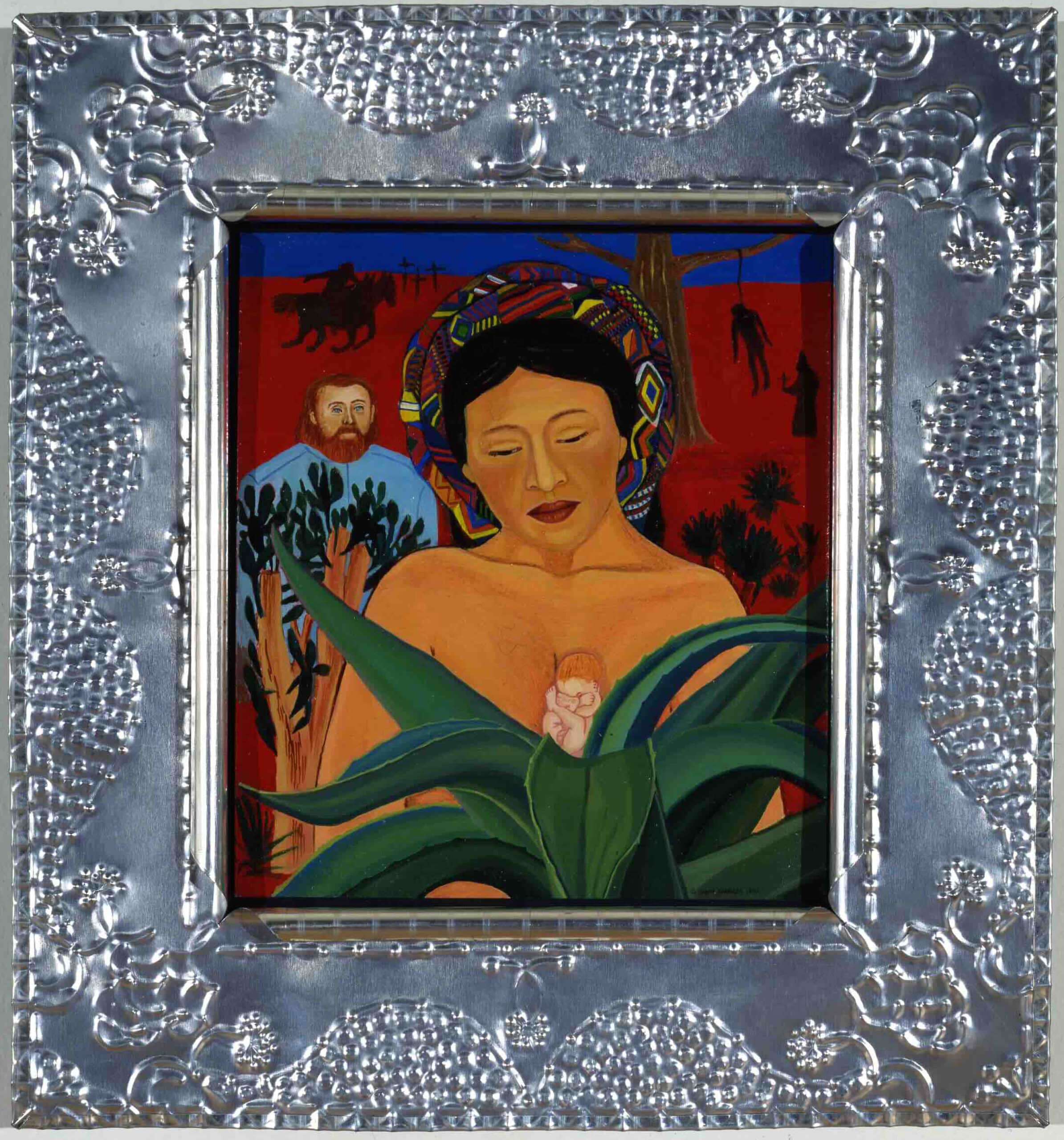
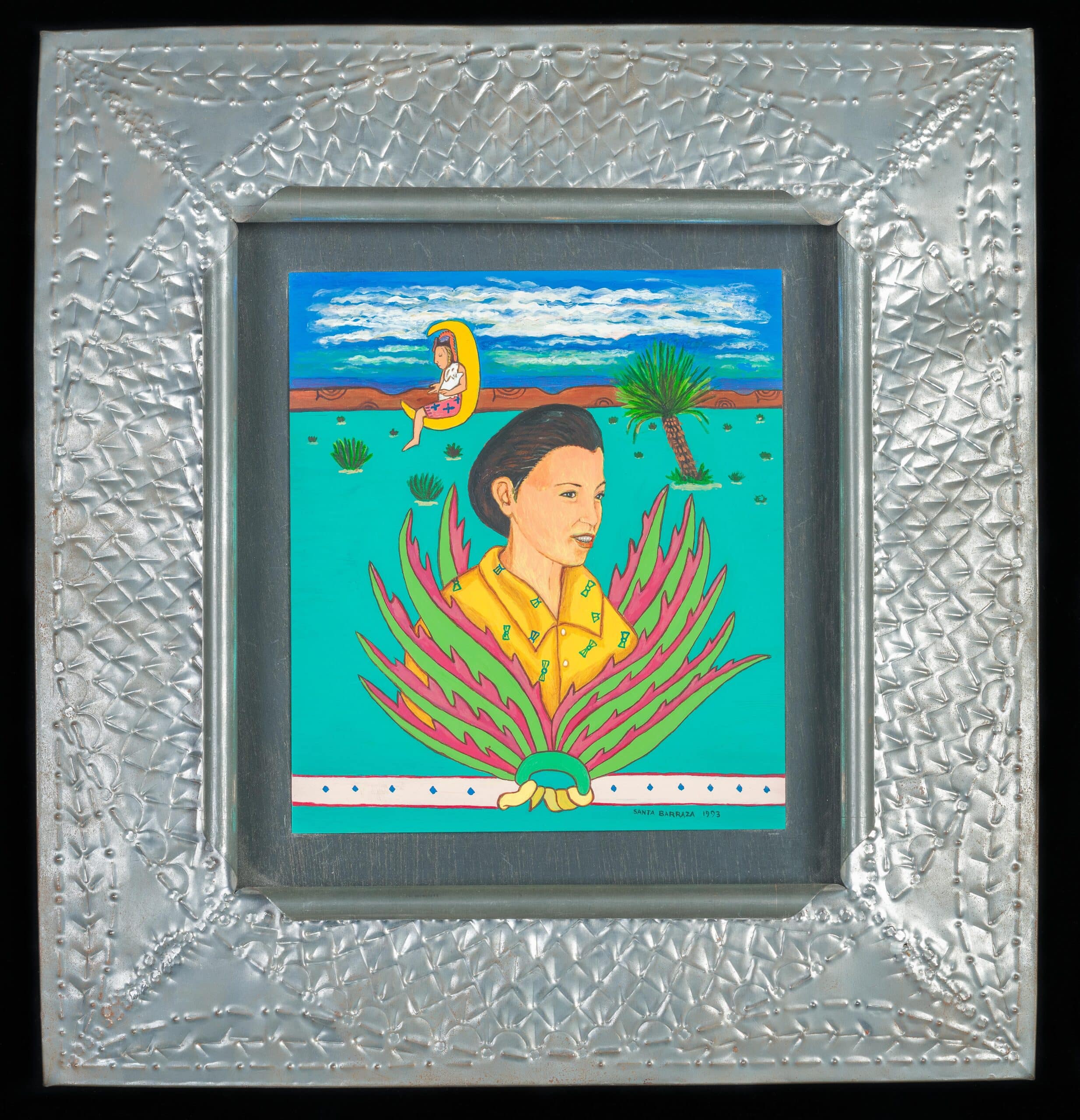
(Right) Santa Barraza, Emma Tenayuca Retablo, (1993). Oil on metal, 15 × 14 × 1 3⁄16 inches (framed). San Antonio Museum of Art. Purchased with funds provided by the Dorothy Antoinette LaSelle Foundation, the William and Salome Scanlan Foundation, and Candace and Michael Humphreys, 2023.9. © Santa Barraza.
Born and raised in Kingsville, South Texas, Barraza completed her BFA (1975) and MFA (1982) at the University of Texas at Austin. While in Austin, her early work during the 1970s was largely comprised of graphite drawings and intaglio printmaking, often based on family photographs. In the 1980s, she began to produce stone lithographs and monoprints inspired by her dreams and by the rituals of curanderismo (folk healing) and other spiritual practices. In parallel to her artmaking, Barraza cofounded the collective Mujeres Artistas del Suroeste (MAS), which organized exhibitions, symposia, and other opportunities for women artists.2 In 1985, in the throes of a marriage in disarray, Barraza and her daughter left Texas for Pennsylvania. There, she began her career as a university professor, first at La Roche College in Pittsburgh and subsequently at Penn State University, beginning in 1988.
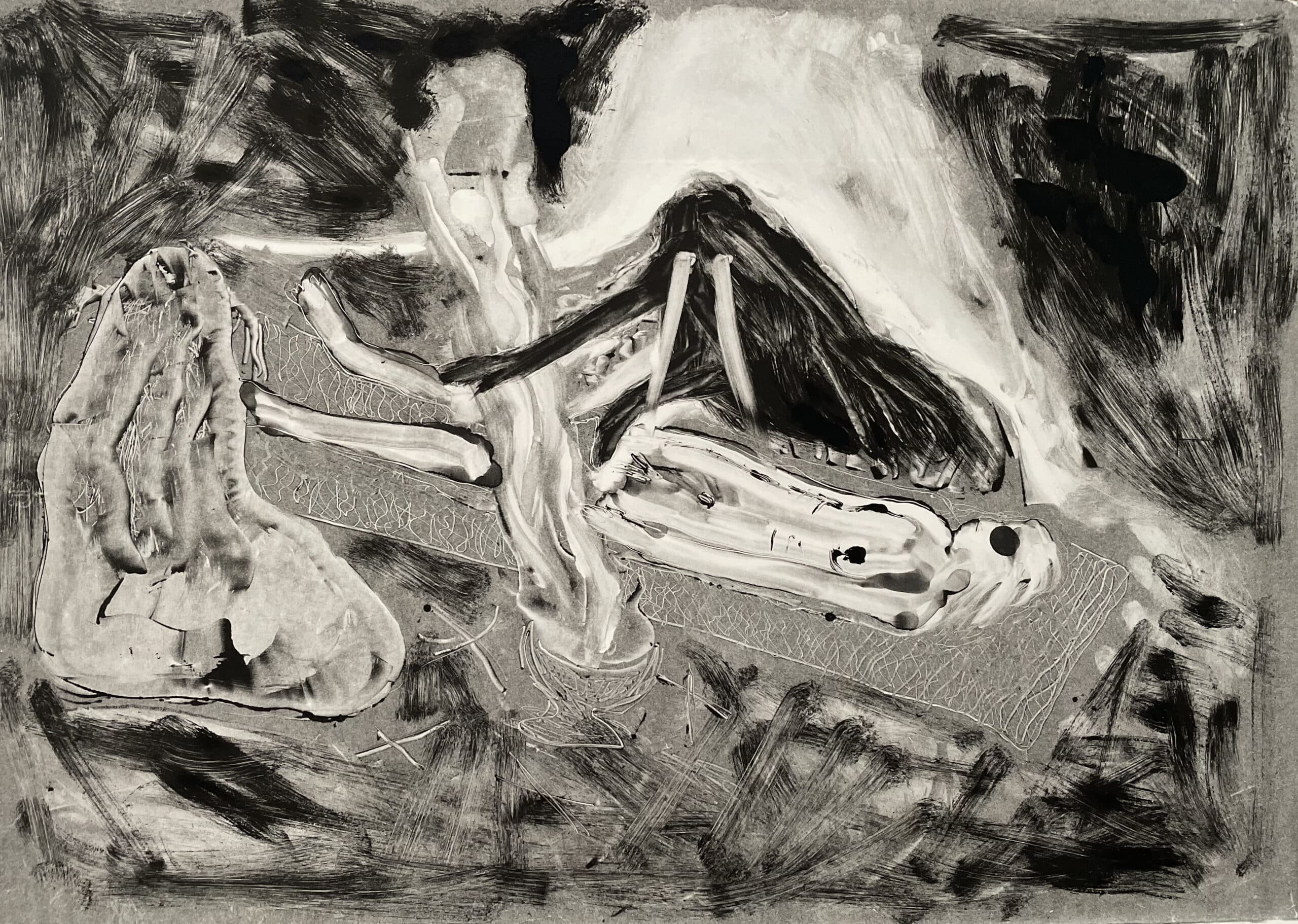
Barraza’s move from Texas to Pennsylvania coincided with a shift away from the largely black-and-white palette she employed during the 1970s to a newfound embrace of color beginning in the 1980s.3 Not only did she gravitate toward increasingly vivid hues, in 1990 she also began creating diminutive retablos on tin and steel, showing some twenty of them in an exhibition at Sacramento’s La Raza / Galería Posada in 1992. According to curator Tere Romo, the exhibition ushered the viewer into Barraza’s “world of the retablo” through both the small-scale paintings and their translations into larger mural-scale artworks.4 Building on Romo’s formulation, I argue that Barraza’s retablos construct miniature worlds that invite a relational connection between the viewer and the represented historical subject.
Her engagement with the retablo format drew on the work of scholars such as Gloria Kay Giffords, who in 1974 published Mexican Folk Retablos: Masterpieces on Tin, as well as Barraza’s own in-person study.5 In 1990 she received a grant from the Institute for the Arts and Humanities at Penn State to research religious artwork in Mexico, presaging her subsequent urge to create “as many retablos as possible.”6 Though the copresence of historical research and spiritual practice had long constituted a cornerstone of her oeuvre, her retablos more generally and the Malinche and Tenayuca paintings in particular crystallized a heightened emphasis on a spiritually and historically infused pedagogy that complemented the exigencies of full-time work as both a practicing artist and university educator.7
In Barraza’s rendition of La Malinche, an unclothed woman stands placidly behind a maguey (agave) plant, allegorizing “renacimiento or rebirth.”8 Eyes downcast, she gazes adoringly at the red-haired fetus (the son she would bear to Cortés) nestled between her breasts. Her dark hair is bound in a brightly patterned tocoyal headscarf. Yet Malinche’s serenity contrasts jarringly with the scenes in the distance. Set against a bloodred ground, on the left a double-headed horse—inspired by José Clemente Orozco’s representations of Spanish soldiers in his 1937 Spanish Conquest of Mexico mural cycle in the Hospicio Cabañas in Guadalajara—gallops past a trio of crosses.9 A figure dangles from a noose while an evangelizing cleric stands holding a cross, connoting parallels between forced conversion and Indigenous death during Spanish colonization. Between these spectral scenes and Malinche hovers red-haired Cortés, tunic and eyes blazing pale blue.
An enigmatic figure whose full name remains unknown yet whose assistance with negotiations between Cortés and the Mexica nobility secured her historical notoriety, La Malinche has been variously celebrated and disparaged in Mexico as the putative mother of mestizaje and as a traitor who abandoned her people by fraternizing with the colonial enemy.10 Reclaimed in the 1970s and 1980s by Chicana artists and writers, her story was recast as that of an empowered survivor. Chicana writer Gloria Anzaldúa characterizes “la chingada (Malinche), the raped mother whom we have abandoned” as one of a triumvirate of female archetypes to be “reread” through such reclamatory impulses. As she writes, “In part, the true identity of all three has been subverted—Guadalupe to make us docile and enduring, la Chingada to make us ashamed of our Indian side, and la Llorona to make us long-suffering people.”11 Poignantly, the intimate bond that Barraza illustrates between Malinche and her son Martín Cortés would later be severed, as the child was sent to Spain at the age of six and would not see his mother again prior to her death the following year.12 Barraza’s tender rendering of Malinche as victimized by yet also transcending the circumstances wrought by her complex entanglement with Cortés, is an affirmation of the artist’s recuperative impulse to reframe narratives of colonialism and violence.
Where Malinche stands removed from the oppressiveness of colonization and heteropatriarchy, Barraza depicts Tenayuca against a turquoise field and beneath a dark blue cloudy sky, emerging as if reborn from a stylized maguey and flanked by yucca—a play on her last name and an allusion to the landscape of Tenayuca’s (and Barraza’s) South Texas homeland.13 Mexica and Maya references abound: her shirt’s pattern invokes the concept of ollin (movement in Nahuatl) while a goddess holding a rabbit seated on a stylized crescent moon pulls from ancient Mesoamerican iconography; though Barraza describes the figure as the Mexica moon deity Coyolxauhqui, it also resembles a moon goddess motif found incised on a Late Classic Maya vase.14 According to the artist, the yellow of the shirt invokes the Afro-Caribbean tradition, symbolizing sacrifice and attesting to a broader symbolic repertoire influenced by friends and colleagues she encountered in the Northeast.15 In this way, a malleable integration of Indigenous and African references endow Tenayuca’s narrative of labor advocacy with a multilayered spiritual undertone.
Born in San Antonio in 1916, as a teenager Tenayuca began organizing cigar workers, garment workers, and other laborers, eventually rising to the rank of general secretary of ten chapters of the Workers Alliance of the Congress of Industrial Organizations (CIO) in 1937. In 1938 she led the pecan-shellers strike, which garnered her national attention. In spite of an intense campaign of police harassment and the jailing of hundreds of strikers, the strike led to an increase in the minimum wage from five to twenty-five cents per hour. A member of the Communist Party from 1937 to 1941, Tenayuca’s politics ultimately led to death threats and she was blacklisted and forced out of San Antonio.16 Likewise key to her story was her Indigenous identity, which she viewed as central to her pursuit of work that benefited the most vulnerable: “On my father’s side, we never claimed anything but Indian blood, and so throughout my life I didn’t have a fashionable Spanish name like García or Sánchez, I carried an Indian name. And I was very, very conscious of that.”17
The historical retablos that Barraza draws on can be divided into two taxonomies: santos (saints) and ex-votos (“from a vow”), with the former representing a specific saint from the Catholic hagiographic tradition and the latter commissioned to commemorate divine intervention in moments of crisis, providing visual testimony of a miracle. Compositionally, ex-votos contain three principal parts: a visual representation of the circumstances of the miraculous event or its beneficiaries, the holy figure responsible, and a text describing the specifics of the occurrence.18
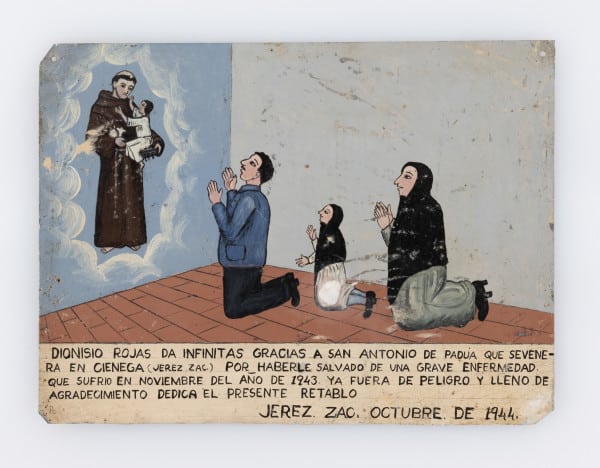
As historian Ramón A. Gutiérrez writes,
Whereas santos are officially sanctioned images diffused downward from the clergy to the laity to enhance piety and devotion, ex-votos are popular manifestations of religious sentiment that are brought by the laity to churches, shrines, and domestic altars . . . When individuals wanted to communicate directly with the deities or spirits of nature, votive offerings at temples or at potent geographical spots served as a reciprocity-inciting missive that guaranteed divine response.19
Gutiérrez explains that the promesa, or vow, constitutes contractually “engaging the deities in binding ties of reciprocity through gift-giving.” After calling upon a virgin or saint, the individual agrees to visit the shrine and leave a votive offering in exchange for their intercession.20 Barraza’s invocation of real histories presented through the prism of the spiritual enacts a similarly reciprocal exchange.
Malinche and Tenayuca constitute contested personages, maligned and obscured from historical narratives, yet ultimately celebrated and reclaimed. As secular figures and real people, what strategies—pedagogical and otherwise—does Barraza achieve by rendering them in the retablo form? While each painting’s focus on a single subject aligns with the santos tradition, their multi-planar narrative structure and dense iconographic symbolism embody the reciprocal logic of the ex-voto. Moreover, a fulfillment of a vow or promise within an intimately experienced “world of the retablo” is observable in Malinche’s overcoming of the specters of colonialism and Tenayuca’s reemergence from the maguey under the watchful eye of multiple spiritual forces. Entering this world, the viewer is prompted to dialogue with redemptive historical retellings.
Barraza found resonance in retablos as a “format that was of the popular masses.”21 Writing in 1993 about Chicana borderlands artists (including Barraza) and the notion of nepantla, or in-betweenness, Anzaldúa contends that, “Border art, in critiquing old, traditional, and erroneous representations of the Mexico-United States border, attempts to represent the ‘real world’ de la gente going about their daily lives. But it renders that world and its people in more than mere surface slices of life. If one looks beyond the tangible, one sees a connection to the spirit world, to the underworld, and to other realities.”22 Similarly reclaiming Malinche and Tenayuca and placing them within a sanctified visual realm, Barraza activates their stories and legacies to generate a votive pedagogy through a mediated interplay of worlds.
Endnotes
- Barraza commissioned the frames from sculptor Richard F. Dennis. Santa Barraza, Zoom conversation with the author, December 22, 2025. ↩︎
- For a detailed overview of Barraza’s early career in Texas, see Santa Barraza, “Santa C. Barraza: An Autobiography,” in Santa Barraza: Artist of the Borderlands, ed. María Herrera-Sobek, (Texas A&M University Press, 2001), 34–42. See also Shifra M. Goldman, “When the Earth(ly) Saints Come Marching In: The Life and Art of Santa Barraza” in the same volume, pp. 51–63. I discuss Barraza’s monoprints at length in my doctoral dissertation. See Sonja Elena Gandert, “La resolana: Chicano Artistic Imaginaries of Place, Race, and Activism in New Mexico and Texas, 1969–1985,” (PhD diss., The Graduate Center, City University of New York, 2025). ↩︎
- This shift is partially due to a negative experience with a gallery owner in Austin whom she contends did not compensate her adequately after giving her a solo show. See María Herrera-Sobek, “Introduction” in Santa Barraza: Artist of the Borderlands, ed. María Herrera-Sobek (Texas A&M University Press, 2001), xv–xvi. Per the artist, her pastel drawing Renacimiento/Rebirth (1980) marked a significant initial foray into color that would carry through her early 1980s work. Nonetheless, I view her subsequent move to painting in a highly saturated color palette as connected to her transition to her new life in Pennsylvania. ↩︎
- Tere Romo, “Foreword,” in Santa Barraza, Galería Posada, Sacramento, March 8–April 11, 1992, exh. cat., ed. Tere Romo (La Raza / Galería Posada, 1992). ↩︎
- See Gloria Kay Giffords, Mexican Folk Retablos: Masterpieces on Tin (University of Arizona Press, 1974). Barraza recalls that Giffords’s text as well as the opportunity to see retablos at Frida Kahlo’s Casa Azul and the Basílica de la Virgen de Guadalupe were crucial to her exposure to the format. Barraza, December 22, 2025. ↩︎
- Barraza, “An Autobiography,” 44–45. ↩︎
- Though only producing small-format retablos for a brief period (1990–1993), Barraza’s interest in the format was ongoing: Her 1998 Retablo Codex Mural for the Biosciences Building at the University of Texas at San Antonio was realized on metal and inspired by both retablos and Mesoamerican codices. She also taught well-received retablo-making workshops at a homeless shelter in San Jose, California, which she described as enabling the children to “paint a miracle in their lives.” See Mary Thomas, “Teaching and Creating Art in the Borderlands: A Conversation with Santa C. Barraza,” Panorama: Journal of the Association of Historians of American Art 7, no. 2 (2021), accessed April 20, 2026, https://doi.org/10.24926/24716839.12627. ↩︎
- Amalia Mesa-Bains, “Curatorial Statement,” in Ceremony of Spirit: Nature and Memory in Contemporary Latino Art, exh. cat. (The Mexican Museum, 1993), 11. ↩︎
- Barraza, December 22, 2025. ↩︎
- On La Malinche’s historical and contemporary significance, see Victoria I. Lyall and Terezita Romo, eds., Traitor, Survivor, Icon: The Legacy of La Malinche, exh. cat. (Denver Art Museum/Yale University Press, 2022). ↩︎
- Gloria Anzaldúa, “Chicana Artists: Exploring nepantla, el lugar de la frontera,” NACLA Report on the Americas 27, no. 1 (1993): 38. ↩︎
- Javier Molina Villeta, “Los dos mundos de Martín Cortés. Un mestizo en el imperio español,” Revista de Indias 83, no. 289 (2023): 627. ↩︎
- Barraza, December 22, 2025. ↩︎
- For an image and discussion of the various Mesoamerican moon deities, see Mary Miller and Karl Taube, The Gods and Symbols of Ancient Mexico and the Maya: An Illustrated Dictionary of Mesoamerican Religion (Thames and Hudson, 1993), 119. There is a separate narrative involving the moon and a rabbit narrated in the Florentine Codex Book 7 that involves Nanahuatzin and Teucciztecatl, who jumped into the fire to appease the gods and became, respectively, the sun and moon. The angry gods later threw a rabbit in Teucciztecatl’s face, darkening it. See annotated, translated, and digitized version of the Florentine Codex, accessed March 5, 2026, https://florentinecodex.getty.edu/book/7/folio/2v?spTexts=&nhTexts=. ↩︎
- Barraza’s understanding of the color yellow’s relationship to the concept of sacrifice came from secondhand sources: she recalls learning of its meaning from friends of the late Cuban American artist Ana Mendieta, who, according to them, was wearing yellow undergarments when she died after an unexplained fall from her apartment window in New York City in 1985 during a fight with her husband Carl Andre; from Puerto Rican artist Ángel Suárez Rosado, an initiate in santería; and from Marc Zuver, the cofounder, director, and chief curator of Fondo del Sol Visual Arts Center in Washington, DC. Santa Barraza, email correspondence with the author, March 5, 2026. ↩︎
- Yolanda Chávez Leyva, “Tenayuca, Emma,” in The Oxford Encyclopedia of Latinos and Latinas in the United States (Oxford University Press, 2005), accessed March 5, 2026, https://www-oxfordreference-com.colorado.idm.oclc.org/view/10.1093/acref/9780195156003.001.0001/acref-9780195156003-e-907. ↩︎
- Quoted in Leyva, “Tenayuca, Emma.” ↩︎
- Jorge Durand and Douglas S. Massey, Miracles on the Border: Retablos of Mexican Migrants to the United States (The University of Arizona Press, 1995), 10. ↩︎
- Ramón A. Gutiérrez, “Sacred Retablos: Objects that Conjoin Time and Space,” in Art and Faith in Mexico: The Nineteenth Century Retablo Tradition, exh. cat., eds. Elizabeth Netto Calil Zarur and Charles Muir Lovell (University of New Mexico Press, 2001), 32–33. ↩︎
- Gutiérrez, “Sacred Retablos,” 33. ↩︎
- Barraza, December 22, 2025. ↩︎
- Anzaldúa, “Chicana Artists,” 39. ↩︎
Cite as: Sonja Elena Gandert, “Votive Pedagogy: Activating Historical-Spiritual Worlds in Santa Barraza’s retablos,” in X as Intersection: Writing on Latinx Art, September 14, 2026, accessed [DATE], https://uslaf.org/essay/votive-pedagogy-activating-historical-spiritual-worlds/.
Sonja Elena Gandert is an assistant professor of art history at the University of Colorado Boulder and one of the cofounders of USLAF. A scholar of modern and contemporary Latinx and Latin American art, her current book project is a study of Chicana/o artists in New Mexico and Texas from the late 1960s to early 1980s.