
Pepón Osorio’s Convalescence: Reimagining the Teaching Hospital
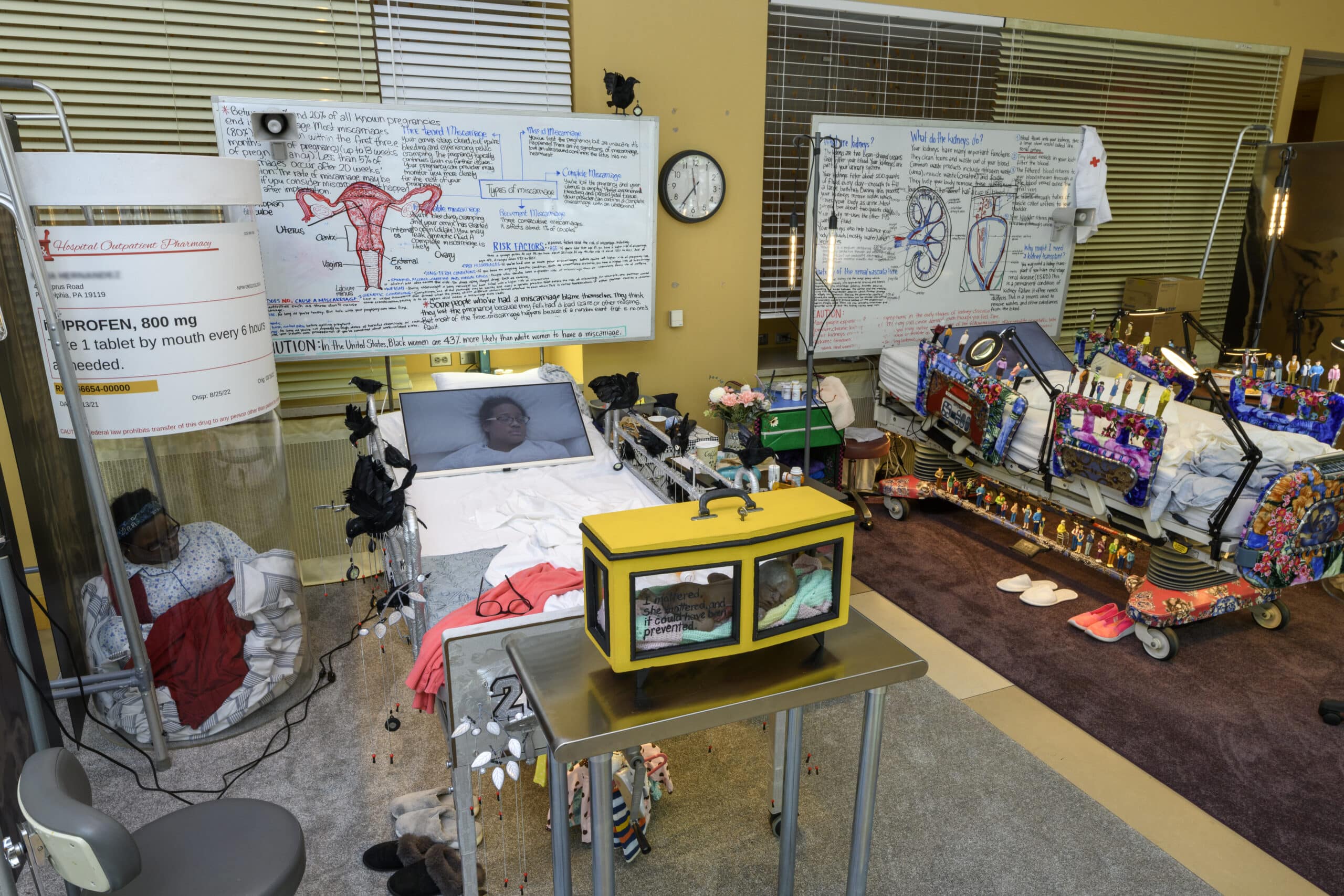
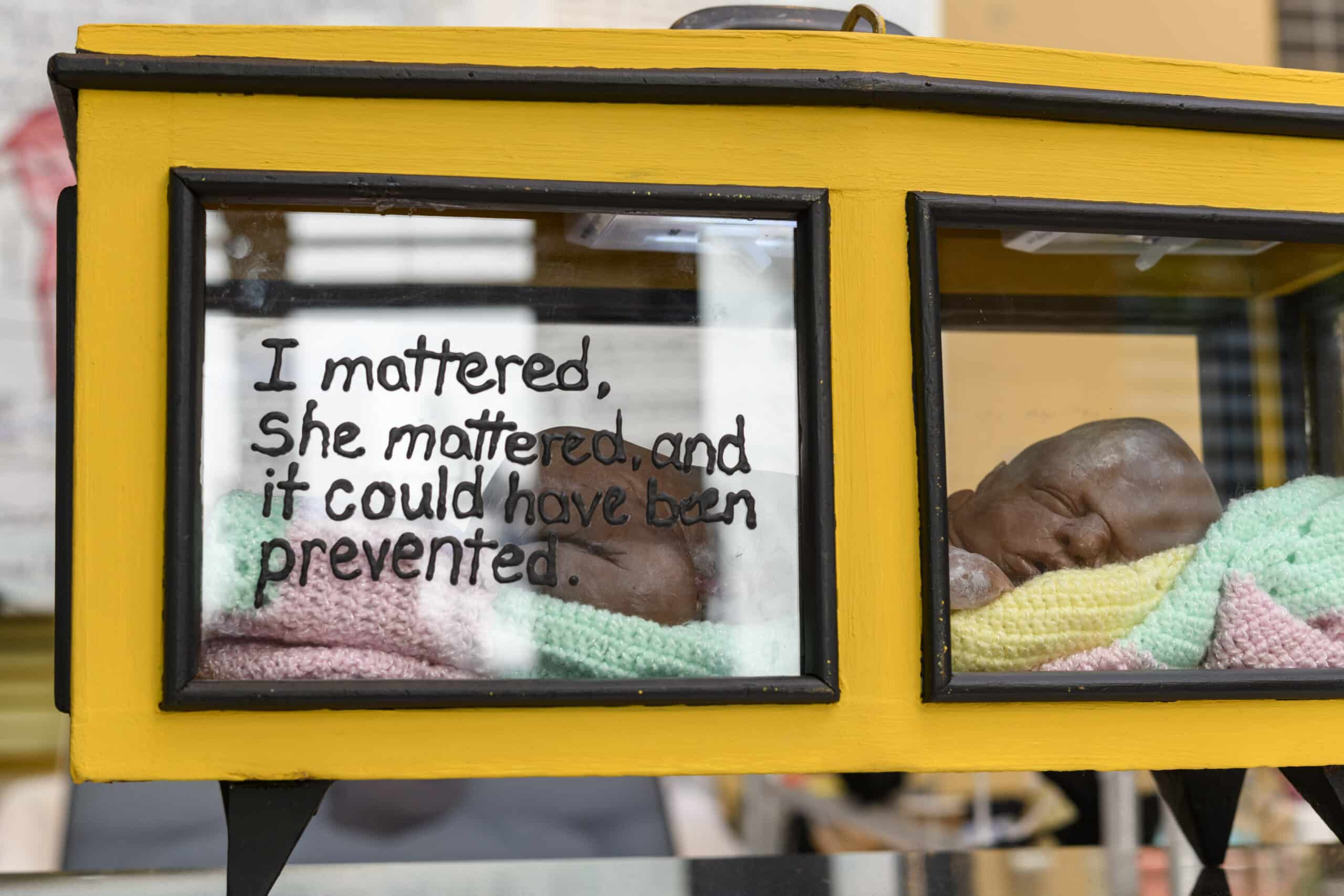
Five medical students gather at the foot of a patient’s bed, bending forward to read a whiteboard charting the details of her case: a possible missed diagnosis of preeclampsia resulting in the death of her fetus. They examine the objects embellishing the bed: rows of colorful baby clothes suspended from its underside, black crows perched on the silver frame, a latex sculpture of an infant encased in a yellow vitrine. A video monitor comes to life, and the patient begins to speak. She recounts a disturbing dream in which her healthcare providers repeatedly sent her home as her blood pressure rose, until she miscarried. The whiteboard above her head diagrams the signs and symptoms of miscarriage, along with a warning that Black women in the United States are forty-three percent more likely to miscarry than white women.1 The students know statistics like this one, but here they encounter it through the patient’s own voice and experience. Not inside a lecture hall, but within Convalescence, an art installation by Pepón Osorio that functions as a critical pedagogical space.
On this afternoon, the installation becomes a classroom for students at an early and critical stage in their professional formation as doctors. They find themselves face to face with what patients feel: from the high anxiety of a life-disrupting diagnosis, to the disorientation caused by medical jargon, to the sense that clinicians aren’t telling the whole story. One student gestures to the whiteboard positioned behind the patient, out of their view, reflecting on the physician’s obligation to share information transparently. Another observes a tension between the orderly logic of a medical case and the messiness of a patient’s whole life. A third notes the contrast between the personalized bed areas in the installation and the sterile, standardized hospital environment. A fourth reflects that objects representing a patient’s deepest concerns—the baby visible in the vitrine—remind physicians to consider what is meaningful to a patient beyond diagnosis alone.
Convalescence (2024) brings to life the stories of five Philadelphians with life-threatening conditions navigating the US healthcare system, reconfiguring the hospital as a site of critical learning that centers patients’ lived experience and community-based forms of care in tension with institutional medical authority. It is Osorio’s most personal installation in a four-decade career devoted to immersive installations addressing complex social problems of particular urgency to Latinx and Black communities.
During the 1990s, Osorio became known for installations including Scene of the Crime (1993), which recreated a household shattered by domestic violence, and Badge of Honor (1995), which documented a monthslong conversation on video, filmed by the artist, between a teenage boy and his incarcerated father. For Badge of Honor, Osorio recreated both the father’s prison cell and the teenage boy’s bedroom—the latter thickly encrusted with sports paraphernalia in the artist’s distinctive visual style of building his installations with found objects that draw out personal and cultural narratives. Juxtaposing the two environments, Osorio projected the videos of father and son on facing walls, inviting visitors to witness an exchange rendered deeply poignant by their enforced separation. Such earlier works were informed by Osorio’s experience as a caseworker for New York City’s Department of Social Services in the 1980s and ’90s, which awakened in him an attention to people’s lives that became the foundation for his artistic process.
“I began more and more to listen without the intention of passing judgment, just listening and trying to find the cues and the clues,” Osorio explained. “When I’m really willing and able to listen, it is about honoring people’s experience in a complete, 360-degree way—giving collaborators an opportunity to tell their full story in a way that the viewer is going to listen to it.”2
For Convalescence, this listening process began with Osorio’s own cancer diagnosis and lymphoma treatment, which put him in places like chemotherapy waiting rooms where other patients often shared their stories unprompted. As several years went by after his own treatment, Osorio developed the idea of a project based on the patient experiences that he bore witness to, including his own. The resulting installation highlights how patients experience the US healthcare system as broken—a place where they feel dismissed, struggle to find what can accurately be called care, and sometimes leave traumatized yet still dependent on a system they regard with deep ambivalence. These intimate stories mirror larger inequities in healthcare access and treatment, underscoring the need for systemic change.
“I wanted to share with others what it meant to go through this,” Osorio said. “Doctors have more of a factual and pragmatic way of dealing with the body. But this is a learning lesson in caring, love, closeness. Sometimes we heal medically, and sometimes we heal spiritually. They don’t go hand in hand.”3
Throughout his career, Osorio has situated his work in non-museum spaces where a broader public can encounter his installations and where the problems they address are embedded in everyday culture. Osorio has often sought to recreate and critique an institution in its shadow, producing an “institutional displacement” that art historian Jennifer A. González has described as “a kind of portal, as if two distant points were made to intersect or collapse by the folding of space.”4 Before Badge of Honor was acquired by the Museum of Modern Art in New York, Osorio created the installation for a vacant storefront in a working-class neighborhood in downtown Newark, where the project directly addressed the lived experiences of local residents.5
I first met Osorio when he was searching for a hospital to host Convalescence, a project that had begun to emerge in his 2023 survey at the New Museum.6 Osorio had addressed health disparities in earlier works such as Maria Cristina Martinez Olmedo, D.O.B. 3/27/89 (1989), a sculpture that drew attention to infant mortality rates, grimly surrounding a Black baby doll with plastic medical breathing and IV tubes in a lace-skirted bassinet. Another installation, El Velorio (The Wake) (1991), staged seven full-size coffins in a gallery at El Museo del Barrio to represent deaths from AIDS in Latinx communities; inside some coffins, photographs representing deceased individuals powerfully invoked the personal stories and lives lost behind epidemic statistics and government silence. I knew that, over more than three decades, Osorio’s approach had attracted its critics—particularly those who see his earnest approach as heavy-handed in its social critique or as merely depicting social problems that are already known.7
I also knew that across the span of Osorio’s career, public health researchers have only brought more attention and public outrage to the persistence of racialized health inequities in the US.8 Art in medical settings is often selected for its soothing qualities, but serious illness raises unsettling existential and political questions.9 When Osorio described how Convalescence reflected his own cancer treatment experience, alongside difficult stories that fellow patients and Philadelphians had shared with him, I knew—as a former museum curator who now directs a medical humanities curriculum—that his project would be challenging and potentially uncomfortable for members of our teaching, learning and clinical community. I also believed that it would have the potential to offer powerful lessons about healing and care.
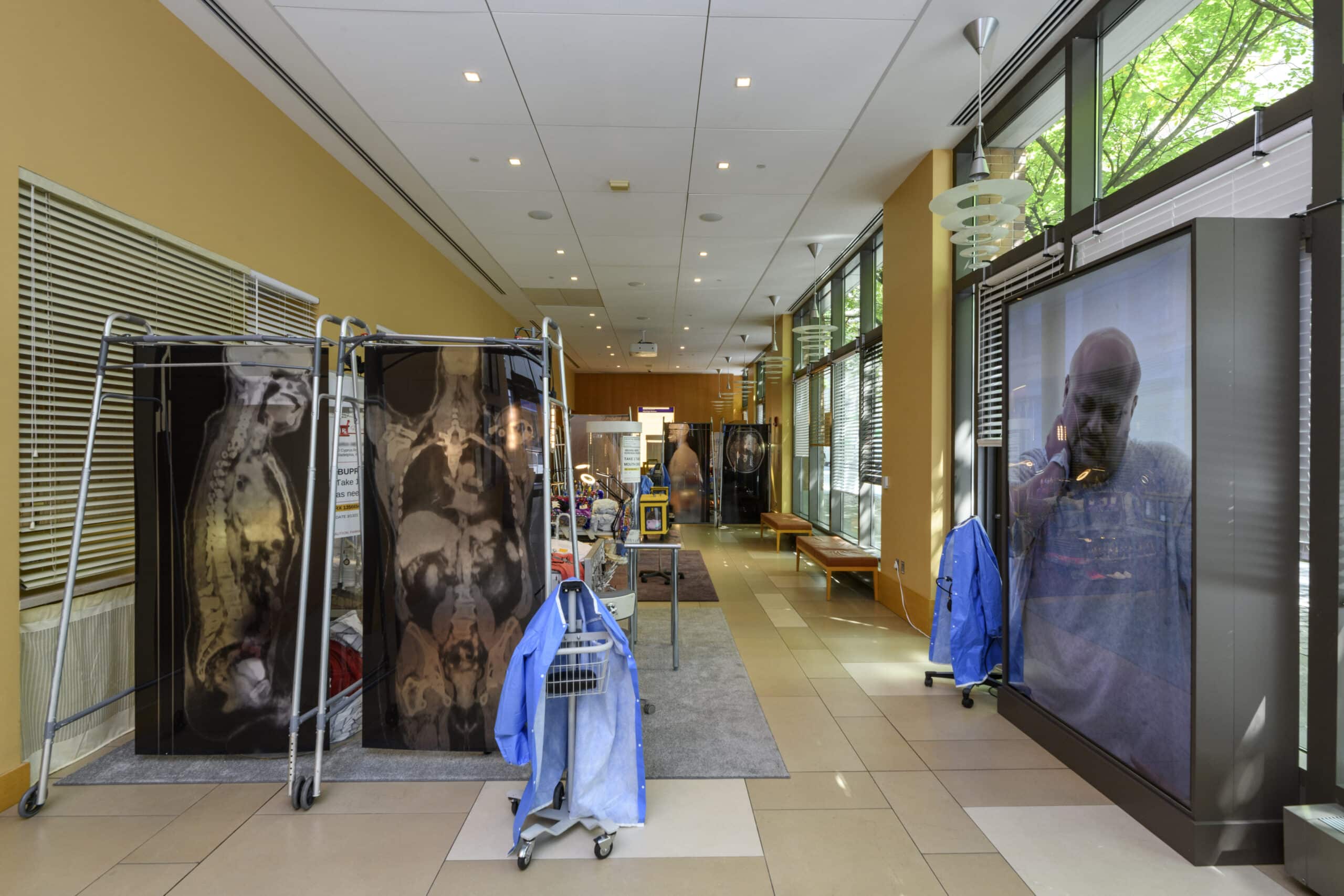
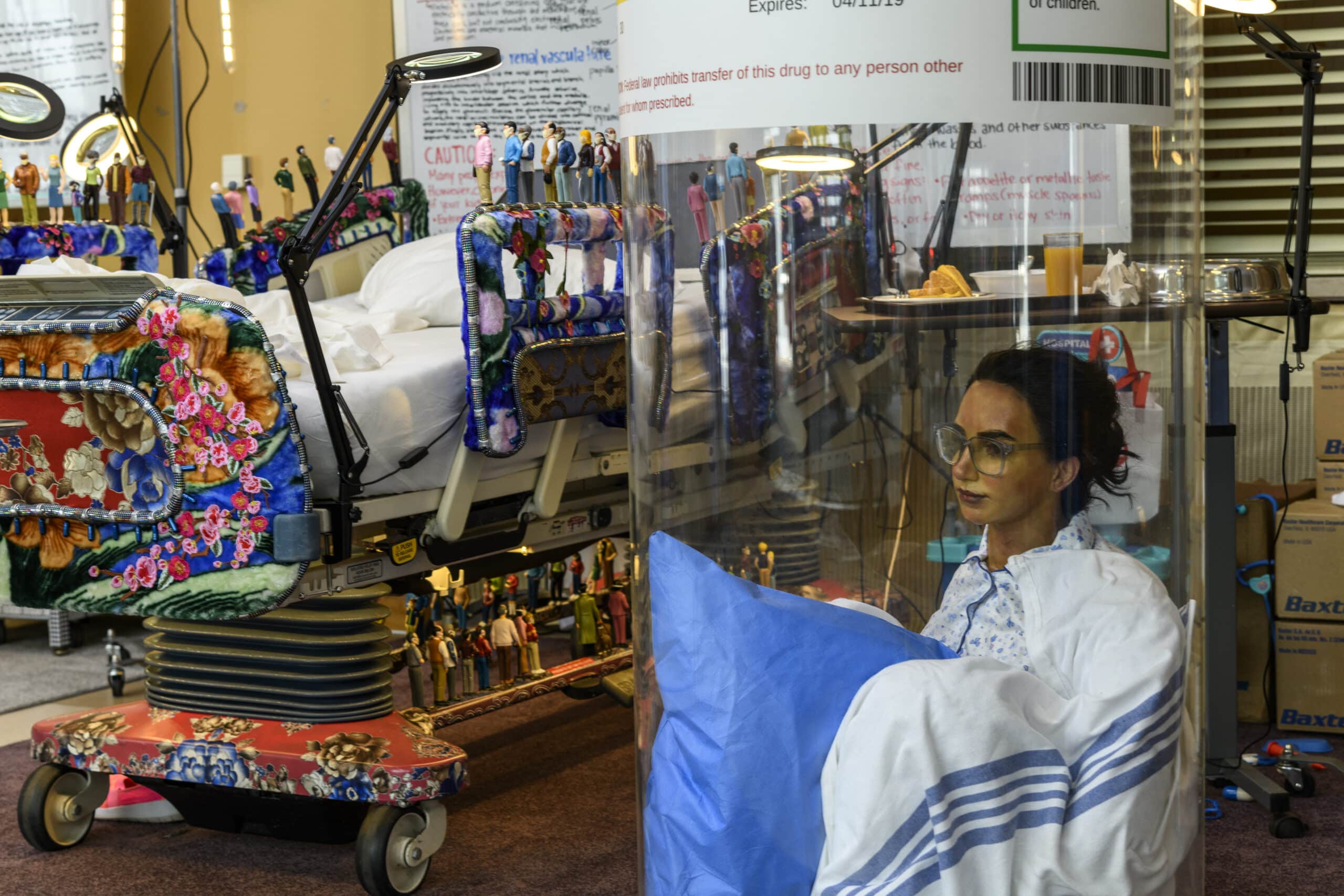
Presented at Thomas Jefferson University from September 3 to November 1, 2024, Convalescence opened on the ground floor of a university medical building in Center City, Philadelphia, a block from the university hospital. Over two months, Osorio and a team of assistants transformed an 1,800-square-foot institutional lobby into a simulated hospital ward featuring five patient stories. Through half-open venetian blinds, pedestrians on Walnut Street—a busy public transit corridor—peered inside at five patient beds alongside five-foot-tall clear plastic pill bottles, each containing a life-size sculpture of a patient, symbolizing both pharmaceutical dependency and the extraordinary profits of drug companies. Each pill bottle stood next to a bed overlaid with embroidery, small toys, and personal effects—slippers, a beloved pillow—objects recontextualized to reflect the patient’s story. Osorio’s own bed was encircled by vessels of water for spiritual protection, evoking the Santería rituals long present in his work, together with a bottle of alcoholado, a traditional Puerto Rican home remedy. Through public programs that ran alongside the installation, visitors were invited to make their own alcoholado at a local community garden.10
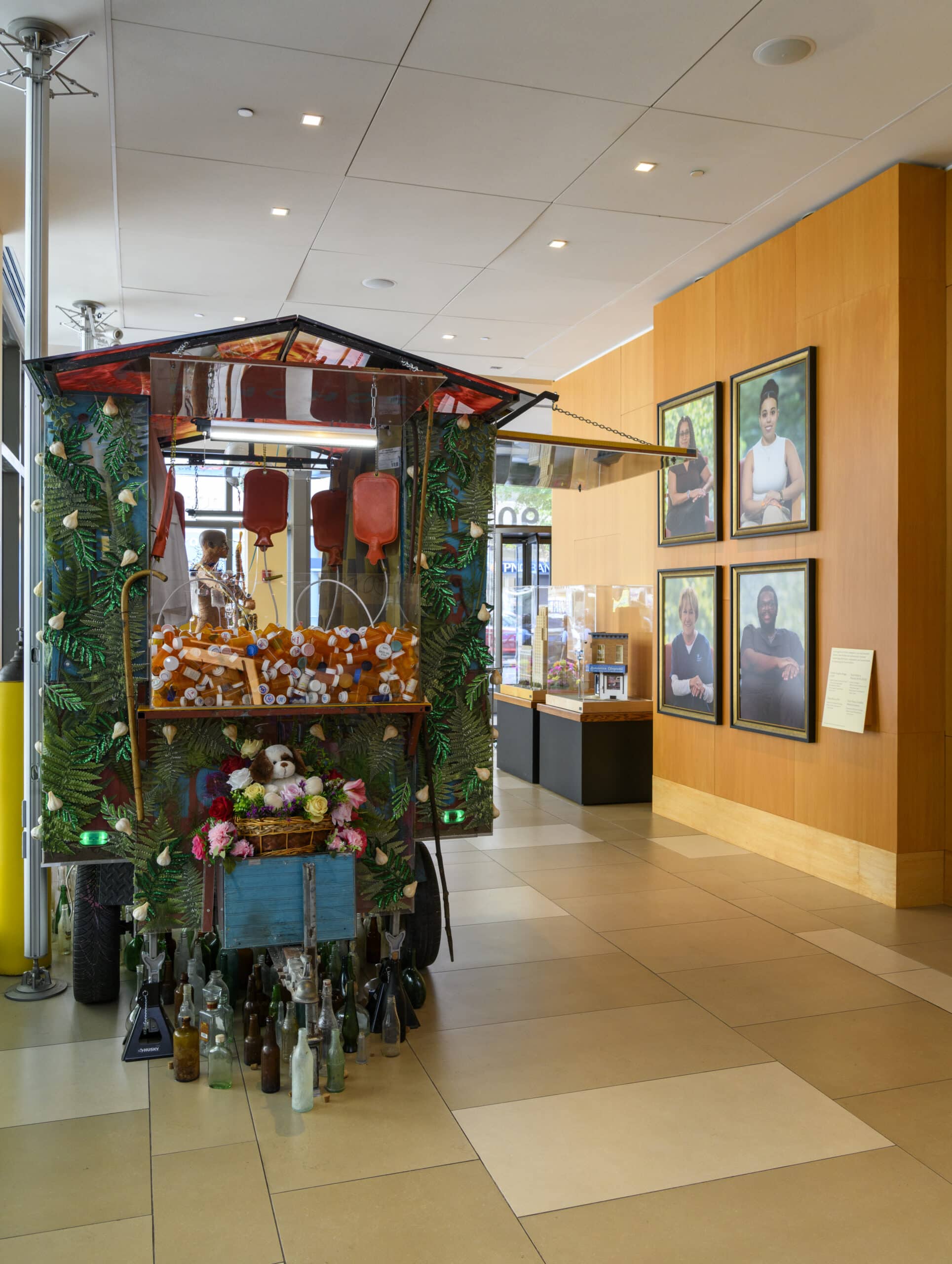
When visitors entered Convalescence, they found traditional medical authority upturned. While patient-centered care is often invoked in institutionalized medicine, Convalescence made space for patient voices that asserted a different idea of care, redistributing epistemic power away from the institution. At the entrance, an oversized teddy bear surrounded by flowers admonished visitors to “Get Well Soon,” capturing, in Osorio’s words, the commercialization of caring. Nearby, a scale model of Botánica Oloyumi, a store for herbal and spiritual remedies in Philadelphia’s Puerto Rican community neighborhood, was placed next to an architectural model of the building itself. Osorio also included portraits of university healthcare workers nominated by colleagues in oncology, countering the donor and physician portraits that decorate many hospitals and medical schools.
This inversion of power was underscored by a large-format display of the Patient’s Bill of Rights on a lightbox. The document, first developed in 1973 to protect patients in hospital settings, emphasizes respect, informed consent, and open communication about diagnosis and treatment. Most pointedly, much of Convalescence was spoken in Spanish, with English translations available on request. This reversal centered the voices of Philadelphia’s Latinx community and made English-speaking visitors experience, even briefly, what it feels like to navigate healthcare in a language not your own.
At the heart of Convalescence are the uncomfortable feelings that life-changing illness brings forth: helplessness, grief, rage. Osorio’s installation echoes well-known critiques of healthcare—analyses of how medical institutions expropriate communities’ self-healing capability,11 the economic and political conditions of racialized health inequity,12 and medicine’s long entanglement with imperial power and the destruction of Indigenous knowledge systems13—but his artwork offers visitors a visceral, embodied experience of these realities. Visitors often broke down and cried. On-site guide Chelsey Velez witnessed tears and fielded questions: Are these stories real? Are the people still alive? In response, she shared tissues and her own story of caring for her mother during cancer treatment.
On the afternoon of our rounds of the art installation with medical students, my physician colleague listened to the students’ observations of Convalescence, first responding to a comment about the banal sterility of clinical environments. She noted that such sterility depersonalizes patients, serving the convenience of the medical system more than the needs of patients. She acknowledged that while she embraces emotional connection with patients, administrative systems often work against this—and that, as much as she loves the profession, she is uncertain she would choose to pursue medicine today. Surrounded by Osorio’s installation, she spoke candidly with students about the tensions between a professional call to care and the constraints of a complex and ambivalent system.
Convalescence emerged from the aftermath of the COVID-19 pandemic, which brought health disparities into broad public awareness and led public health researchers to invoke the term “syndemic” to describe the compound effect of the virus alongside systemic racism and chronic health inequity.14 In many ways, Convalescence takes this entanglement as its subject, and what it means to pursue health justice within it. The work arrived in the wake of mass grief, when personal and collective loss called for healing across registers. Handwritten on Osorio’s own hospital bed is the installation’s most poignant lesson: “Accepting that you will never be the same is the hardest thing: That is Convalescence.”
Endnotes
- For a discussion of Black maternal health disparities in the United States, see Keisha Ray, Black Health: The Social, Political, and Cultural Determinants of Black People’s Health (Oxford University Press, 2023), 23–57. ↩︎
- Pepón Osorio, interview with the author, December 29, 2025. ↩︎
- Osorio, December 29, 2025. ↩︎
- Jennifer A. González, Pepón Osorio (UCLA Chicano Studies Research Center Press, 2013), 68. ↩︎
- Abigail Satinsky and Lily Sargeant, “From Convalescence to Cure: The Role of Art in Healing Healthcare Systems,” Wagner Foundation, August 5, 2025. http://wfound.org/insights/from-convalescence-to-cure-the-role-of-art-in-healing-healthcare-systems-2/. ↩︎
- Holland Cotter, “An Artist’s Wounded Heart,” The New York Times, July 14, 2023, C1(L). ↩︎
- Joan Acocella, “Pepón Osorio’s Plastic Heaven,” Artforum International 30, no. 5 (January 1992): 4; T.J. Demos, “Pepón Osorio: Institute of Contemporary Art,” Artforum International 43, no. 5 (January 2005): 186. ↩︎
- Caleb Jang and Henry Lee, “A Review of Racial Disparities in Infant Mortality in the US,” Children 9, no. 2 (2022): 257, https://doi.org/10.3390/children9020257. ↩︎
- David Levi Strauss, Between Dog & Wolf: Essays on Art and Politics (Autonomedia, 1999), 23. ↩︎
- Peter Crimins, “What ails you? This garden in Kensington mixes a traditional Puerto Rican alcoholado cure,” WHYY, September 23, 2024, https://whyy.org/articles/alcoholado-kensington-philadelphia-garden-puerto-rican-folk-medicine/. ↩︎
- Ivan Illich, Medical Nemesis: The Expropriation of Health (Pantheon Books, 1976), 9. ↩︎
- Jonathan M. Metzl and Helena Hansen, “Structural Competency: Theorizing a New Medical Engagement with Stigma and Inequality,” Social Science & Medicine 103 (February 2014): 126–33, https://doi.org/10.1016/j.socscimed.2013.06.032. ↩︎
- Barbara Katz Rothman, The Biomedical Empire: Lessons Learned from the COVID-19 Pandemic (Stanford University Press, 2021), 2–16. ↩︎
- Clarence C. Gravlee, “Systemic Racism, Chronic Health Inequities, and COVID-19: A Syndemic in the Making?” American Journal of Human Biology 32, no. 5 (2020): 32:e23482, https://doi.org/10.1002/ajhb.23482. ↩︎
Cite as: Megan Voeller, “Pepón Osorio’s Convalescence: Reimagining the Teaching Hospital,” in X as Intersection: Writing on Latinx Art, September 14, 2026, accessed [DATE], https://uslaf.org/essay/pepon-osorios-convalescence-reimagining-the-teaching-hospital/.
Megan Voeller is an educator, curator, and writer based in Philadelphia. As Director of Humanities at Thomas Jefferson University, they lead medical humanities curricula along with an artist-in-residence program and the Helix Gallery. They are a PhD candidate in art history at Tyler School of Art & Architecture, Temple University.