The Investigator’s Folder:
Curriculum as Form in Lizania Cruz’s The Investigation of the Dominican Racial Imaginary
Somehow, I’m still nervous to pose the question. Standing and looking at my computer screen in Oakland, California, talking to Lizania Cruz in her studio in New York City, I manage to make my mouth sound the words: Is the curricular aspect of your work an extension of the artworks, or part of the work itself? My nerves are older than this conversation, they’re a lingering doubt that’s lived on from so many exchanges that frame the curricular and pedagogical as junior partners of the art practice “itself.” So many divisions between what counts as education and what counts as art. Educators and academics often treat arts-based research and teaching methods as fuzzy, as secondary. Artists and critics often discount the educational as technocratic at worst, and ancillary or peripheral at best. These are caricatures of positions, for sure, but they speak to a dynamic that’s felt by anyone trying to be an educator in an artistic way, or attempting to infuse artworks with participatory pedagogical substance. Cruz’s work, however, refuses these distinctions between art and education. Rather than relegate the educational to something secondary, her work challenges us to conceptualize the curricular itself as a formal element of the artwork—a formal element that is foundational to the functioning of the participation.
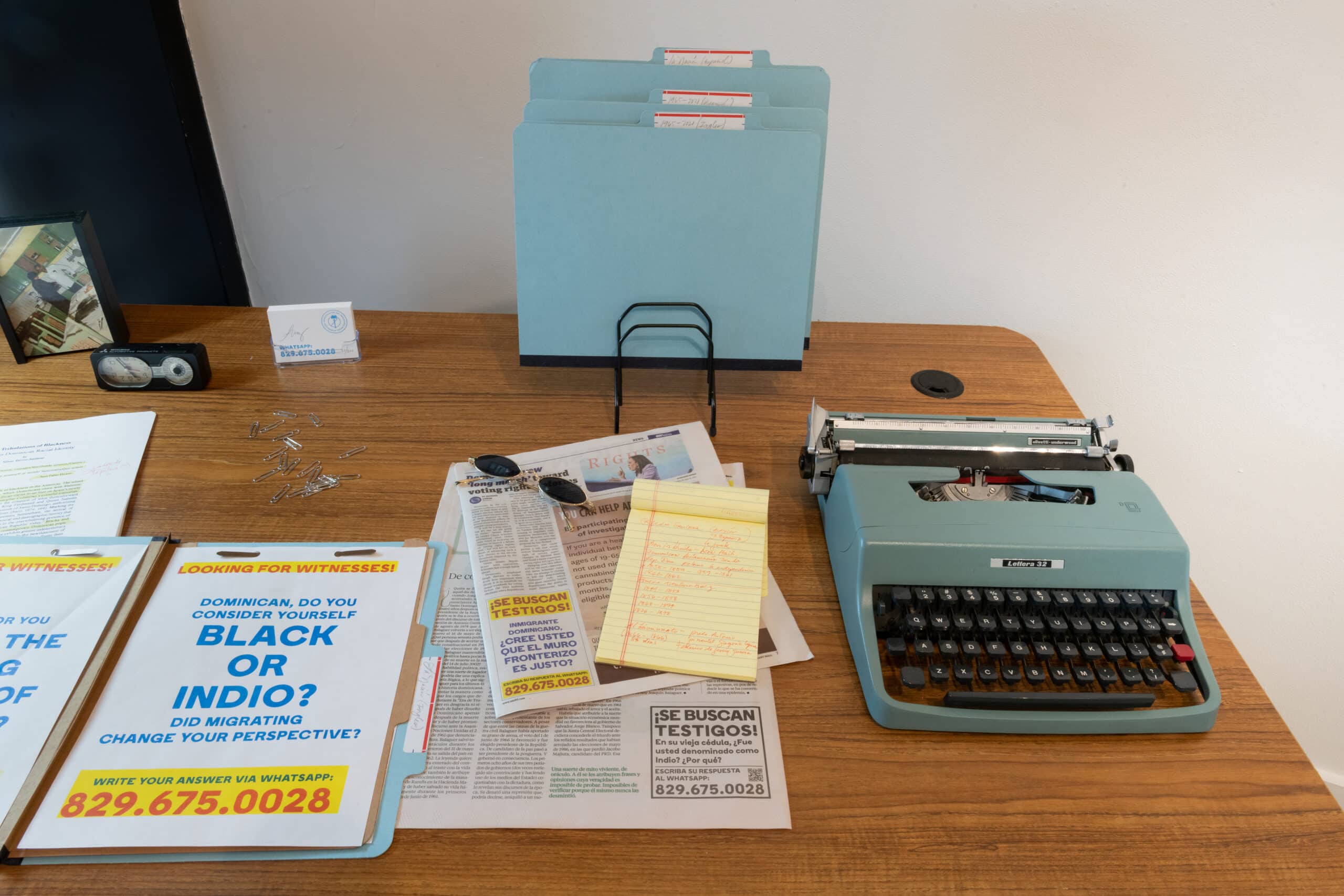
Hailing from the Dominican Republic and residing in New York City, Cruz defines herself as a participatory artist whose work assembles design-based ephemera such as zines and printed material, community-engaged happenings, installation, and printmaking to approach questions of national identity, racial imaginaries, and diasporic migration. The Investigation of the Dominican Racial Imaginary (2019–) is one of Cruz’s long-term participatory art investigations, a methodology that she’s developed over years of practice, rigorously unraveling racial ideologies through a subtle pedagogical approach. Participants are recruited through posters advertising the projects, allowing them to self-select their engagement, but Cruz also steps out into the streets and meets participants directly where they are. She highlights her process explicitly through a video work, titled ¡Se buscan testigos! [Looking for Witnesses!] (2020-2021), that presents a close-up of her grassroots pedagogical inquiry, across both New York City and the Dominican Republic.
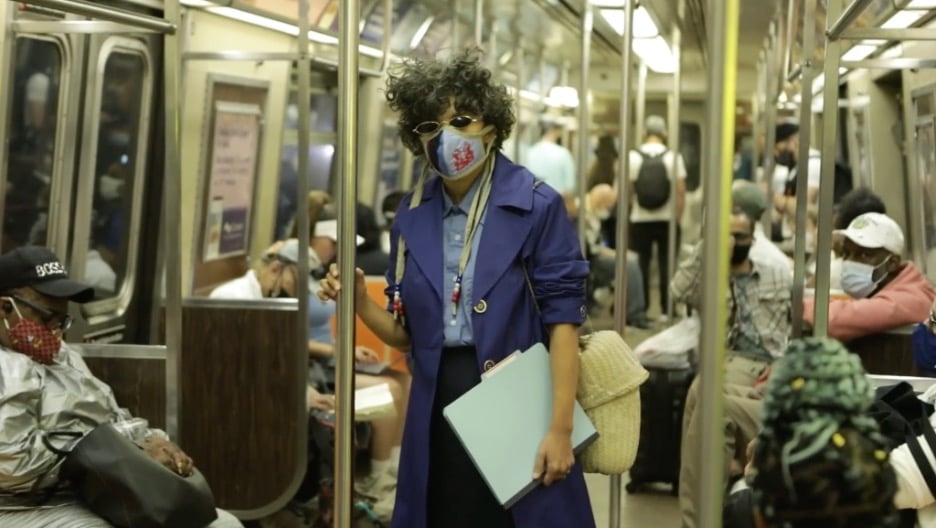
The opening scene of her video presents Cruz dressed as the investigator, donning a face mask with two red fists breaking free from chains fastened around their wrists. Centered in the frame, she stands in the middle of the A train heading to Washington Heights, holding onto the grab bar, and clutching a pale-blue folder that my eyes fixate on. Two visual elements anchor her costume. If the red fists are suggestive of the investigator’s emancipatory political commitments, that pale-blue folder contains the curriculum she has crafted for her inquiry. Inside, letter-sized sheets of paper carry the questions she has prepared for the participants she’s yet to encounter, but whose anticipated presence already shaped her curriculum. In this way, Cruz—the person inhabiting the role of the investigator—has inscribed participants into the curriculum from the beginning. However, this curriculum has space for the participants to complicate those inscriptions during the encounter. Rather than unidirectionally centering herself as the facilitator of political consciousness, or flatly highlighting the agency of her participants, Cruz’s curriculum is realized through a set of interview questions that constitute a pedagogical encounter that carefully unearths and subtly critiques the everyday racial ideologies among Dominican participants.1
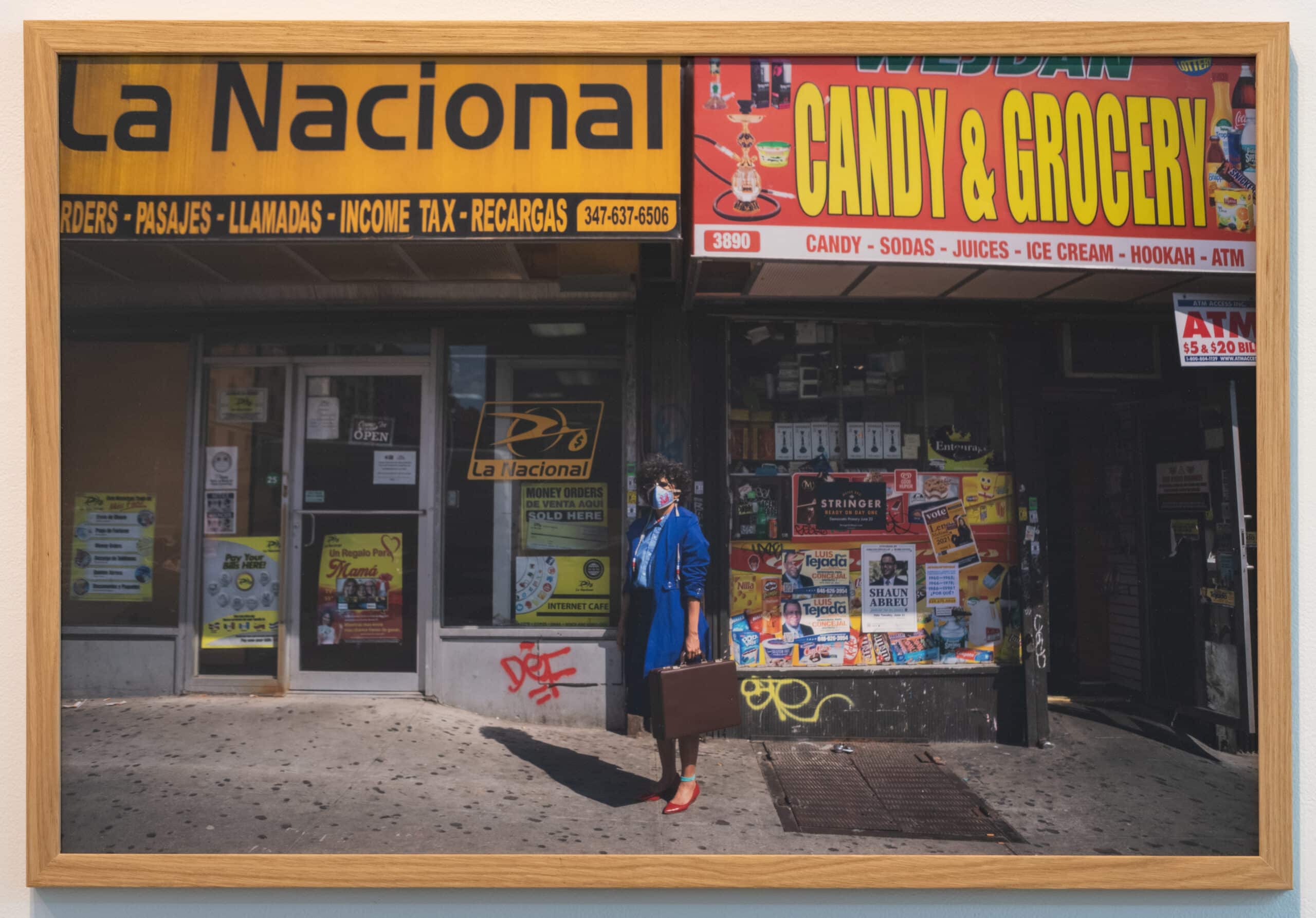
The investigator steps off the train and into the streets, walking down sidewalks filled with Dominican street vendors sitting on plastic stools underneath large umbrellas, shielding assemblages of commodities set up on plastic tables, while the artist stands in front of them, clipboard in hand, posing questions: “Do you consider yourself Black or Indigenous?” The question seems simple enough at first, maybe even a bit blunt. But the answers that ensue reveal the contradictory truths that Cruz presents us with. “I am a mixture of both . . . a mixture that is not there,” the man says, his pandemic mask lowered below his chin, gesturing at Cruz’s clipboard and investigatory folder that holds the interview questions, immediately interpellating it as a bureaucratic curricular form—a piece of paper complicit in the siloed systems of racial classification; an artifact of a system that subsumes phenotypical features into racial registers, legible to the lingering colonial gaze; and an artifact suggestive of a school worksheet and demographic survey, twin technologies of categorization. It’s not clear whether the participants recognize that their participation is itself foundational to the artwork, and this indeterminacy creates space for the interaction to be open-ended. Aside from the artist’s inhabiting of the investigator’s position—long coat, buttoned-up shirt tucked into a long skirt, the aforementioned clipboard and attendant research materials—there is no script being followed here, and the remuneration for participation comes in the form of a gift pencil, alongside an invitation to learn more about the project through contacting the artist.
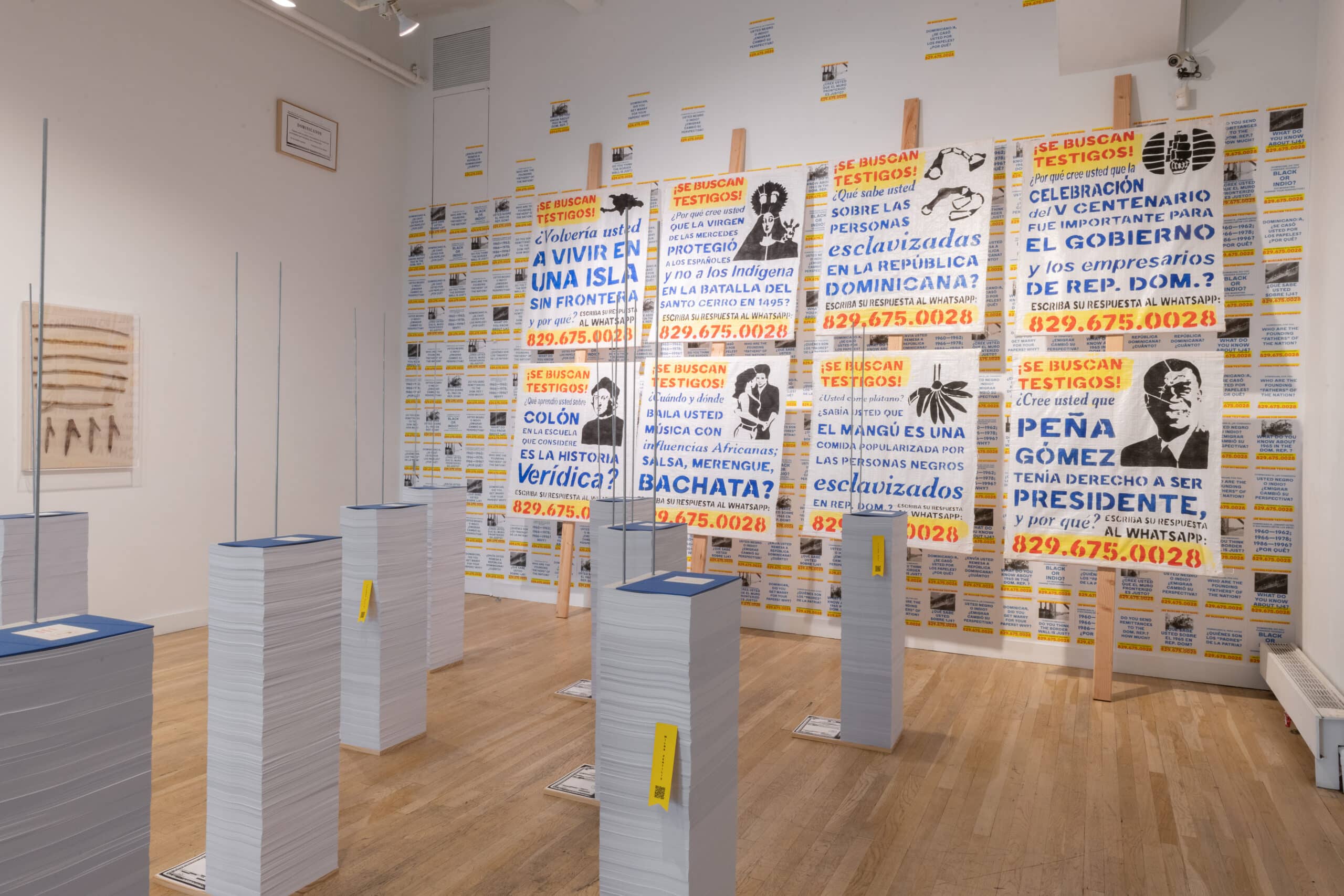
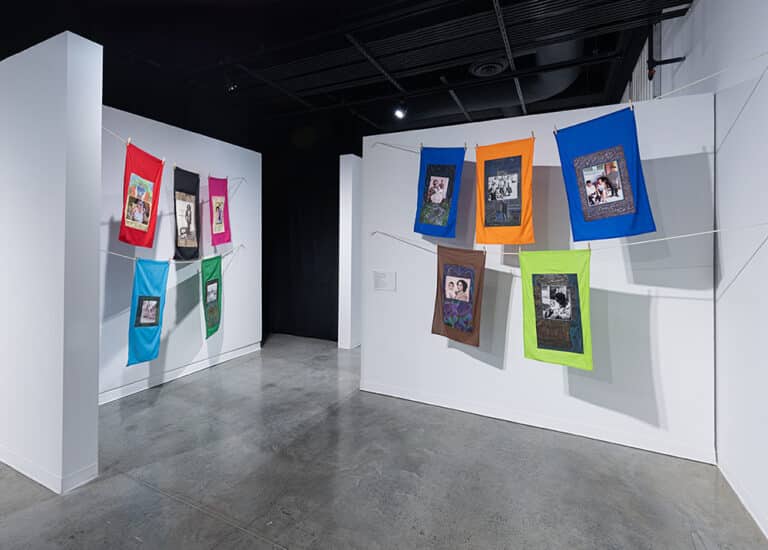
The street encounters form one component of a gallery installation, where the video component plays in a loop alongside printed works that translate the dialogues into other modalities, most centrally a series of prints. In one, titled Evidencia 026: Terminología del Mestizaje [Evidence 026: Terminology of Miscegenation] (2021), a horizontally oriented grid features eighteen rectangular spaces, displaying a racial category constructed through Spanish colonialism as each grid’s title: Negro, Mulato, Pardo, Tercerón, Cuarterón, Mestizo . . . Under the racial categories are red and black fingerprints that are pressed onto the individual grids—all of them filled but one, Pardo—indexing the identity categorizations that the participants in the piece highlighted in their talks with the investigator.
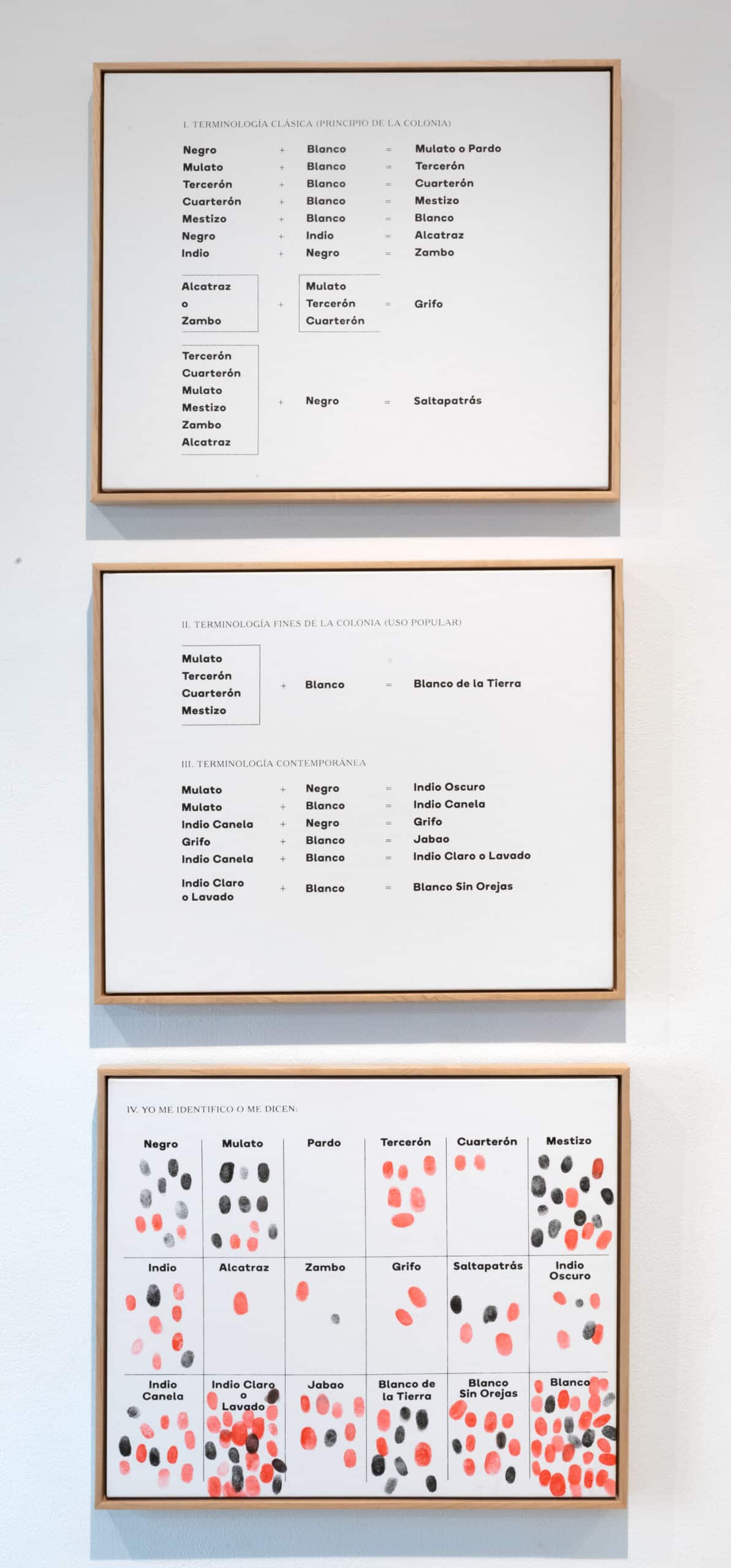
The presence of these fingerprints is striking: that participants identified, or were identified by others, through these terms makes clear the ongoing presence of the colonial categories. But the fact of their existence may not surprise many viewers, well aware of the reproduction of racial categories in the present. What is Cruz trying to accomplish through displaying what amounts to a frequency table of racial classifications? Is it the ubiquity of the colonial categories? Is it the skewed distribution, with “Indio Claro” and “Blanco” seemingly having the most representation–an indication of the prevalence of White(r) identities among participants? Cruz complicates these questions, sharing that most participants would “not be categorized as White . . . but they do feel like such. So where does that come from?”2 The distance between how participants might be perceived and how they perceive themselves is one of the crucial sites of learning and inquiry. Cruz’s emphasis on including categories that reproduce anti-Black and colorist hierarchies within her installations suggests that confronting these racial ideologies means learning the roots of their reproduction.
Cruz’s interventions exemplify how gestures within participatory art can be thoughtfully pedagogical in their structure. In the same way that she leaves open-ended space for viewers to puzzle over the distribution of racial identifications in her prints, she opens a similar space in her video works through sequences of interviews where a variety of racial discourses are articulated. Within the context of a single interview, she displays a dialogical style that engages participants without shaming them, even when they articulate views shaped by anti-Black and colorist logics. In conversation, Cruz explained to me that, “specifically with the investigation work, I am trying to not superimpose something on people, and I’m working against shaming, and more finding a way of walking people through their thinking: ‘Okay, you think this way perhaps because you’ve been conditioned in X, Y, and Z forms to think this way.’”3
Cruz’s video documentation highlights this approach through moments when she reflects back a participant’s framing within a wider historical or political horizon rather than correcting it, or poses an open-ended but direct question, so that the participant has room to keep thinking aloud. Here, curriculum theorist Ted Aoki helps. Aoki distinguishes “curriculum-as-plan,” the codified roadmap of objectives, materials, and methods, and “curriculum-as-lived-experience,” the emergent encounter that always exceeds the plan.4 Cruz’s installation makes both formally visible: her screen-printed posters, prepared questions, and diagrammatic prints compose a curriculum-as-plan; the video documents the curriculum-as-lived-experience that unfolds when the plan meets the street. What her practice adds is a further move—curriculum as aesthetic form—where both registers are converted into compositional material and held in tension. Her research materials compose a type of curriculum, a set of objectives for the participatory interactions she designs. In the context of anti-Blackness and anti-Indigeneity, this curricular design is provocative, and its results surface in the video’s dialogical interactions. Cruz is regularly shown leading with this question, and the participants have lively responses. This pedagogical encounter is simultaneously guided, facilitated, and mediated by the curricular materials that Cruz has developed. But it’s also open, with space to breathe, with space for participants to shape the interaction as it unfolds.
This dialogical pedagogy is not a simple achievement; it reflects a nuanced response to the colonial racial ideologies that continue to shape national consciousness in the Dominican Republic and far beyond it. It’s not always clear if the dialogical engagements that form the heart of Cruz’s work act in ways that transgress the racial order, or risk reproducing it by not pushing back on participants’ adherence to the categories. The indeterminacy makes for a precarious situation: are participants transforming their racial ideologies through these engagements, or potentially reifying them? The outcome is not determined in the video work, nor in the resulting prints and ephemera.
The indeterminacy that I sense is part of what makes it simultaneously thought-provoking and troublesome. What helps resolve it for me is the way curricular materials constitute her on-the-street engagements: she draws on a bureaucratically planned set of forms and simultaneously enacts and transforms them through her dialogues with participants; they shape the encounter as much as they are shaped by it. This dynamic carries forward into the prints that circulate in her installations, as the visitors exit the exhibition and walk back out into the street, potentially beginning another iteration of the inquiry. This is the heart of the curricular form that Cruz invites us to consider: the circulation of inquiry, of learning, and, yes, of teaching is composed and recomposed through the dynamic between bureaucratic planning materials and lived engagements with the materials. The curriculum is a moving contradiction that is at once fixed and fluid, and each iteration opens space for new questions to be asked, for colonial knowledge to be challenged, and for new relationships to blossom.
Endnotes
- For a discussion of pedagogical encounters, see Shirin Vossoughi and Miguel Zavala, “The Interview as Pedagogical Encounter: Nurturing Knowledge and Relationships with Youth,” in Critical Youth Research in Education: Methodologies of Praxis and Care, ed. Arshad Imtiaz Ali and Teresa L. McCarty (Routledge, 2020), 136–54. For a discussion of racial ideologies among Dominican participants, see Alex Santana, “Archival Irreverence,” CUE Art Foundation, June 25, 2021, https://cueartfoundation.org/young-art-critics-essays/archival-irreverence-alex-santana. ↩︎
- Lizania Cruz, communication with the author, May 22, 2026. ↩︎
- Lizania Cruz, interview with the author, February 2, 2026. ↩︎
- See Ted T. Aoki, “Legitimating Lived Curriculum: Towards a Curricular Landscape of Multiplicity,” Journal of Curriculum and Supervision 8, no. 3 (1993): 255–68. ↩︎
Cite as: Alex Feliciano Mejía, “The Investigator’s Folder: Curriculum as Form in Lizania Cruz’s The Investigation of the Dominican Racial Imaginary,” in X as Intersection: Writing on Latinx Art, September 14, 2026, accessed [DATE], https://uslaf.org/essay/the-investigators-folder-curriculum-as-form/.
Alex Feliciano Mejía is a writer, filmmaker, and educator focused on archives, displacement, and cultural memory. His projects involve cataloging, digitizing, and preserving film archives in Guatemala, and interrogating archival tensions through poetry and filmmaking. He teaches courses on multilingual and media arts pedagogies at San Francisco State University.