Ongoing Contestations: Kathy Vargas’s My Alamo
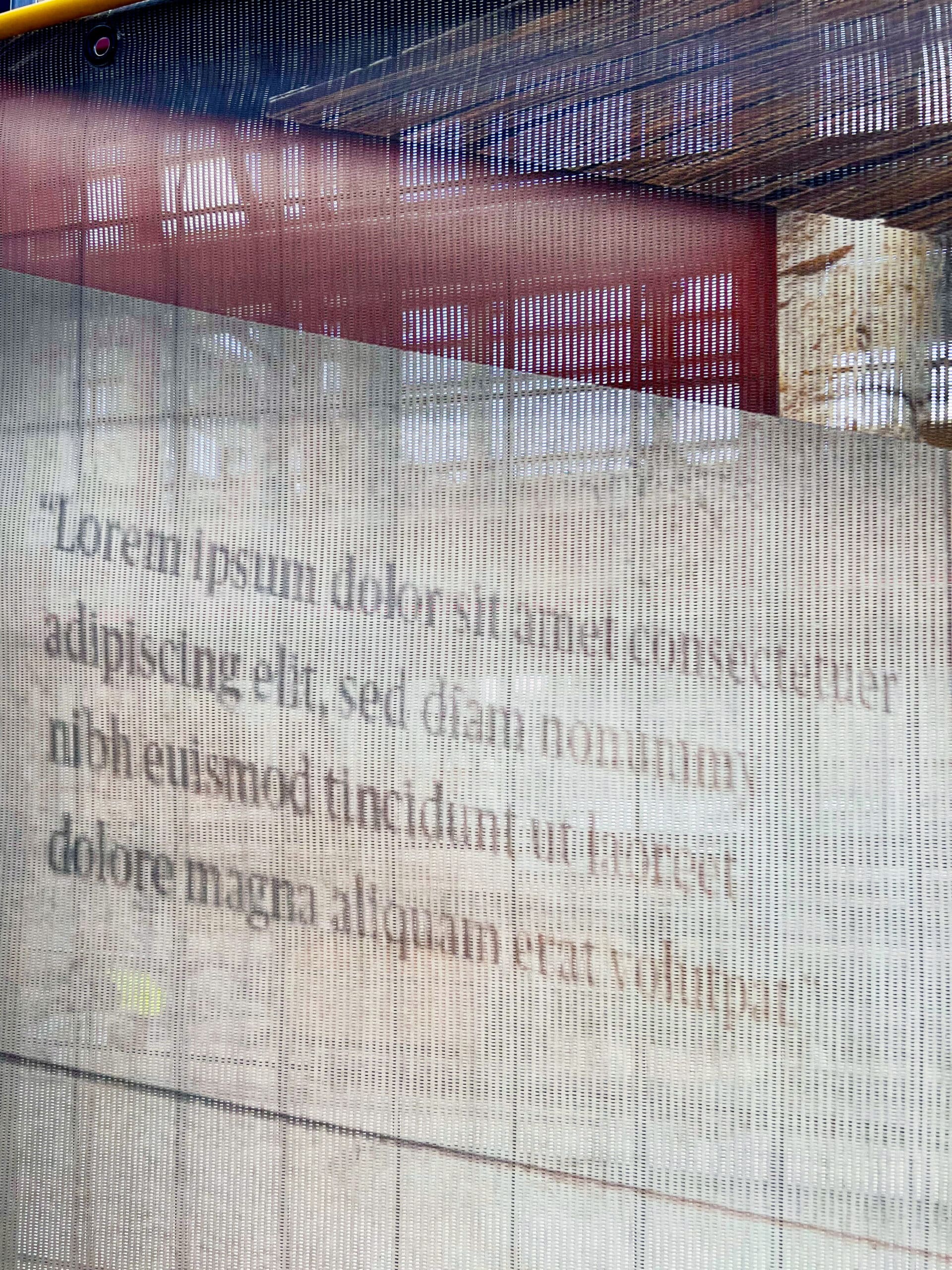
Near the iconic Spanish colonial mission in downtown San Antonio, a construction crane bearing a weathered Texas state flag sat idle at the Alamo Visitor Center and Museum, scheduled to open in 2028.1 A tall metal fence covered with windscreens obscured the worksite and repeated the message “The AlamoTM/Pardon Our Dust/History in the Making.”2 The temporary barrier doubled as an advertisement for what the future might hold: a panoramic series of architectural renderings picturing visitors of various races and ethnicities standing like lifeless mannequins inside luminous galleries displaying historical artifacts. Beneath the exhibition wall headings “The People of Béxar” and “San Antonio at the Turn of the Century,” lorem ipsum served as nonsensical placeholders for text panels yet to be written.
The content of those undetermined didactics had recently become even more uncertain following the forced resignation of Kate Rogers, the Executive Director of the Alamo Trust, who oversaw the redevelopment of the museum galleries. Drafts of the didactics had faced scrutiny from a Republican-led review, which criticized them for incorporating “woke” language and “the ‘oppressor/oppressed narrative’ peddled by academic historians and activists.”3 The ongoing culture wars have stoked disputes surrounding acceptable historical interpretations of the Alamo within educational and museum contexts. Yet while the contemporary political landscape is often characterized as “unprecedented,” debates surrounding the Alamo as an emblem of Texas patriotism long precede these latest controversies.4
Born in San Antonio in 1950, Chicana-Tejana artist and photographer Kathy Vargas has spent decades examining the contentious legacy of the Alamo and its function as “a racial-ethnic dividing line.”5 This critical lens is exemplified in her photographic series, My Alamo (1995), which was commissioned for the exhibition From the West: Chicano Narrative Photography, curated by Chon A. Noriega and held at the Mexican Museum in San Francisco.6 Vargas’s series invites a deeper examination of the historical and cultural implications surrounding this iconic site. For My Alamo, Vargas utilized a large-format 4 × 5-inch view camera to create twelve silver gelatin prints, which are presented in diptychs. These photographic works feature a combination of multiple exposures and photomontage techniques. Intent on bringing explicit criticality to her imagery of the Alamo, Vargas inscribed handwritten commentary directly onto the prints with colored pencil, adding another layer to the compositions.
Throughout her artistic practice, Vargas has worked exclusively in analog photographic techniques. Her distinct visual language and emphasis on the materiality of photography mark a deviation from traditional, so-called “straight” photography, which has emphasized sharpness and prints produced from single negative frames. As Irma Mayorga notes, “Vargas’s latter work has migrated towards thoughtful and thought-provoking reckonings with the tensions between portraying ‘reality’ (taking pictures) and capturing the less tangible contexts that generate and circumscribe those ‘realities’ (making pictures).”7 My Alamo presents an autobiographical arc of how Vargas’s accumulated experiences and memories led her to interrogate the racial and settler-colonial complexities of the so-called “shrine.” The diptych format, reminiscent of traditional altarpieces, juxtaposes Chicana-Tejana histories and experiences with the prevailing values that were enshrined at the Alamo. Within each diptych, Vargas places competing narratives in dialogue: one side depicts a photographic restaging of a familial anecdote, personal recollection, or contemporary incident; the other distills the dominant power structures defended at the Alamo into their most potent and popular symbols.8
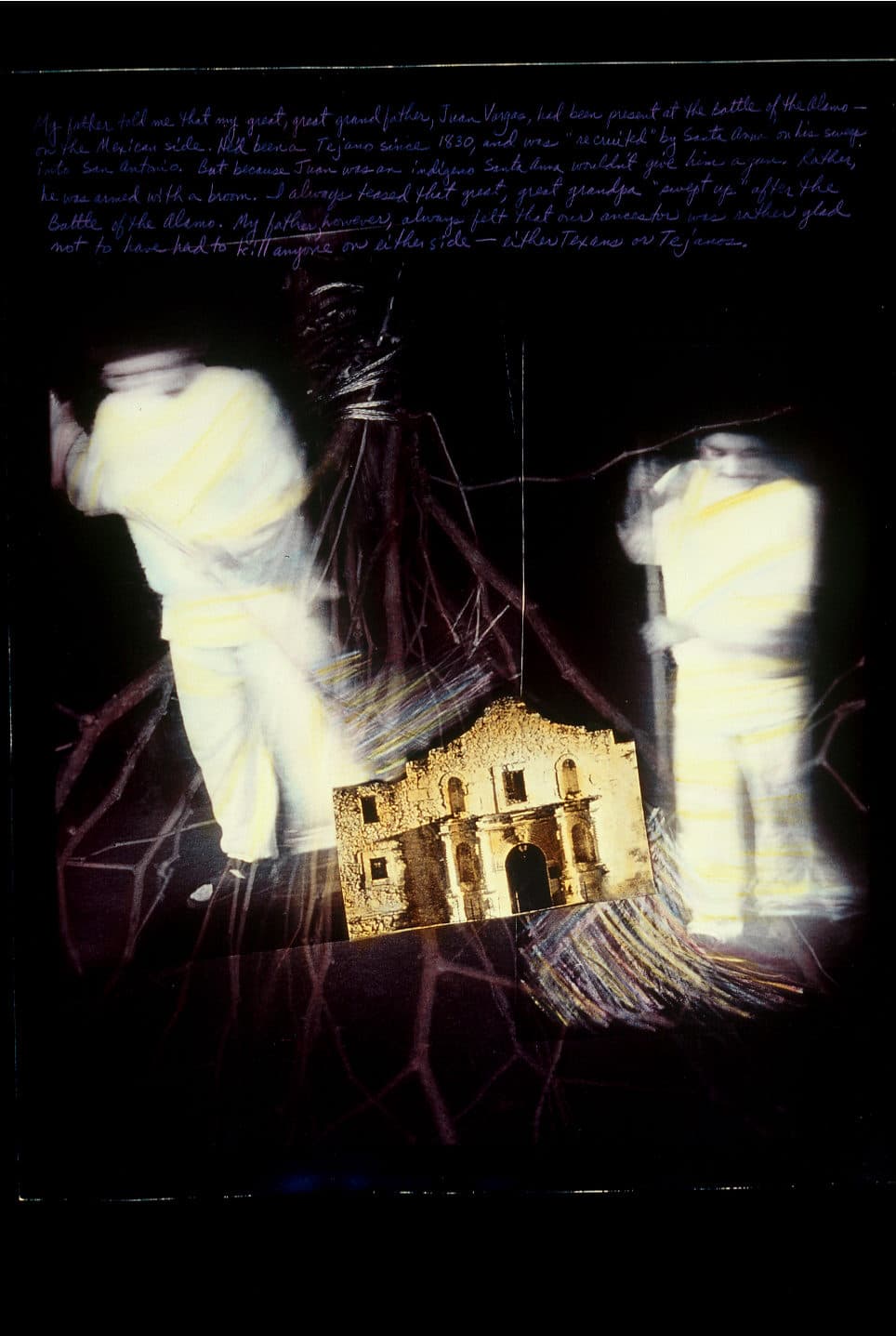
Vargas traces her paternal lineage in San Antonio back several generations, beginning with her great-great-grandfather, Juan Vargas, who was born in 1795 in Oaxaca, Mexico, and arrived in San Antonio in 1830.9 In 1910, a San Antonio newspaper published an account detailing Vargas’s captivity under General Antonio López de Santa Ana, during which he was left unarmed and compelled to perform menial labor around the camp. He refused to enter the Battle at the Alamo but bore witness to the slaughter and “uncounted dead” buried in trenches.10 The artist’s statement accompanying My Alamo frames the series as a reckoning with a familial inheritance: “Even before I was born, the Alamo figured in family history and identity.”11 Appropriately, the series commences with a reenactment of the sweeping labor performed by her ancestor, which Vargas pairs with a pistol framed by a matte stamped with silhouettes of the mission.
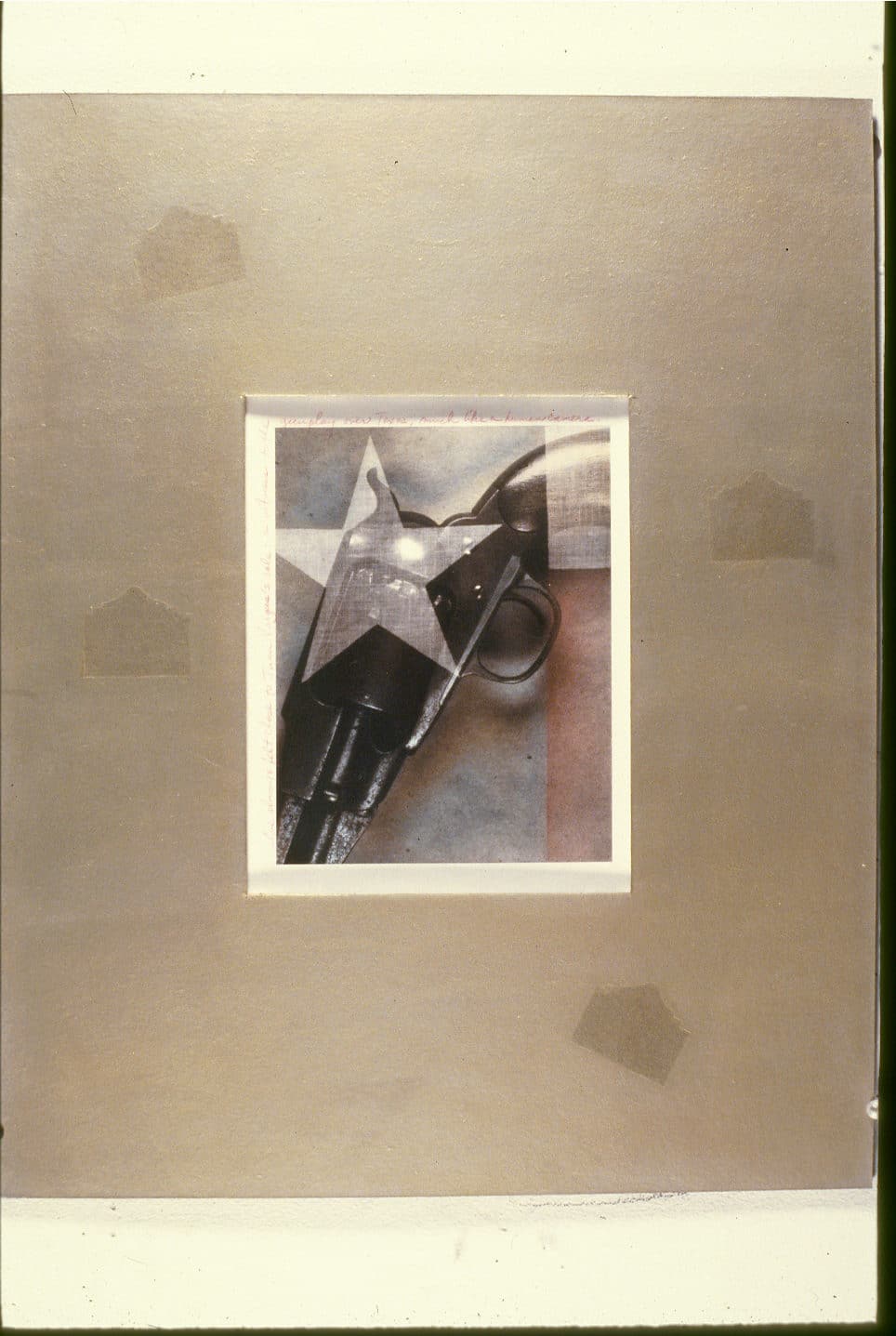
(Right) Kathy Vargas, My Alamo, #1b (1995). Mixed media with hand-colored gelatin silver print, 10 × 8 inches, on 20 × 16-inch metal and archival matte paper. Courtesy of the artist.
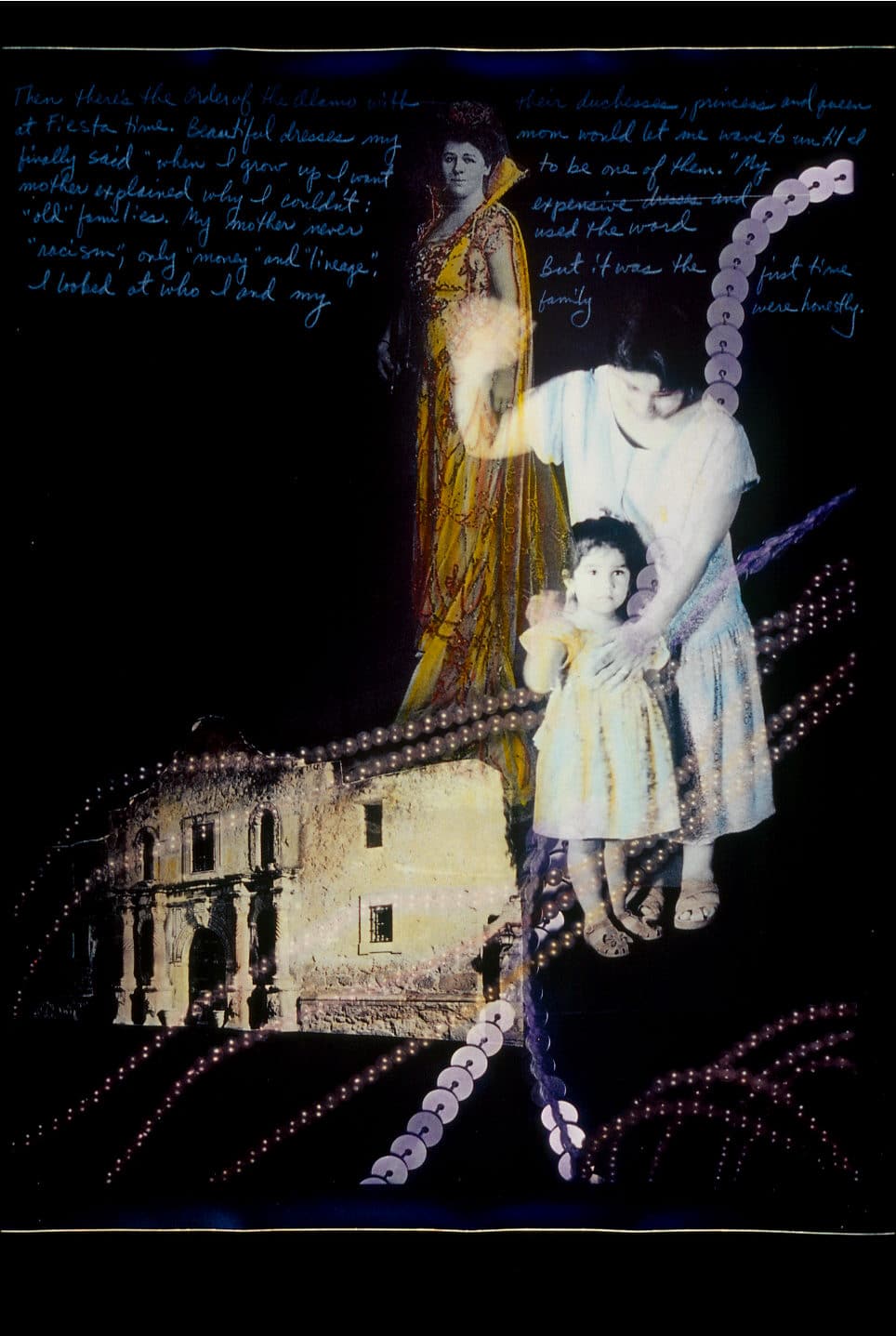
The series subsequently navigates through Vargas’s childhood memories and her emerging racial consciousness, announced in her refusal to don a Davy Crockett–style hat, given the incongruity of Crockett’s role in the murder of Indigenous peoples and her family’s claims of Aztec ancestry. Its corresponding print reproduces an illustration of Crockett superimposed on a papel picado banner shaped like the Alamo. The series then recalls Vargas’s girlhood spectatorship of the elite social ritual of Fiesta San Antonio, a parade and citywide celebration established to commemorate heroes of the Texas Revolution, which she encapsulates in a close-up of regalia finery. Continuing her biographical arc, the subsequent diptych centers on the artist’s teenage encounter with the filming of the comedy Viva Max! (1969) and its circulation on VHS tape, seen in the opposite print.
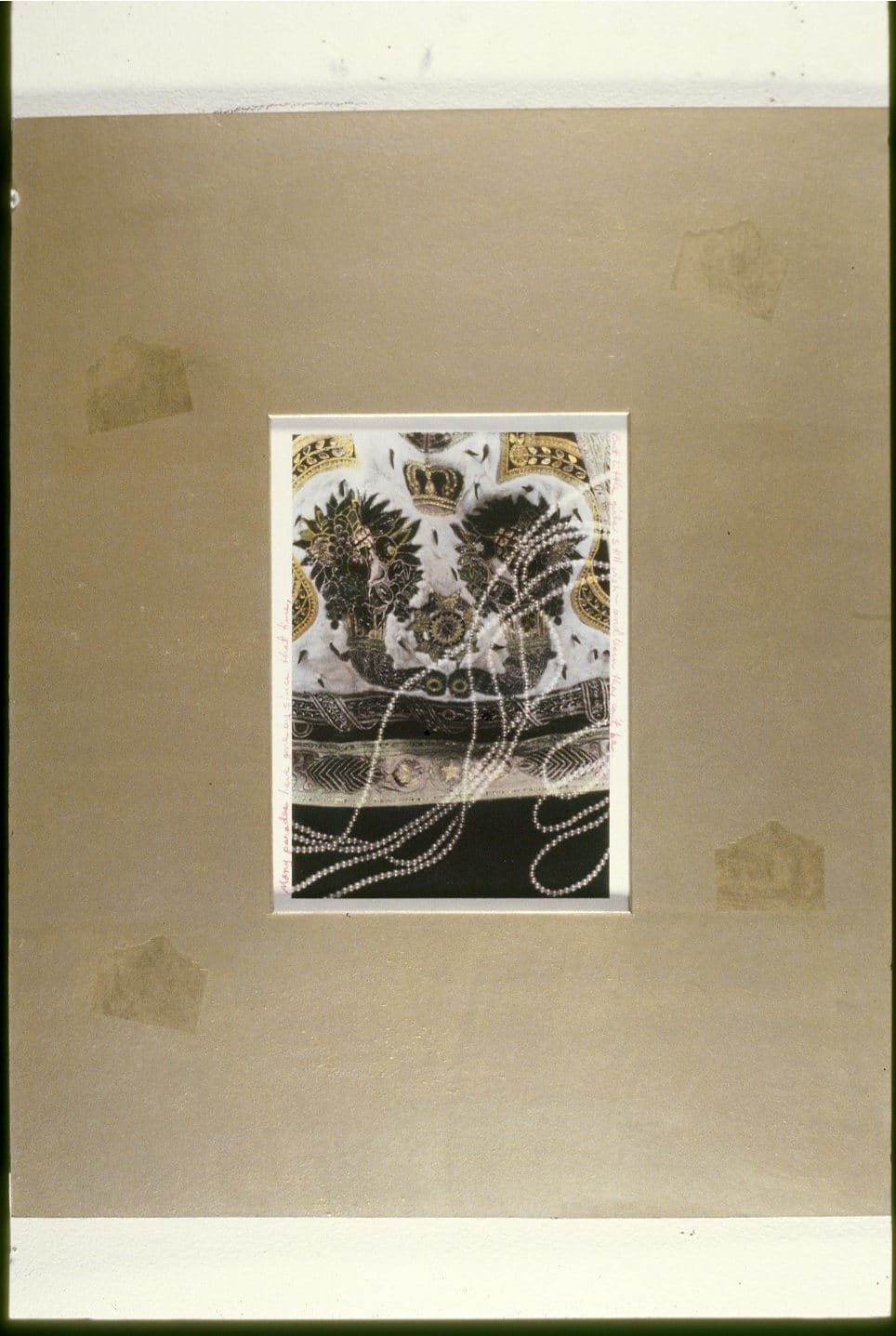
(Right) Kathy Vargas, My Alamo, #3b (1995). Mixed media with hand-colored gelatin silver print, 10 × 8 inches, on 20 × 16-inch metal and archival matte paper. Courtesy of the artist.
As the series transitions into her adulthood, the fifth pairing discusses the threatened displacement of raspa sellers from Alamo Plaza due to their “inappropriate” visibility near the historical landmark.12 Officially authorized memorabilia, including a felt pennant souvenir representing the Alamo, toy knife, and product known as Alamo Crackers, serve as counterpoints to the precarious positions of the Latino street vendors and highlight the hypocritical logic of their proposed expulsion. Finally, the concluding diptych recounts a 1982 public intoxication incident involving Ozzy Osbourne, who was banned from San Antonio and later apologized with a monetary donation. Considered “sacrilege,” the episode brought clarity to Vargas’s “ambiguous relationship with everything Alamo.” The United States currency in the accompanying print represents the systems that govern the Alamo and the financial gains derived from its managed legacy.
According to Vargas, her decision to incorporate text into My Alamo stemmed from a desire to document her family’s history and her own relationship to the mission and its reverberations. Rather than leaving the interpretation of these photographic images to the viewer, Vargas’s handwritten accounts intervene in the frequent treatment of photographs as mere illustrations of historical events. Furthermore, her inclusion of text enables greater precision in her meaning, thereby granting her authorial control over a historical narrative often dominated by Anglo- and settler-colonial perspectives. Her use of handwritten text first appeared in Codex Not-Vargas: The Forgotten Name, a hand-colored photographic triptych with graphite inscriptions on paper created on the occasion of the exhibition The Chicano Codices: Encountering Art in the Americas (1992).13 These handwritten passages are not only informed by the transmission of Indigenous knowledge through codices but also by contemporary life-writing genres, as theorized by Chicana feminists Gloria Anzaldúa and Norma Elia Cantú, which validate the lived experiences of marginalized subjects.
Within the multigenerational chronology of the series, Vargas protects the legacy of her great-great-grandfather, Juan Vargas. Whereas settler-colonialism gunslinging mythology frames her great-great-grandfather’s unarmed labor at the Alamo as emasculating, the opposite panel of the diptych counters this logic and resists the romanticization of violence. Inscribed along the edges of a hand-tinted photographic print of an overlapping pistol and Texas flag, Vargas’s cursive handwriting states, “My father, however, always felt that our ancestor was rather glad not to have had to kill anyone on either side—Texans or Tejanos.” In light of the pervasive visual culture that exalts settler-colonial fantasies and bloodshed as a necessity of nation-building, such an interruption is critically needed. The diminutive scale of the artist’s handwriting requires one to look closer—an exercise that places responsibility on the viewer to not only do the work of reading but also to reassess taken-for-granted narratives from critical perspectives.
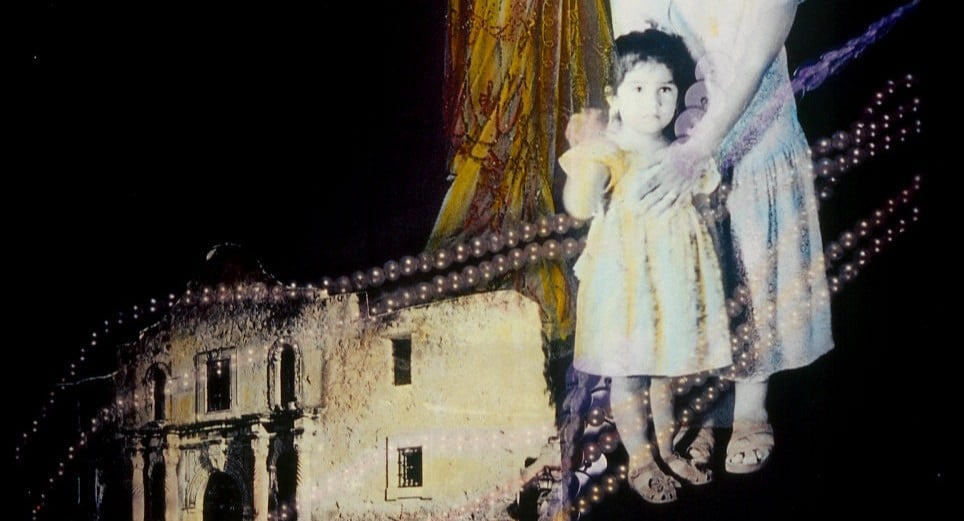
In conjunction with the texts, Vargas’s layering of photographic images and found materials unsettles the use of photography as an opaque and evidentiary historical source. Returning to the third diptych, Vargas stages a scene from her childhood, when she and her mother watched the parade of the Queen of Fiesta and her presiding court. Within the composition, she places a newspaper reproduction of the first Fiesta Queen behind the mother and child whose blurred hands wave toward an unseen procession. Metallic sequins and gleaming pearls snake across the photograph and the Alamo façade in the lower left-hand corner. As a child, Vargas was dazzled by the opulence, a sensorial effect conveyed through her hand coloring of the gown. Written across the top and flanking the queen, Vargas remembers sharing her aspiration to become a queen. “My mother explained that I couldn’t be: expensive dresses and ‘old’ families, she said. She never used the word ‘racism,’ only ‘money’ and ‘lineage’—but I got the message.” The hand-tinted style of the series may evoke nostalgia for an imagined past; however, Vargas’s textual recounting offsets the sentimentality one might assign to this photograph and its subject, grounding its imagery in a precocious racial and class consciousness.
During my conversation with Vargas, I asked her what she hoped viewers across generations might take away from the series three decades after its making. No matter their race or ethnicity, she stated, “I hope they find themselves in it,” echoing an intention for the series she had previously expressed.14 To emplace Vargas’s series within a present-day context, I made the short drive to the Alamo to see what (dis)identifications might arise from my positionality as a millennial San Antonio-born Tejanx descending from Coahuila. My trip ended at the Long Barrack, where tourists immersed themselves in an augmented reality experience, and life-size depictions of historical figures betrayed distortions characteristic of AI-generated images. The integration of new technologies attempted to situate contemporary audiences within historical settings, but, in effect, they only further alienated the present from the past. The estrangements provoked by these computer technologies stood in stark contrast to Vargas’s analog photographic practice and the recognizably human narratives that form the core of My Alamo. The significance of the series, three decades after its making, became all the more potent as I struggled to relate to the textual displays and exhibits, despite my own ancestral connections to this region.
At the end of my visit to the Alamo, I stood near a commemorative plaque installed by the Daughters of the Republic of Texas and overheard a tourist ask a docent, “Who does the Alamo belong to?” This inquiry of possession and affinity was so germane to Vargas’s series and the occasion of my visit that it seemed almost too fortuitous.
Endnotes
- “Visitor Center and Museum,” The Alamo, accessed January 5, 2026, https://www.thealamo.org/support/alamo-visitor-center-museum. ↩︎
- I visited the Alamo on December 22, 2025. ↩︎
- Sherry Sylvester, “a close political aide to Lieutenant Governor Dan Patrick,” was tasked with “reviewing” the text panels and wrote the memo detailing revisions to terminology and framework. Sylvester is now a member of the Alamo Trust, Inc. Board of Directors. Forrest Wilder, “A Memo Obtained by Texas Monthly Reveals How State Leaders Are Rewriting the History of the Alamo,” Texas Monthly, November 18, 2025, https://www.texasmonthly.com/news-politics/alamo-rewrite-dan-patrick/. ↩︎
- When tourists visit the Mission San Antonio de Valero (founded in 1718), now known as the Alamo Mission, and its adjacent area, they traverse the burial grounds of Indigenous people who underwent Catholic conversion as well as those of early Spanish colonists. Reflecting this fact, members of the Tāp Pīlam Coahuiltecan Nation have taken legal action to assert their right to practice religious ceremonies at the Alamo and to advocate for the designation of the site as a cemetery. Simon Romero, “Burial Ground Under the Alamo Stirs a Texas Feud,” The New York Times, November 25, 2021, https://www.nytimes.com/2021/11/25/us/alamo-burial-native-americans.html. ↩︎
- Kathy Vargas, in conversation with the author, University of the Incarnate Word, December 22, 2025. ↩︎
- In addition to Vargas’s series, the traveling exhibition featured newly produced works by Chicano/a photographers Robert C. Buitrón, Christina Fernandez, Harry Gamboa Jr., Miguel Gandert, and Delilah Montoya. ↩︎
- Irma Mayorga, “Our Alamo: Resistant Theatricality in Kathy Vargas’s ‘My Alamo’ Series,” Women’s Studies 38 (2009): 315. ↩︎
- Vargas, December 22, 2025. ↩︎
- Yolanda K. Parker, “Juan Vargas: Eyewitness to History and Centenarian of San Antonio,” Handbook of Texas Online, May 25, 2022, https://www.tshaonline.org/handbook/entries/vargas-juan. ↩︎
- Vargas reportedly lived to be 114 years old. Louis De Nette, “This Man Was Old When Santa Ana Spilled Blood in Alamo and Built Texan’s Funeral Pyre,” San Antonio Light and Gazette, April 3, 1910. ↩︎
- Kathy Vargas, “My Alamo,” in From the West: Chicano Narrative Photography, exh. cat., ed. Chon A. Noriega (The Mexican Museum, 1995), 72. ↩︎
- In 1987, the San Antonio City Council sanctioned a plan to restore the Alamo to its “hallowed ground” status by prohibiting traffic and eliminating “clutter and commercial interests.” This initiative targeted raspa street vendors, whom the plan recommended be moved to the southern periphery of Alamo Plaza where they would be required to use pushcarts and adhere to a dress code. Susie Phillips and Rolando Martinez, “DRT Opposes Alamo Plaza Plans,” San Antonio Express-News, August 1, 1987. See also Nancy Perdue, “Battle Cry: Protect Alamo! Shrine Thought Falling Victim to Commercialization,” San Antonio Express-News, February 28, 1987. ↩︎
- Vargas, December 22, 2025. As curator Marcos Sanchez-Tranquilino addresses, “Codex Not-Vargas underscores the loss to Chicanos of all their indigenous names, depicting identity as a strategy of ensuring cultural survival beyond a yearning to recover an irretrievable past as a ‘literal fact.’” Marcos Sanchez-Tranquilino, “The Chicano Codices: Feathered Reflections on an Aztlanic Archaeology,” in The Chicano Codices: Encountering Art of the Americas, exh. cat., ed. Patricia Draher (The Mexican Museum, 1992), 5. ↩︎
- Vargas, December 22, 2025. As Vargas has written, “The construct of the myth of the Alamo is ongoing. Each generation will remake it.” Kathy Vargas, “Revisiting My Alamo,” in Born of Resistance: Cara a Cara Encounters with Chicana/o Visual Culture, ed. Scott L. Baugh and Victor A. Sorell (The University of Arizona Press, 2015), 206. ↩︎
Cite as: Deanna Ledezma, “Ongoing Contestations: Kathy Vargas’s My Alamo,” in X as Intersection: Writing on Latinx Art, September 14, 2026, accessed [DATE], https://uslaf.org/essay/ongoing-contestations-kathy-vargas-my-alamo/.
Deanna Ledezma is a Tejanx scholar specializing in the history and theory of photography and contemporary Latinx art. She is the Writing Lab Director of the Crossing Latinidades Humanities Research Initiative at the University of Illinois Chicago and a co-founder of the Place as Practice Research Collective.