
Between Punchline and Praxis: Chris E. Vargas’s Consciousness Razing
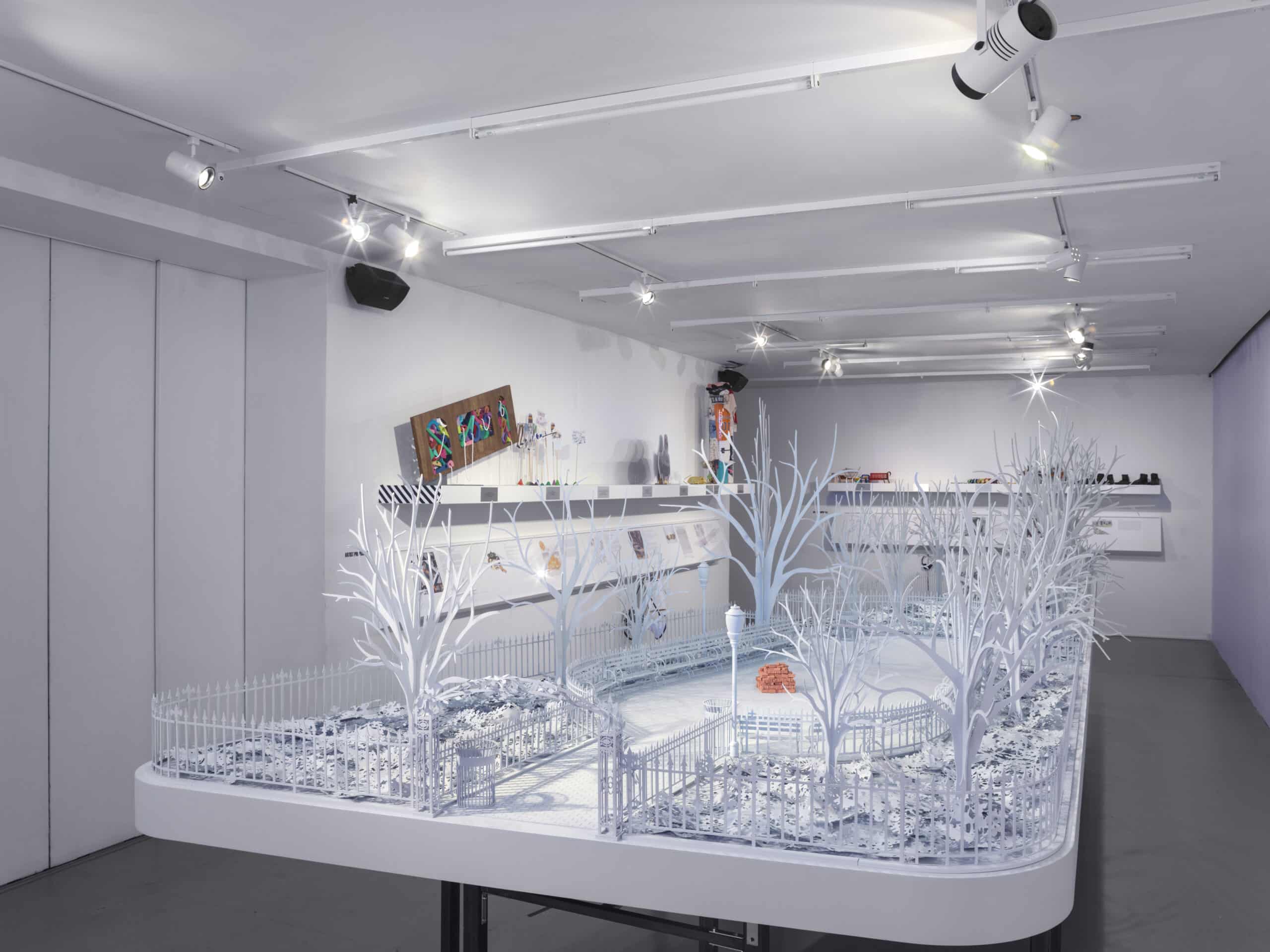
Chris E. Vargas’s Consciousness Razing—The Stonewall Re-Memorialization Project (2018) was installed on the New Museum’s education floor in 2018. The exhibition centered on a 1:7 scale architectural model of Christopher Park, a small triangle of trees and benches in the West Village located across from the Stonewall Inn, where on June 28, 1969, queer and trans patrons fought back against the police after an early-morning raid. The Stonewall Riots mark a milestone in the LGBTQ+ liberation movement and are a historical focal point for Pride marches around the globe: the park is now the site of the National Stonewall Monument and of Gay Liberation (1980), George Segal’s life-size, white-lacquered bronze sculptures of two men standing and two women sitting in the park.
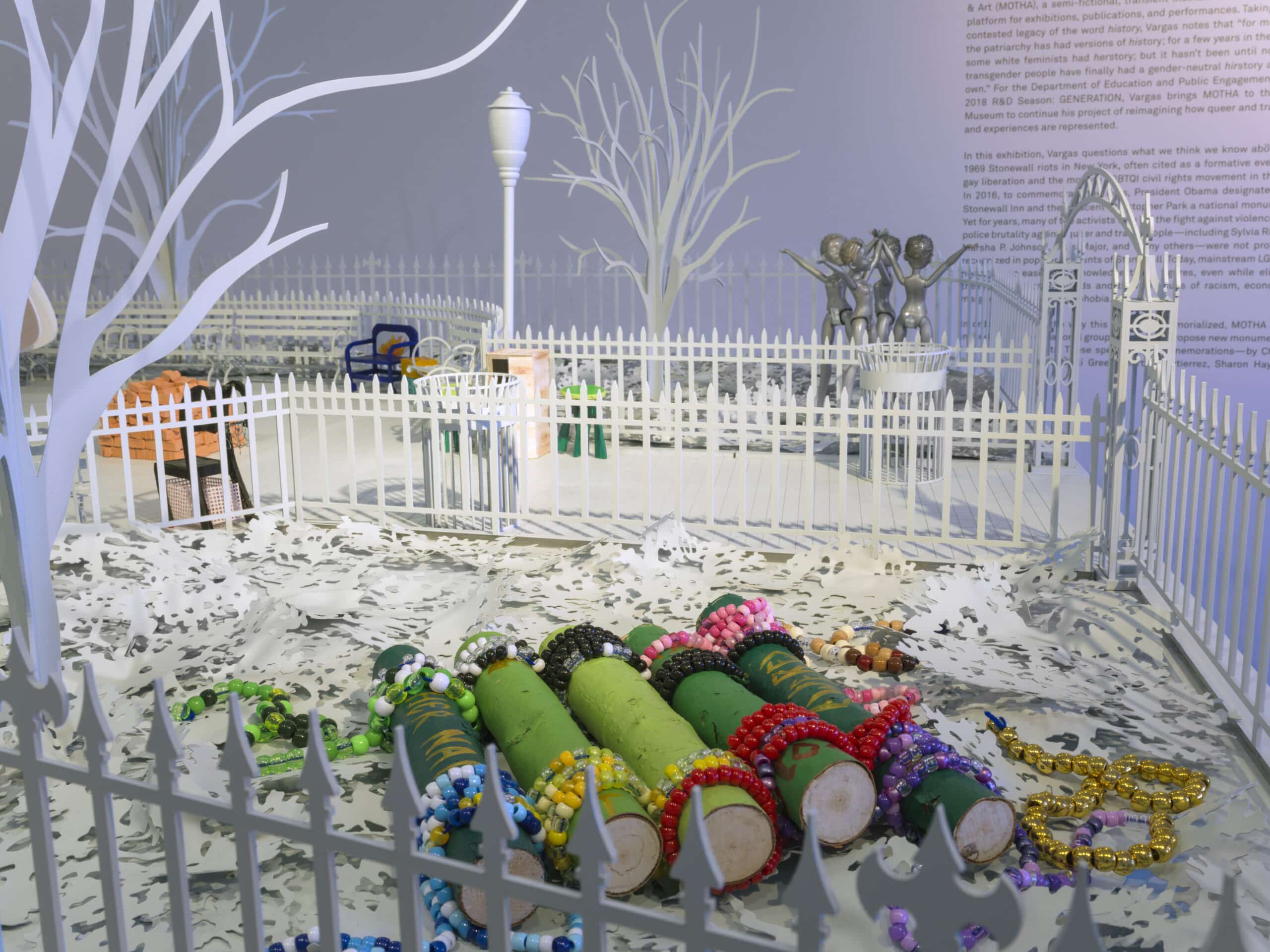
Vargas’s maquette, on a platform in the center of the gallery, omitted Segal’s sculptures, but rendered the park—its pavement, benches, trees, and gates—entirely in their white non-color. The model became a blank canvas for a colorful panoply of miniature monuments by twelve artists invited by Vargas: Chris Bogia, Jibz Cameron, Nicki Green, Martine Gutierrez, Sharon Hayes, Thomas Lanigan-Schmidt, Catherine Lord, Devin N. Morris, D’hana Perry, Keijaun Thomas, Geo Wyeth, and Sarah Zapata. Surrounding walls held each artist’s descriptions of their respective proposals, and an audio guide supplied a mobile “site tour.” The exhibition also included a study center featuring audio such as Sylvia Rivera’s 2001 speech to Latino Gay Men of New York, alongside other materials compiled by the Sylvia Rivera Law Project (SRLP), including a pamphlet called “Tips for Trans People Dealing with Cops.”1 Near the back stairwell of the space was a vitrine of objects with labels explaining their relevance to the Stonewall site and event.2
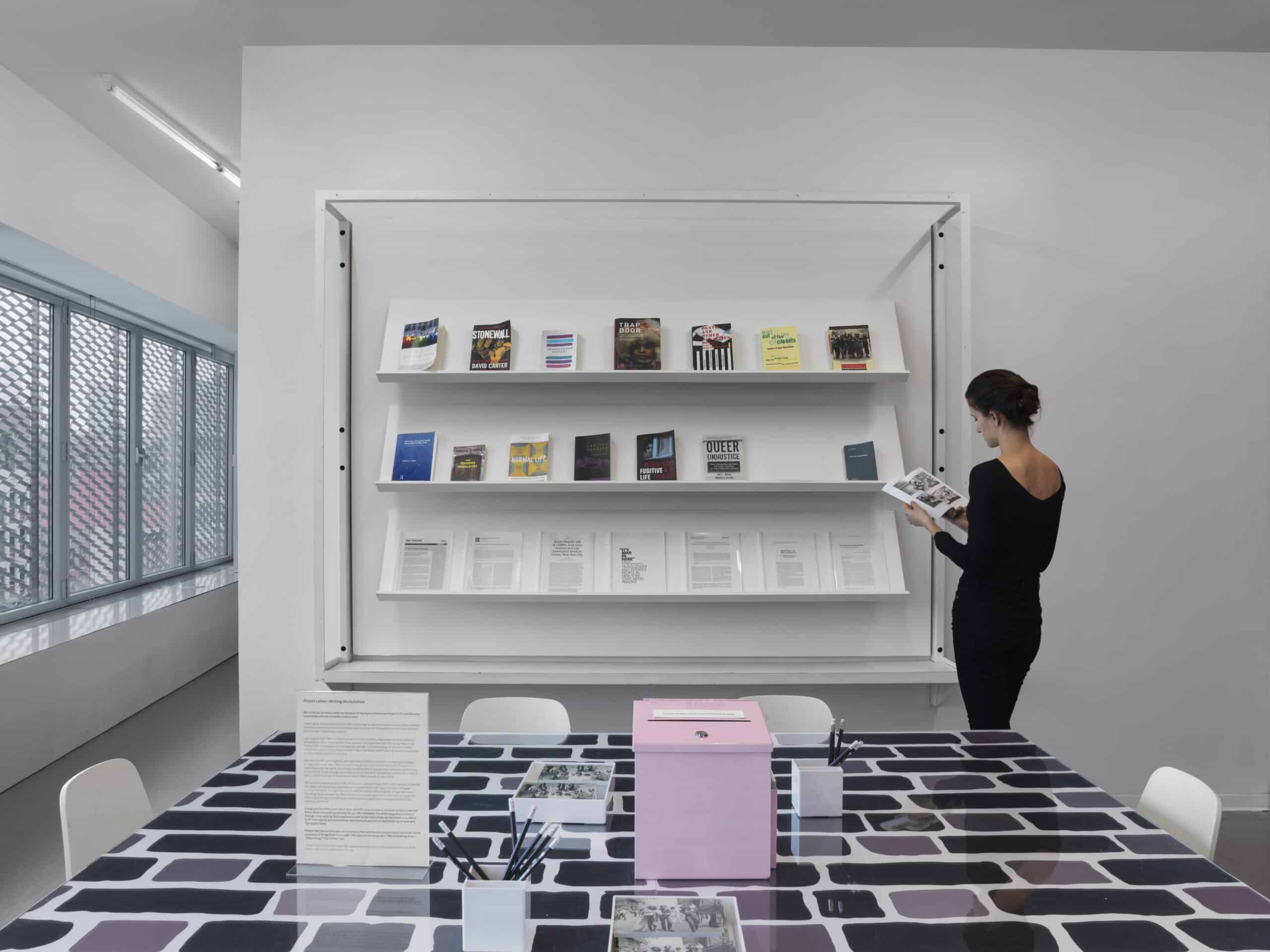
Consciousness Razing is one iteration of Vargas’s ongoing artistic project, MOTHA (Museum of Transgender Hirstory and Art), a conceptual, forever “under construction” institution that, without a permanent space or collection, researches and exhibits objects of trans and gender nonconforming art and history. Using the spaces of established institutions to re-inscribe cis and heteronormative narratives, MOTHA foregrounds trans and queer figures excluded from official archives, while blurring the authority of those archives themselves. In keeping with past MOTHA projects—which often foreground speculative objects, historical lore, and institutional parody—the vitrine included a high heel of the now-late Miss Major Griffin-Gacy; a brick in reference to those ostensibly thrown at Stonewall; a bottle (referring to a planned raid by the Bureau of Alcohol, Tobacco, Firearms, and Explosives); and a fake turd (referring to the real ones allegedly thrown by participants in Stonewall uprising lore).3
I say “ostensibly,” “allegedly,” and “lore” to underscore, as Vargas does, the multiplicity of voices, the erasures of history, the premature deaths of the uprisings’ most marginalized participants, and the incongruous nature of existing accounts. The site of a watershed moment in the movement for gay liberation, the Stonewall Inn became a national monument in 2016.4 In a recent conversation, Vargas reflected on the radically different political context in which Consciousness Razing was realized, contrasting it with today’s conservative backlash, exemplified by Donald Trump’s 2025 order to remove the “T” from “LGBT” on the Stonewall Inn plaque and the National Register of Historic Places website.5
Although the posthumous recognition and cultural influence of Black and Latina trans activists Marsha P. Johnson, Sylvia Rivera, and Miss Major Griffin-Gacy have radically expanded over the past decade, Vargas’s argument for the plurality of voices and the centrality of these figures to the struggle is still timely. As Vargas himself points out, the narrative of Stonewall is revisited with each generation, with new interpretations both adding and obscuring layers of meaning: the intergenerational group of artists that Vargas invites to participate in the project underscores this point.6 Yet, the public site itself, minus temporary and unofficial interventions,7 remains defined by Segal’s two visibly cis, all-white bronzes. When the bronzes were installed in 1992, Johnson herself said, “How many people have died for these two little statues to be put in the park to recognize gay people?”8
Johnson’s comment orients us to the stakes of Consciousness Razing—a project that, in a joyful and disarming way, reveals the limitations of most “official” monuments to express either the human toll of their past or the liberatory hopes of the present. It also brings to mind Paulo Freire’s concept of the limit-situation, which he defines as a highly oppressive, historically-contingent situation.9 Stonewall itself may constitute what Freire would call a “limit-act”—a moment of collective action that recognizes, confronts, and disrupts an oppressive situation, rather than accepting it as inevitable.10 For Freire, the capacity of people to undertake limit-acts toward their own liberation emerges from their conscientização (“consciousness”) of their situation.11 To “raze” consciousness—to reference the pun of Vargas’s title and its associations with not only Freire, but the consciousness-raising of the historical women’s movement—is to reimagine how we might reshape not only our worldview, but our physical reality.12
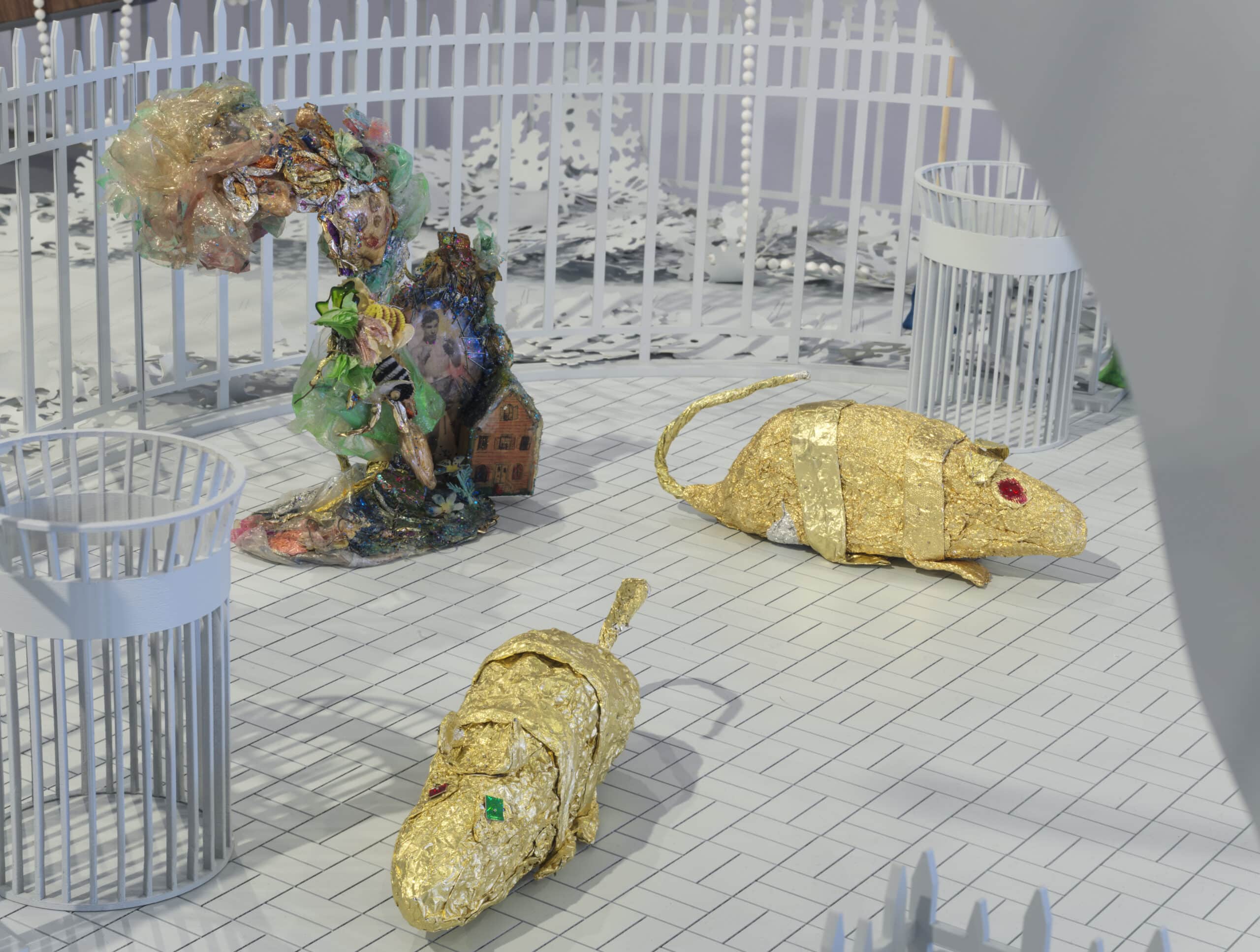
The Stonewall Re-Memorialization Project, (2018). Exhibition view. New Museum, New York. Photograph courtesy of Maris Hutchinson and EPW Studio.
A commitment to re-inscribing the lives of trans people of color into our dominant institutional and historical narratives requires working within them: within the museums, libraries, university departments, and national monuments and other designated historic places in order to deconstruct and make visible their power relations. To achieve this in the space of the museum in particular—the space by which most visual art connects with publics, and the space within which those publics might feel disconnected—is to find novel, effective, and joyful ways to subvert the expectations of the institutional encounter.13 For Vargas, humor is a key strategy, and his project is blithe, pithy, and humorously self-reflexive throughout.
Vargas takes a vernacular approach to media in this work, using recognizable materials—hair ties, foil, cheap dolls—to undercut what viewers might expect to see in a museum space. The entirely white maquette highlighted the conceptually sophisticated, but materially simple sculptures (which he describes as “made of ‘mixed trash’”) that, quite literally, provide all the park’s colors.14
Thomas Lanagan-Schmidt’s proposal placed three rats made of crushed florist foil, with red Magic-Marker eyes: a sculpture made from materials “from the five-and-ten” but that evoked his and his friends’ identity as “street rats” in the 1960s and ’70s, as well as the sparkle of street queens, divinity, and miracles. Keijaun Thomas describes her installation of logs as “connected by hair beads like the kind my momma used to use when she did my sister’s hair.”15 Martine Gutierrez’s proposal for four joined, mirrored, monumental, abstracted gender-ambiguous figures is represented by four Bratz dolls spray-painted silver in a pun on the word “doll” to refer to trans women, as well as a wry nod to the fact that even children’s toys are fundamentally anatomically gender ambiguous. The cutouts, T-shirt towers, beads, and foil animals set up Vargas’s fourth wall of urban-cultural planning, setting the conditions for demolishing it.
In the audio guide, Vargas undertakes more fourth-wall razing. He opens with “What constitutes a monument?”—rhetorically asking how their purpose, longevity, and fate are determined. Quoting Walter Benjamin’s chestnut about history being written by the victors, he then asks, “But who writes history? The Victor/Victorias?”16 Briefly describing the structure of the project, he then apologizes for “doing all the talking” and invites the visitor to feel whatever happiness, anger, or other emotions the projects evoke: “Is a single monument ever an adequate way to commemorate an event? Even when it does justice to objective history, can it ever do justice to subjective memory? Go ahead and say your answers out loud. I’m listening! [pause] Uh-huh. [pause] Wow. [longer pause] Yeah. Wow. I hear you.”
Freire rarely mentions (or exhibits) humor in his writings, but in 1994 he described his praxis as one of “laughter, of questioning, of curiosity.”17 In 1990, he characterized laughter as a nonnegotiable element, saying “It’s necessary to laugh with the people because if we don’t do that, we cannot learn from the people, and if we are not learning from the people, we cannot teach them.”18 While laughter can never be sufficient on its own for developing critical capacity, it can effectively rupture power relations between teachers and students, and productively absurdize those relations in the museum and public sphere. Vargas isn’t actually listening, but his asynchronous performance of listening might rupture one’s sense of passive inattention. It might also direct visitors to other parts of the room where their thoughts would be more actively received, such as a station for writing postcards to incarcerated trans people.
Power structures can be funny—and jokes are historically a form of subterfuge. As Freire argued, it is fundamental to consider the multiple forms of resistance of the popular classes, including “parties, dances, jokes, and legends.”19 Consciousness Razing invites visitors, most of whom are too young to have witnessed the 1969 riots, to the afterparty: the in-joke of a historical museum in which the objects were recently collected, with their didactics based in community gossip. A label identifying a stiletto heel as belonging to Miss Major Griffin-Gacy (who used it to kick an officer in the torso before escaping the paddy-wagon) describes the scene in delightful, B-novel detail. The fake turd points to the iconic (rather than indexical) nature of the objects on view: that, as a joke, Vargas’s merde d’artista places a gag inside a vitrine (which then pushes the joke into the open).
Vargas also uses this space not only to make jokes, but to point out where and when the joke is on us. A newspaper headline announcing Judy Garland’s death the morning of the uprisings invokes one explanation for that evening’s resistance: the outsized emotional impact on the community. Vargas, dropping all charades, channels Rivera’s words into the space crediting the Black and Latinx trans community for this act of resistance: “That’s a myth. We were all involved in different struggles, including myself and many other transgender people. But in these struggles, in the Civil Rights movement, in the anti-war movement, in the women’s movement, we were still outcasts . . . You all had rights. We had nothing to lose.” A moment of critical consciousness, in which a joke sets the stage for historical truth.
Endnotes
- “Resources for Resistance” was a study center with reading material compiled by Vargas and Kate Wiener. Along with pamphlets provided by the Sylvia Rivera Law Project and audio material, it included trans-focused publications, including The New Museum’s then-recently published compilation: Reina Gossett, Eric A. Stanley, and Johanna Burton, eds., Trap Door: Trans Cultural Production and the Politics of Visibility (MIT Press, 2022). ↩︎
- Vargas’s project took shape, notably, in the education department of the New Museum, as part of a residency lasting six months. Its inclusion in the Education Floor’s program was largely the result of the curatorial leadership of that space, led by Education Director Johanna Burton. ↩︎
- For an engaging description of the project and its implications for trans futurity, see Cyle Metzger, “Chris Vargas’s Consciousness Razing: From Forgetting to Futurity,” Transgender Studies Quarterly 7, no. 1 (February 2020): 99–104. ↩︎
- Obama used his authority under the Antiquities Act, a marker for a generational return to the Stonewall narrative that, arguably, was seen as cementing his own legacy as the president in power during the legalization of same-sex marriage in 2015. See the US government press release, “Secretary Jewell Applauds President Obama’s Designation of Stonewall National Monument,” US Department of the Interior, effective June 12, 2026, https://www.doi.gov/pressreleases/secretary-jewell-applauds-president-obamas-designation-stonewall-national-monument. ↩︎
- Chris E. Vargas, Zoom interview with the author, January 2, 2026. ↩︎
- Vargas, January 2, 2026. ↩︎
- On July 24, 2025, Young Joon Kwak along with artists Sungjae Lee and Young Sun Han, led a procession from the Leslie-Lohman Museum of Art in SoHo to Christopher Park, and a performance responding to the Segal sculptures, culminating in an explosion of multicolored glitter over the statues and the park, in a performance entitled Curing, Shimmering, Together. A number of other interventions to Christopher Park and the Segal sculptures have been staged over the years, including a 2021 action placing a monument to Marsha P. Johnson in the park. See Tat Bellamy-Walker, “Activists Bring Marsha P. Johnson Sculpture to Christopher Park,” Gay City News, posted August 27, 2021, https://gaycitynews.com/activists-install-marsha-p-johnson-sculpture-in-christopher-park/. ↩︎
- Pay It No Mind—The Life and Times of Marsha P. Johnson, directed by Michael Kasino (2012; Redux Pictures). ↩︎
- See Freire’s now-canonical 1968 study of and treatise on literacy education in Brazil. Paulo Freire, Pedagogy of the Oppressed, trans. Myra Bergman Ramos (Continuum, 2005), 99. ↩︎
- According to Freire, limit-acts do not resolve oppression once and for all; rather they create the conditions for recognizing new and ongoing forms of injustice. Freire writes, “As reality is transformed and these conditions are superseded, new ones will appear, which will in turn evoke new limit-acts.” Freire, Pedagogy of the Oppressed, 100. ↩︎
- Freire, Pedagogy of the Oppressed, 109. ↩︎
- Consciousness raising, in the context that would be most readily referenced by visitors to Vargas’s exhibition, was a tool used by the Women’s Liberation Movement in the 1960s and ’70s. Adapted from the civil rights movement, this practice involved women posing questions to one another, sharing common experiences, and using these exchanges to draw conclusions about systemic gender oppression. Feminist consciousness-raising was positioned as non-hierarchical, fundamentally opposed to single authorship, and not aligned with specific political or philosophical movements. In fact, it emerged in part in response to the dismissal of women’s specific concerns as irrelevant within leftist movements of the period. There is no shortage of academic work exploring the intersections of Western consciousness-raising and Freire’s concept of conscientization. For an early study, see Shauna J. Butterwick, “Learning Liberation: A comparative analysis of feminist consciousness raising and Freire’s conscientization method” (Unpublished MA Thesis, University of British Columbia, 1987). ↩︎
- Tom Finkelpearl correlates Freire’s “banking model” of education with the typical artist-audience relationship in the museum, in which the artist presents their work without the opportunity for active engagement. This, he says, is only occasionally encouraged in the contemporary museum. Tom Finkelpearl, Dialogues in Public Art (MIT Press, 2000), 278. ↩︎
- Danilo Machado, “MOTHA and Chris E. Vargas: Consciousness Razing—The Stonewall Re-Memorialization Project,” Brooklyn Rail, December 2018, https://brooklynrail.org/2018/12/artseen/MOTHA-and-Chris-E-Vargas-Consciousness-RazingThe-Stonewall-ReMemorialization-Project/. ↩︎
- Keijaun Thomas, In the Reflection of Ancient Tides, (2018). Acrylic on birch wood, yarn, multicolored plastic pony beads, and audio. ↩︎
- Victor/Victoria, directed by Blake Edwards (1982; Metro-Goldwin-Mayer) is a musical comedy starring Julie Andrews, who plays a female soprano who finds work playing a male female impersonator. ↩︎
- Moacir Gadotti, Reading Paolo Freire: His Life and Work (State University of New York Press, 1994), 160. ↩︎
- Myles Horton and Paulo Freire, We Make the Road by Walking: Conversations on Education and Social Change (Temple University Press, 1990), 247. ↩︎
- Paulo Freire and Pia Lindquist Wong, “Politics and Education,” UCLA Latin American Studies 83 (1998), 47. ↩︎
Cite as: Stamatina Gregory, “Between Punchline and Praxis: Chris E. Vargas’s Consciousness Razing,” in X as Intersection: Writing on Latinx Art, September 14, 2026, accessed [DATE], https://uslaf.org/essay/between-punchline-and-praxis/.
Stamatina Gregory is a curator and art historian engaging with queer and radical pasts, presents, and futures. They are Head Curator and Director of Exhibitions and Collections at the Leslie-Lohman Museum of Art.