Made of Traces: Diasporic (Re)Assemblies in Terrestrial Bodies
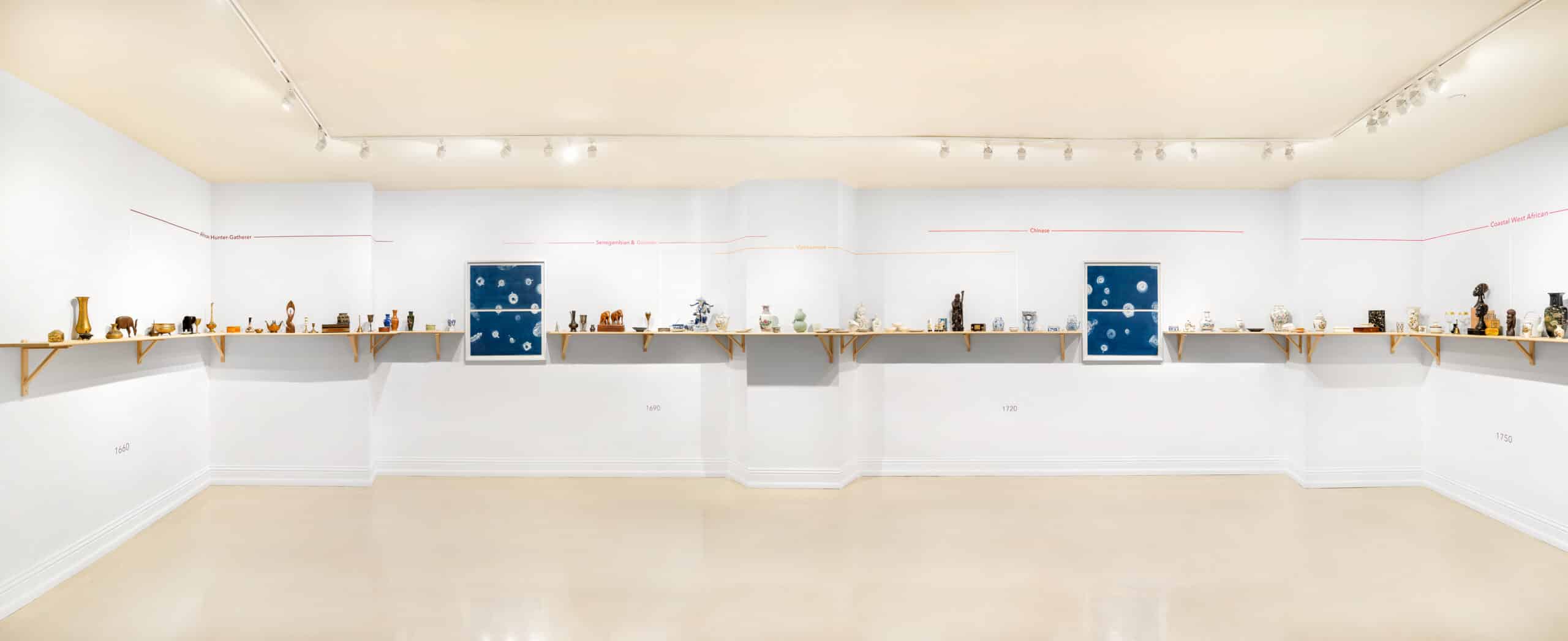
Terrestrial Bodies began with an inherited belief—the kind of familial lore passed down like an heirloom—that Cuban-born artist Juana Valdés’s maternal line carried Chinese ancestry. With no surname or formal record, this origin remained speculative memory. Seeking to connect that missing thread, Valdés submitted her mother’s DNA for analysis through 23andMe. The results traced her lineage to the mid-seventeenth century, spanning Europe, West Africa, and a sweeping arc of Southeast Asia—from China to Vietnam and Myanmar. Yet the 1660 start date, Valdés notes, “marks the rupture caused by the transatlantic slave trade, which interrupts the continuity that might have existed had my lineage remained in one place.”1 Her maternal line mirrors larger histories of colonial expansion—of slavery, indenture, and the global circuits of empire that bound Africa, Asia, and the Caribbean. What emerged was a schematic of diasporic identity shaped less by origin than by movement, asking what it means to inhabit ties that are inherited yet historically estranged.
Valdés translated the results’ geographic spread into Terrestrial Bodies, a room-size installation first exhibited at the Museum of Art and Design at Miami Dade College in 2019. The gallery walls were encircled by a printed ancestral timeline derived from the 23andMe report, its neat bands of color wrapping the space like a panoramic horizon. Beneath this running line, narrow medium-density fiberboard shelves hold dozens of decorative objects gathered from flea markets and thrift stores.2 Each object loosely corresponds to a region named in the genetic analysis: the warm tones of Senegalese carved wooden busts give way to the white-and-blue glazes of Chinese porcelain, which in turn cede to the muted bronze of Vietnamese deity figurines and Congolese carved boxes. Deep-blue cyanotypes punctuate the sequence, referencing the transoceanic routes through which bodies, commodities, and histories have continually moved. The logic of accumulation and display in Terrestrial Bodies carries forward themes from Valdés’s Loot (2008-) series and Terra incognita et Nullius Rediscovered—The World Anew (2023). There, collectibles perch on spindly wooden legs or sit atop stacked shipping crates—makeshift supports that substitute the museum’s polished plinths with architectures of precarity and circulation. While those works materialize imperial desire, Terrestrial Bodies reconfigures it through intimate genealogies, revealing how colonial histories persist as embodied and inherited structures. 3 Ancestry here moves not in a straight line but like a current, its artifacts carried along the tides of migration and exchange, scattered as flotsam across the aftermath of empire.
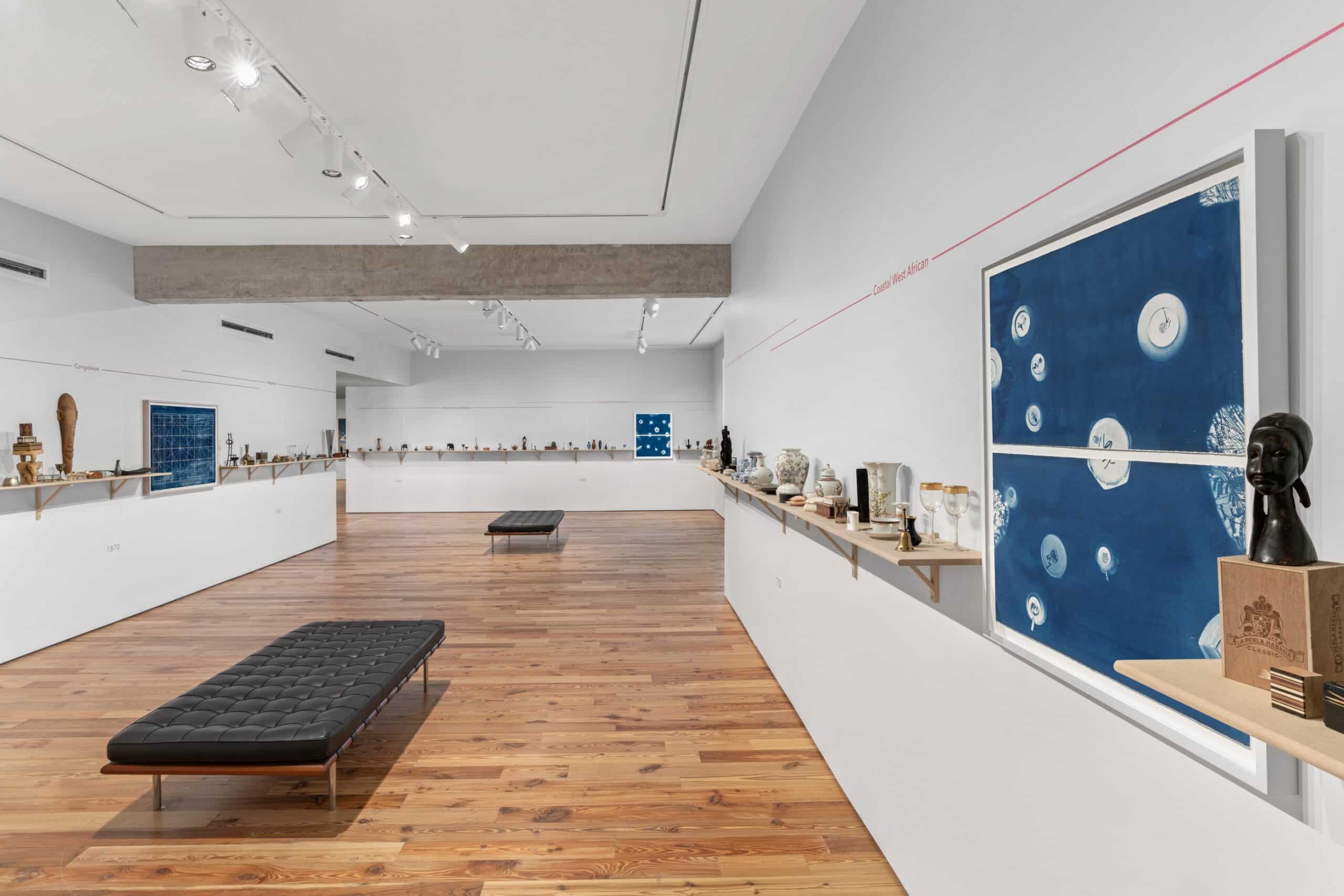
Although the objects in Valdés’s installation are contemporary, many were chosen for how their forms and materials evoke aesthetic conventions that gained currency during colonial expansion—particularly within decorative arts that linked ornament to imperial appetite.4 Some point directly to extractive economies: boxes with white inlays recall ivory networks that connected Europe and Africa through cycles of resource extraction and economic dependency. Bronze export sculptures from West Africa, cast with Greco-Roman floral motifs, suggest how local artisans adapted their work to suit European tastes. Nearby, a cigar box labeled La Perla Habana—though not African in origin—surfaces in the same section, signaling the entanglement of African labor in Caribbean tobacco production. Across the installation, objects do not signify neatly, and such juxtapositions unsettle the viewer’s search for order or authenticity. Valdés leverages this slippage to expose the expectations we bring to material culture: the desire for objects to represent and commemorate.
While these colonial and export-driven traditions once connoted luxury, Valdés’s versions are deliberately inexpensive, largely factory-made, even kitschy—undermining their original associations and exposing the commodifying logics that underpin them.5 Among them, blue-and-white porcelains patterned with European motifs gesture toward the legacy of chinoiserie wares mass-produced for Western markets, which repackaged cultural difference into legible surface.6 These are the kinds of objects Valdés gathers—souvenirs fabricated for global circulation—that serve less as vessels of heritage than as scripted stand-ins for it. Even objects that are hand-carved or bear traces of the hand—brushstrokes, minor asymmetries, the imperfect glaze—gesture toward craft while ultimately serving, in Valdés’s point of view, an industrial system of cultural production for the foreign gaze.7 They simulate identity and tradition through forms tailored to external expectations. Moving across borders, these objects accrue meaning through displacement. In Terrestrial Bodies, this instability of meaning becomes the very condition of their significance: decorative yet extractive, seductive in their familiarity yet disfiguring in what they claim to represent.
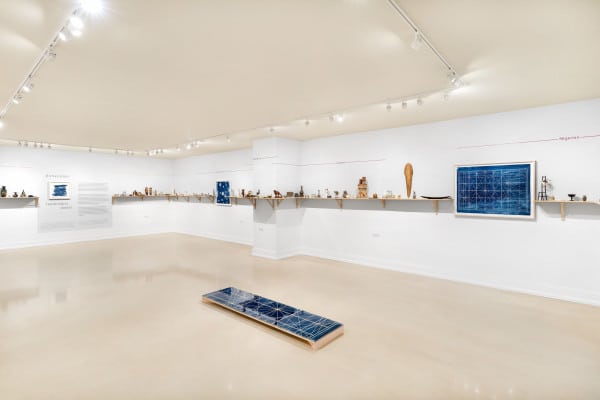
Where the souvenir trades in surface and portability, Valdés’s five cyanotypes turn to mapping—revealing it as a form that can unmoor as easily as it can locate. They create spatial ruptures within the installation, interrupting its geographic and chronological flow with their positioning. Two in particular—Last Voyage, placed on the floor, and Celestial N. 34, inset into an otherwise continuous shelf—evoke astral charts, etched with faint lines and scattered coordinates. Emptied of legible markers or territorial names, they withhold the cues for orientation. Cartography has long been a means of charting relations, but also of fixing borders, displacing Indigenous epistemologies, and legitimizing imperial claims. Valdés suspends those functions: stripped of its bearings, the map reveals not territory but ideology, giving way to the instability of representational frames.8
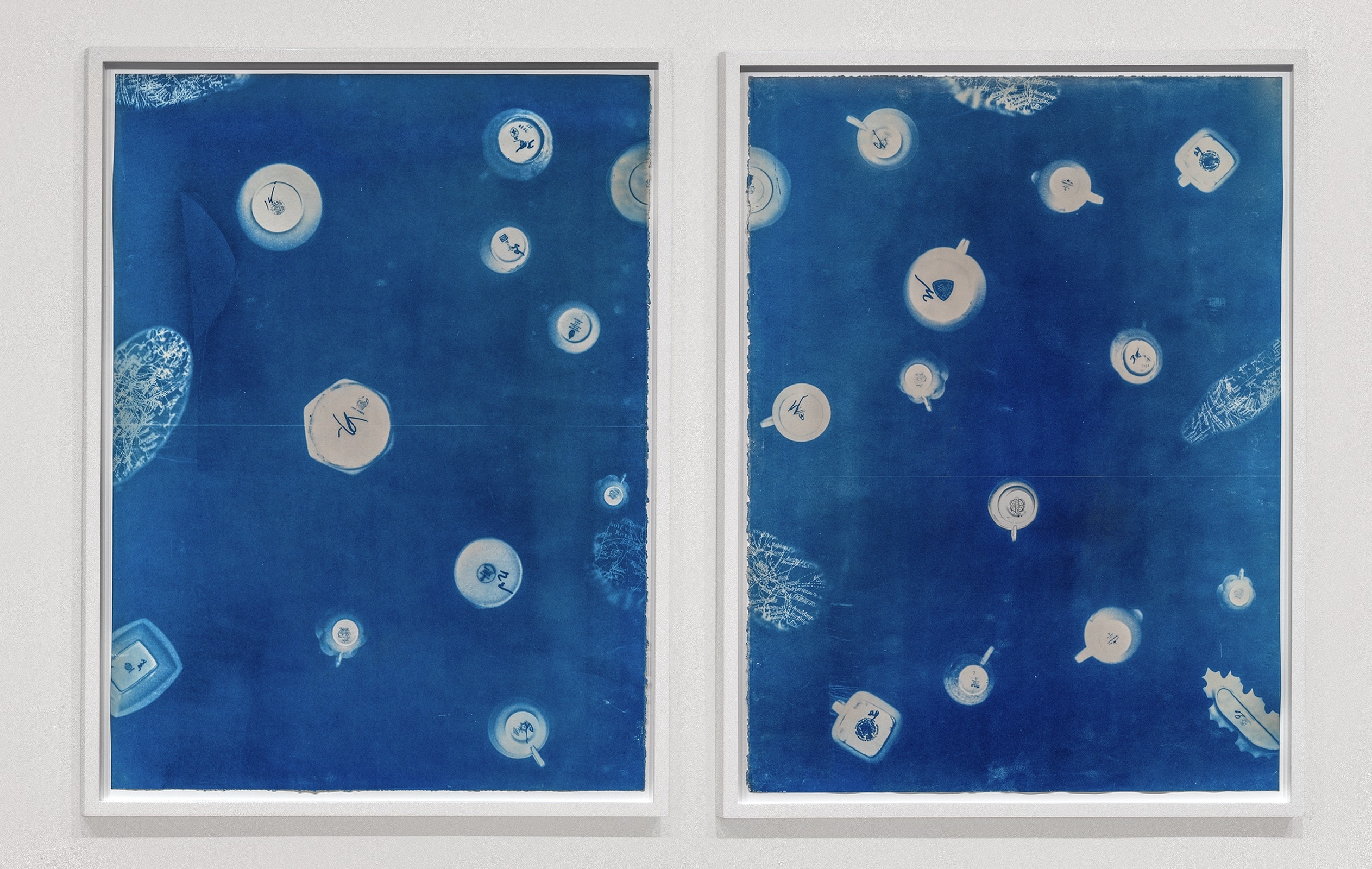
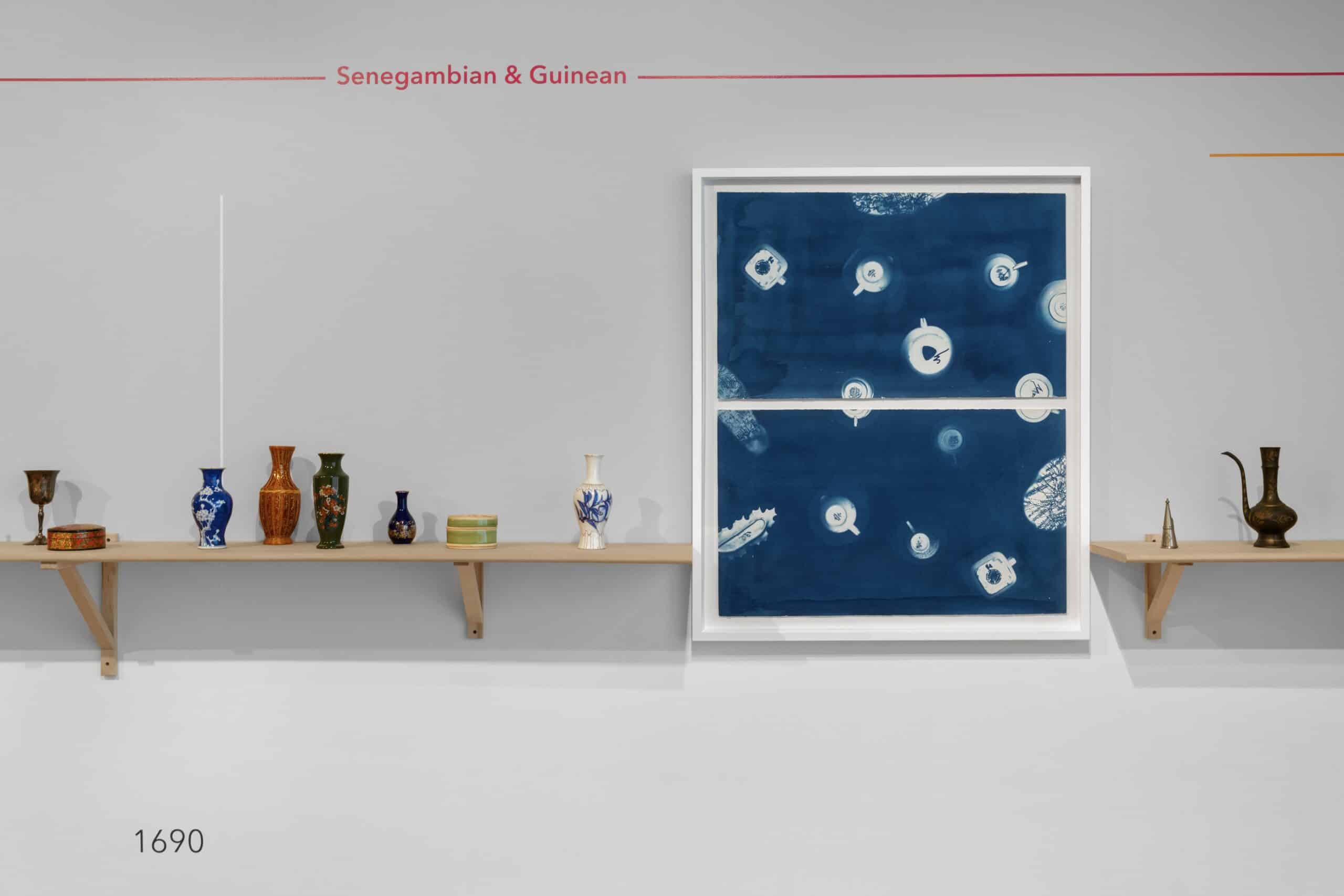
Carrying this tension between what can be seen and what remains obscured, the cyanotypes Under View of the World (2015) depict the undersides of ceramic and clay vessels, their rounded bases and concave ridges rendered in negative against deep Prussian blue. Valdés likens them to the vessels of trade and the ships that carried enslaved and displaced people across oceans—seen as if from beneath the water, looking up at drifting hulls. The works recall nineteenth-century botanical photography, particularly that of Anna Atkins, who used cyanotypes to catalog plant specimens in luminous blue silhouettes, rendering organic forms legible through taxonomic clarity. They also resonate, more obliquely, with William Henry Fox Talbot’s photographic inventories, such as Articles of China (1844), which promoted the medium’s capacity to record and sort objects more efficiently than written description. For both Atkins and Talbot, photography served a classificatory function: to make collections visible, sortable, and knowable.
Valdés unsettles this photographic lineage by turning her lens toward what is typically concealed: the undersides of ceramic vessels, where faint factory stamps, production marks, and “Made in” labels remain.9 Her cyanotypes do not document discrete, nameable artifacts but register traces of global circulation and manufacture.10 Through a medium once used to fix and frame, Valdés redirects attention toward “the movement of bodies and goods across the globe in ways that official histories often leave out.”11 In this, she approximates what Macarena Gómez-Barris calls the “submerged perspectives” of the extractive zone—vantage points from within systems of extraction that expose the infrastructures of labor and displacement normally left unseen.12
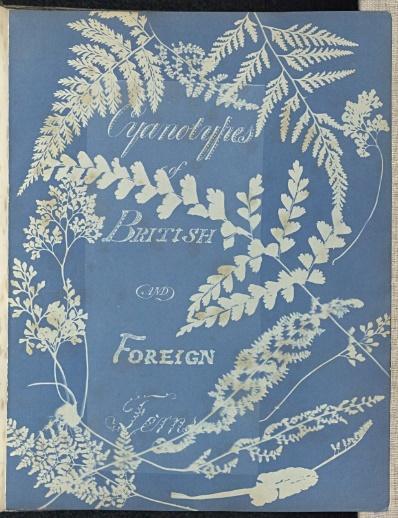
Cyanotype, 25.4 × 19.4 centimeters. The J. Paul Getty Museum.
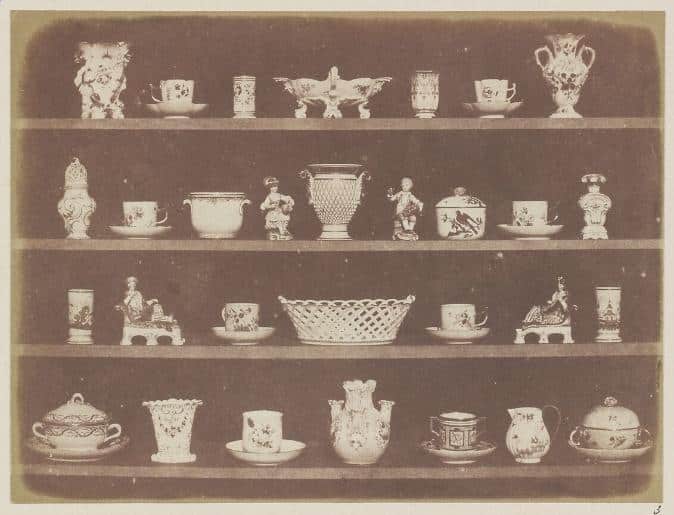
This impulse to reorient runs throughout the installation. The shelving system of Terrestrial Bodies recalls not only Talbot’s photographic inventories but also the museological logic behind them: the cabinet of curiosities, or Wunderkammer.13 Rooted in colonial extraction and hierarchies of value, this framework of collecting and display shaped the modern Western museum, which continues to grapple with these legacies in its systems of acquisition, display, and interpretation. Valdés stretches the Wunderkammer’s from a compact, self-contained structure into a long, lateral sequence that refuses the cabinet’s centralized, totalizing gaze. Her installation cannot be seen or grasped at once; the viewer must walk its length, experiencing the work as a kind of drift. While Valdes’s method of gleaning and arranging secondhand housewares by geographic origin mimics the museological impulse to collect, classify, and display, Terrestrial Bodies turns that operation inside out.
Though the groupings in Terrestrial Bodies loosely follow the geographic arc of her ancestry, they do so with deliberate imprecision—refusing coherence and declining to stabilize heritage or identity. After all, how can diaspora conform to the museum’s organizing logics when its very condition is one of dispersal, disarticulated memory, and movement? Many objects were made in one place yet are made of materials, motifs, and histories that reach far beyond national borders and centuries alike. This ambiguity is intentional: Valdés mirrors and critiques the classificatory shortcuts of museums, which can reduce objects to singular geographic or cultural labels that flatten the complexity of their trajectories.
In Valdés’s hands, these collected objects point not to culture but to its staging—and to the ways diasporic subjects, like souvenirs, are expected to signify “origin” while remaining estranged from it.14 The diasporic self, as Valdés constructs it, does not emerge comfortably within systems of classification but in tension with them: between the taxonomic frameworks that attempt to fix identity and the colonial economies that uprooted it. Her collectibles are less nostalgic than diagnostic, exposing the ideological machinery that renders some identities legible and others unknowable. Timelines, grids, and maps mimic alignment only to let it fall apart, revealing the disciplining logics embedded in coherence. With this, Valdés mines fragmentation not to resolve diaspora’s dislocations but to show what is made of them—how personhood takes shape through drift, disjunction, and reassembly, as forms of relation are continually made and remade.
Endnotes
- Juana Valdés, email exchange with the author, August 10, 2025. ↩︎
- “The collecting process itself is gradual, often spanning two years or more to assemble a constellation of objects that can generate meaningful connections. Selection is always as significant as omission.” Juana Valdés, email exchange with the author, October 24, 2025. ↩︎
- As Valdés notes, “While other works of mine address historical timelines, trade, and material culture, Terrestrial Bodies is unique in that it ties these ideas directly to the body, through my mother’s DNA and the histories it carries.” Email exchange, August 10, 2025. ↩︎
- See David Cannadine, Ornamentalism: How the British Saw Their Empire (Oxford University Press, 2001). ↩︎
- Valdés describes her collecting as a way to “foreground how coloniality persists within the structures of daily life,” noting that “in items made for tourist markets, this persistence becomes especially legible: they are seemingly ordinary goods, yet they index histories of representation, labor, and value shaped by colonial economies.” Email exchange, October 24, 2025. ↩︎
- While such patterns may appear generic or benign, their stylization once functioned as a visual grammar that aestheticized and domesticated foreignness, fixing racial and cultural difference into ornamental form. ↩︎
- Email exchange, October 24, 2025. ↩︎
- In Reclaiming the Americas: Latinx Art and the Politics of Territory (University of Texas Press, 2023), Tatiana Reinoza examines how Latinx printmakers reclaim colonial cartographic media as tools of decolonial critique. ↩︎
- This gesture recalls Valdés’s earlier photographic grid Imperial China (2017) that documents similar markings of manufacture on the bottom of porcelain tableware. ↩︎
- One exception in the cyanotypes is Route Río de Oro—titled after a former Spanish territory along Africa’s Atlantic coast—that bears cartographic names and markers that swarm so densely they become unreadable, suggesting more disarray than orientation. ↩︎
- Valdés, email exchange, August 10, 2025. ↩︎
- Gómez-Barris invites us to consider “the realms of differently organized reality that are linked to, yet move outside of, colonial boundaries.” Macarena Gómez-Barris, The Extractive Zone: Social Ecologies and Decolonial Perspectives (Duke University Press, 2017), 1. ↩︎
- Emerging in sixteenth-century Europe, these proto-museums assembled artworks, natural specimens, and so-called “exotic” cultural objects into eclectic displays that visualized empire through acts of collection and classification, valuing objects for their rarity, legibility, or symbolic function. For a critical account of the cabinet of curiosities’ colonial and political implications, see Tony Bennett, The Birth of the Museum: History, Theory, Politics (Routledge, 1995). ↩︎
- The artist observes that “Together, these objects reveal the tension between mimicry and resistance—the effort at self-representation while still conforming to colonial models of how cultural identity should appear.” Email exchange, October 24, 2025. ↩︎
Cite as: Clara Maria Apostolatos, “Made of Traces: Diasporic (Re)Assemblies in Terrestrial Bodies,” in X as Intersection: Writing on Latinx Art, April 2, 2026, accessed [DATE], https://uslaf.org/essay/made-of-traces-diasporic-reassemblies-in-terrestrial-bodies/.
Clara Maria Apostolatos is Research Associate, Interpretive Planning at The Metropolitan Museum of Art. Her writing on modern and contemporary art appears in The Brooklyn Rail, Hyperallergic, Frieze, and Burlington Contemporary, among others.