
Against Ruination: Building Sacred Futurities
rafa esparza’s building: a simulacrum of power (2014)
Dear reader, please take a moment to watch the two short videos on this page, as well as minutes 41:35-52:46 of this YouTube video and then return here.1
On the dry edge of the Los Angeles River—at the border where asphalt cuts into the soil and the city drags its limits—a long, flat platform shaped like an obelisk rises from a trench dug between the river and train tracks (used for cargo as well as human passengers), spanning a wasteland.
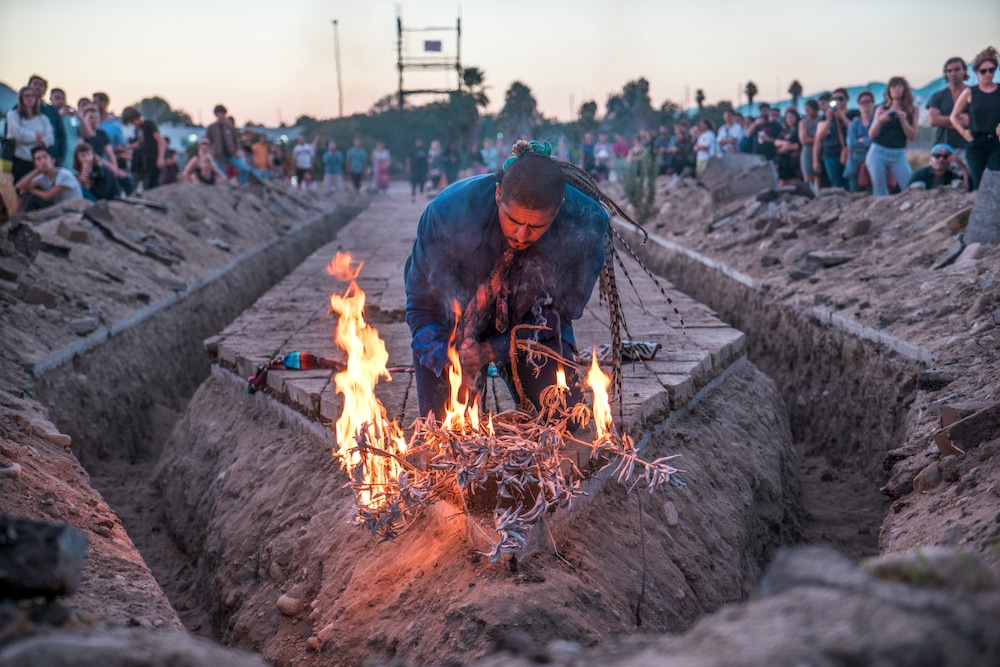
Under the late-afternoon sun, four dancers enter the trench and perform a dance in which they interact with the earth and the platform. Their movements evoke people riding La Bestia—The Beast, the perilous network of freight trains that cross Mexico, used by migrants making the journey north to the United States—as well as the flow of the river water, now channelized, that once overflowed this land.2 After a time, four dancers emerge from the trench, and a solitary figure—their hair tied in a ponytail with long pheasant feathers, their body clad in a loincloth, elements of Danza Azteca garments—begins to perform a Water Dance around the obelisk. Crossing the trench onto the platform, the dancer lowers their body to the ground and crawls on their belly along the flattened obelisk.
As with the dance group, the lone figure’s movement across the platform evolves in direct relation to an already constructed form. Motion develops along, over, and against the structure’s fixed geometry, registering human movement as patterns of possibility. This possibility involves individual, social, architectural, or environmental bodies; collective and personal movements; and proposed shifts in societal, spatial, and temporal structures. It is through these relations that my reading of rafa esparza’s building: a simulacrum of power (2014) unfolds.3 This invites the question: what does building mean when a fixed structure is both encountered and countered through human movements over time—through friction, traction, and contact?
I. Foundations. Laboring the Steps.
The work began long before the dance. Reactivating his father’s knowledge of adobe-making, esparza invited his parents, siblings, and a friend to make 1,400 adobe bricks with him. rafa’s dad had learned and worked with adobe in Mexico but never practiced it or spoke of it after migrating to the U.S. When rafa discovered this through his mother, he began incorporating adobe-making with his father into his art practice, including building…
The bricks were used to pave Michael Parker’s The Unfinished (2014), a 137-foot obelisk-shaped platform carved into the ground of the Bowtie Project on the east bank of the Los Angeles River. Parker’s monumental earthwork evokes an ancient Egyptian obelisk that was never successfully raised, symbolizing the collapse of oppressive power.
Extending Parker’s vision, in building… rafa esparza activated a self-organized space for creativity, care, and mutual support, resisting oppressive hierarchies—a gesture I suggest can be read as a nod to an undercommons. Adobe-making was reclaimed as a transgenerational practice. Weeks of strenuous collective labor transformed the platform into a site for public gathering (again) and a space in which to restore connections with the elements (earth, water, wind, and fire) and with other humans. The platform became a spot to transmit ancestral knowledge and to repair relations, allowing rafa to reestablish a bond with his father that had weakened when the artist came out to his family sometime earlier.
II. Endurance. A Critical Offering.
After the dance, esparza lowered himself onto the adobe-covered surface. With his body pressed to the ground, he began to crawl atop the obelisk. The movement was deliberate and unrelenting—part proof of endurance and will, part ritual submission. Through friction and great physical effort and vulnerability, his choice to crawl and not dance evoked a reclaiming of power and relationality with the elements, the adobe, and his family, who worked with the earth and water that produced the bricks. esparza describes the scene as follows:
“There are several things that happened in the performance. One of them is acknowledging that this body of land transformed into bricks was made collaboratively with my family, so this is our labor, our bricks that I then get to address with my body… I wanted to have that kind of direct relationship to the structure. When you’re working with the adobe, we’re mixing it with our feet or shoveling it with our hands, molding it on our knees … and I wanted every inch of the body to touch the bricks.
And I was thinking about, like, so, I’ve been doing Danza Azteca for maybe twelve to fifteen years … I was a dancer … I mean, the history of Danza in the United States is very interesting, because the danzantes that introduced Danza to the U.S. didn’t have permission from the circles in Mexico, and they [were] actually punished when they went back to Mexico … and in the States it was a very Chicano thing to do Danza and experience belonging for a sense of origin, and I think that in more recent generations it became a way to connect with our sense of spirituality, connect with a sense of history… [yet] all things are problematic.
When I started to do performance because my relationship to a lot of places of ritual, ceremony and organizing really shifted because in the mid-2000s a lot of these people and spaces, they weren’t ready to embrace me, to accept me. They weren’t very queer friendly then, and that included Danza, so I was very persistent in maintaining a relationship to Danza and to learning the dances. I would dance in the mountain by myself and kept the practice going. And then, a lot of queer danzantes found each other through social media, and there was the first queer danza ceremony…”4
Upon reaching the end of the platform, esparza removed his loincloth revealing a jockstrap and settled his spread legs and buttocks on the obelisk’s tip. I would argue that a queer critical reclamation unfolds in these gestures. First, the crawling evokes both the traction and resistance of queer brown bodies against imperial, patriarchal, raced, classed, logics, that is, the forces aiming to discipline negatively racialized immigrant people. Then, contesting those forces by occupying the obelisk’s cusp, both as act and declaration: bless(ing) the adobe; fuck(ing) the empire bareback.5 The gesture, I suggest, consecrated the adobe, mobilizing a queer positionality.
Still wearing the feather hair tie, esparza then donned a black suit, a tie, and the blue-collar shirt he wore while working in creating the adobe bricks with his family. He poured water over himself. He lifted a dry sage branch his father had once cursed when he tripped over it, placed it atop the obelisk, and set it alight. Tendrils of fragrant smoke spiraled upward, cleansing the air and forming a bridge toward a sacred future yet to be built.
building…, I suggest, activates a critical offering: Estamos aquí, de maneras ancestrales a la vez que nuevas. We are here to consecrate what has been desecrated: earth, water, air, flesh, soul, body, sexuality, sex, labor, kin, community, polity. This work consecrates, also, the X in Latinx—the X that, as Alan Pelaez Lopez points out, “trans and gender-nonconforming Latin Americans wear as we navigate a Latinidad that has yet to love us. By ‘us’ I refer to those who are too queer, too Black, too foreign, too NDN, too femme, too angry to be Latin American.”6 At that wound—the X in Latinx, which can also become a crossroads, recalling the canonical Anzaldúan image—esparza, through coalitional ritual and political imagination, over a collapsed obelisk, summoned the creation of a promenade toward a shared, insurgent becoming.
III. Sacred Futurity. Opening Portals.
In building… transcendence occurs through presence, poner el cuerpo, acuerpar—to put the body, to embody as a political act.7 Building a body politic through shared labor requires perseverance, method. In esparza’s work, the sacred is not metaphor; it is method, a medium, a memory system. Lived experience is an active archive, a present-tense force reactualizing the past, shaping the future. Against the colonial violence of linear time—the belief that history advances only through progress—esparza creates thresholds where ancestors and descendants coexist and cocreate.
Every brick esparza and collaborators mold is hence a form of repair: of familial histories, of relations broken, of knowledge that had been left behind. Against the extractive drive of market forces seeking to turn every gesture into profit, esparza insists on another modality of value: the sacred labor of crafting community. The future is being kneaded now by those who refuse to disband, to forget, to cease to commune with the environment—like the clay and water the adobe is made of—and with each other. In this way, one of the performance’s messages seems to be that to elude capture, it is key to understand that the act of becoming an undercommons is possible only in the here and now, only together, only critically.
The critical awareness that characterizes esparza’s practice is also articulated in his relationship with Danza Azteca, or Danza. In a conversation, esparza and I talked about how Danza can carry problematic connotations within Mestizo-privileging ethnic, racial, and gendered dynamics in Mexico and elsewhere—a tension he reflects upon meticulously and deeply.8 In conversation, esparza mentioned, however, that he is fully aware of the problematic aspects related to the extractive dimension of dance practices, including some potential tendency to imagine Indigenous nations as monolithic and to obscure their diversity and dynamism. He also observed that, on the other hand, the practice helps to build community and belonging, which are particularly important in a migratory context. Within these dynamics, his choice to participate in a specifically queer Danza group embodies, I argue, a critical and thoughtful engagement with the practice, reshaping it through an antiracist migrant queer brown lens.
IV. Invocation. Reflecting time, refracting power
esparza’s work transforms artistic labor into an insurgent architecture, where adobe and sweat become a political proposition: it is possible to target the heart of the empire through collective world-building. building… is an embodied reminder that this has been happening throughout history. This kind of collective labor activates transgenerational knowledge, connecting spatial and temporal dimensions, a feature in esparza’s vision.
In her analysis of Corpo RanfLA: Terra Cruiser (2022)—produced eight years after building… and with esparza as a cyborg lowrider—Laura G. Gutiérrez observes that the artist’s practice affirms that “…human hands are irreplaceable. This understanding of human labor, including the hardships suffered by racialized bodies, is consistent in esparza’s artistic work.”9 In building…the sharing of time, presence, and space reconstructs bridges between generations once fractured by colonialist logics. The earth carries ancestral ashes, mixed with water and shaped by communal effort into bricks. As Josh T. Franco has noted, esparza’s adobe work sometimes literally incorporates the ancestors whose bodies were buried in the land.10
The performance entailed a meditation that mobilized sunlight to reflect on time, space, and the act of bearing witness to each other. Throughout the weeks-long process, esparza used a small circular mirror to mark the passing of time. And on the last day of building…, during Hernandez’s dance ensemble’s performance, esparza, outside the trench, not far from the tip of the obelisk, held the mirror. He caught the sunlight, scattering it across the dancers in the trench, the obelisk, and the watching crowd. Afterwards, Hernandez held the mirror during esparza’s performance. Playing with light to mark the pass of time, building: a simulacrum of power activated passages between the here and now and the then and there, to follow José Esteban Muñoz’s famous formulation on queer futurity as both a way of being and a utopian practice oriented toward the future. The mirror’s light reflections—momentary and fleeting—seemed like both revelation and interrogation, a meditation on witnessing, visibility and the gaze.
Through the weeks of communal building of the adobe promenade over the fallen obelisk, with his collaborators and with the performance audience—which for esparza include human and beyond human entities as witnesses—power was refracted, redistributed, communed; not withheld. As he shared in our conversation:
I do think about audiences … I think about being seen by nonhuman entities, I think about being witnessed by plants, and animals, and the sky, and the stars, and the soil, and I do think about being seen by my family before I get to be seen by anyone else.11
Coordinating material and immaterial elements activated through human and more-than-human relationality, building… unfolded what Ariella Azoulay calls “political imagination:” a “form of imagination that exceeds the grasp of the individual mind—it is a form of imagination that transcends the single individual alone and exists between individuals and is shared by them.”12 For rafa esparza, to build is to edify in more than one sense. It is assembling and gathering. It is resisting, persisting, and changing. To build is to refuse domination and envision socially-just collective formations. Through the act of building, his work is a reminder that the future is already in our hands, pressed into the clay, waiting to be danced into form.
Endnotes
- “building: a simulacrum of power,” Clockshop, n.d., https://clockshop.org/project/bowtie-aa/building-a-simulacrum-of-power/ (accessed August 28, 2025); for context and description narrated by the artist, see Artists Lecture Series: Rafa Esparza, LACC Visual & Media Arts Artist Lecture Series, video, June 27, 2018, https://www.youtube.com/watch?v=PRqiJ84WTJ0&t=3043s. ↩︎
- The four dancers were Victoria Wolfe, Olivia Orozco, Devon Stern and Rebeca Hernandez, who choreographed the piece. esparza invited Hernandez to share the space and time with him and create a performance to be presented at the same day as the public performance of building…, yet Hernandez’s and esparza’s performances are independent of each other, even though they are organically interconnected. ↩︎
- rafa esparza, building: a simulacrum of power. With Ramon, Lupe, Beto, Fernando, Eric, Manuela & Hermila esparza, Gabriel Banuelos, Jorge Ríos, and Michael Parker. Rebeca Hernandez. Hosted by Clockshop and California State Parks. The Bowtie, 2014. https://clockshop.org/project/bowtie-aa/building-a-simulacrum-of-power/. ↩︎
- rafa esparza, personal communication with the author, October 2025. ↩︎
- In terms of sex and sexuality, esparza’s building: a simulacrum of power establishes a loose connection with Ron Athey’s performance Solar Annus (1998-2006), yet in esparza’s case the piece leans towards themes of immigration, class, and racialized sexuality. ↩︎
- Alan Pelaez Lopez, “The X in Latinx is a Wound, Not a Trend,” ColorBloq (2018), 1. https://drive.google.com/file/d/1DLr048HPzCcFmP-esINd7zUk1teWvCfo/view (accessed August 28, 2025). ↩︎
- Acuerpar is a term emerging from Spanish-speaking Latin American feminism, used in a sense or meaning of being present with the body but also surrounding, embracing, supporting, and accompanying something or someone (a political cause, or other body/bodies) with the body, both in the sense of the physical body but also in the political sense, the political body, the body politic. ↩︎
- See M. G. Moreno Figueroa, “Distributed Intensities: Whiteness, Mestizaje and the Logics of Mexican Racism,” Ethnicities 10, no. 3 (2010): 387–401, https://doi.org/10.1177/1468796810372305; M. G. Moreno Figueroa, “Naming Ourselves: Recognising Racism and Mestizaje in Mexico,” in Contesting Recognition: Culture, Identity and Citizenship, ed. J. McLaughlin, P. Phillimore, and D. Richardson (Palgrave, 2011), 122–43; Emiko Saldívar, “‘It’s Not Race, It’s Culture’: Untangling Racial Politics in Mexico,” Latin American and Caribbean Ethnic Studies 9, no. 1 (2014): 89–108, https://doi.org/10.1080/17442222.2013.874644; M. G. Moreno Figueroa, “Mestizaje: When the Shades Dissimulate Whiteness,” The Funambulist, June 22, 2023; A. Ortega Domínguez, “The Mestizo Gaze: Visualizing Racism, Citizenship, and Rights in Neoliberal Mexico,” Ethnic and Racial Studies 45, no. 14 (2022): 2609–30; Peter Wade, Race and Ethnicity in Latin America (Pluto Press, 2010), https://doi.org/10.2307/j.ctt183p73f; A. Ortega Domínguez and S. Abel, “Public Art and the Grammars of Antiracism,” in The New Public Art: Collectivity and Activism in Mexico since the 1980s, ed. M. Polgovsky (University of Texas Press, 2023). ↩︎
- L. G. Gutiérrez, “‘Cruising Utopia’ with rafa esparza’s Corpo RanfLA: Terra Cruiser (2022),” The Latinx Project at NYU, February 17, 2023, https://www.latinxproject.nyu.edu/intervenxions/cruising-utopia-with-rafa-esparzas-corpo-ranfla-terra-cruiser-2022. ↩︎
- Josh T. Franco, personal communication with the author, August 2025. ↩︎
- rafa esparza, personal communication with the author, October 2025. ↩︎
- Ariella Aïsha Azoulay, Civil Imagination: A Political Ontology of Photography. Verso. Edited by Louise Bethlehem (2012) 9. ↩︎
Cite as: Abeyami Ortega Dominguez, “Against Ruination: Building Sacred Futurities: rafa esparza’s building: a simulacrum of power (2014),” in X as Intersection: Writing on Latinx Art, June 1, 2026, accessed [DATE], https://uslaf.org/essay/against-ruination-building-sacred-futurities/.
Abeyami Ortega Dominguez (she/they) is an anthropologist and interdisciplinary scholar whose work on media, visual culture, and contemporary global art histories addresses racialization, gender, sexuality, and social inequalities in Majority World/Global South contexts, particularly, Latin America. She is Honorary Research Associate in Social Anthropology at the University of Manchester, and has taught at the University of Cambridge, the University of Salamanca, Spain, UNAM, the National School of Anthropology in Mexico, and other institutions. She was awarded the Catedra SLAS by the UK Society for Latin American Studies to teach on Latin American art activism and is co-editor of the volumes Creative Critical Interventions for Social Justice (UCL Press, 2026) and Comics and Race in Latin America (UCL Press, forthcoming 2027). Her work has also been published in Feminist Theory, Ethnic and Racial Studies, Agenda Empowering Women for Gender Equity, AWARE: Archives of Women Artists, Research & Exhibitions (2025), and The University of Texas Press, among others.