Riding in Place: Miguel Luciano’s Double Phantom/EntroP.R., (Un)tethered Diasporas, and Anti-Colonialism
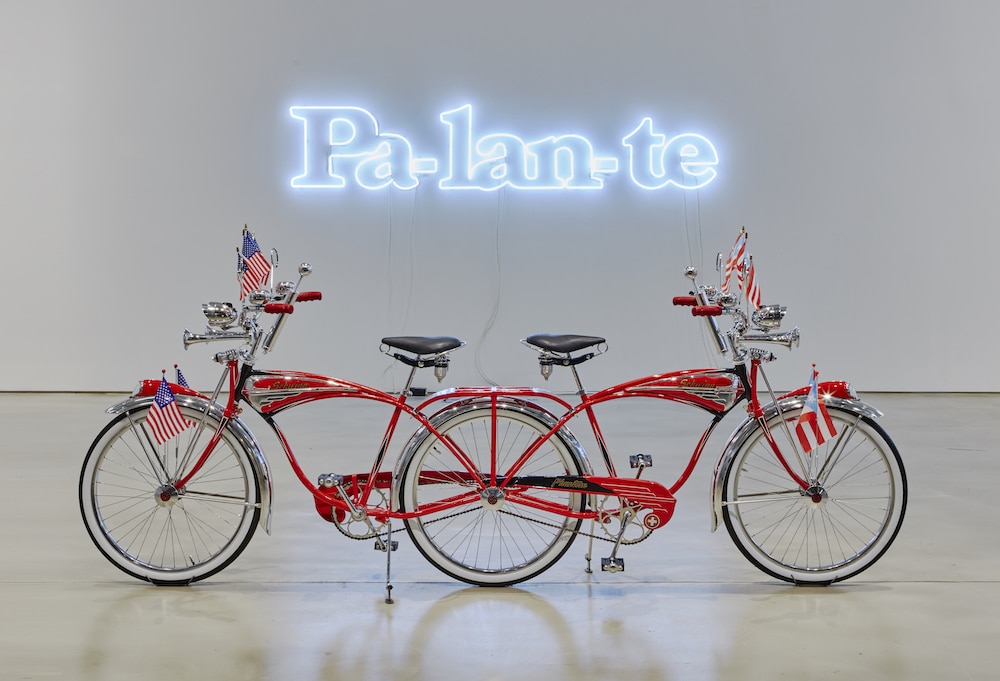
Sutured together, two red 1952 Schwinn Phantom bicycles, adorned with Puerto Rican and U.S. flags and melded into one incongruous form, can go nowhere. If activated, they’d pull in opposite directions. Behind this customized double bicycle, blaring in bright white neon, the word pa’lante—itself a contraction of “para adelante”—disassembles into syllables. Both sculptures by Miguel Luciano, Double Phantom/EntroP.R. and Pa-lan-te, commissioned in 2017 by BRIC—a cultural and media community arts space in downtown Brooklyn—embody how some Latinx artists marshal the visual languages of assembly, disassembly, and mobility to map the cognitive untethering of space and place through diasporic thinking.1 According to Luciano, Double Phantom/EntroP.R. expresses “contradictory forces, ultimately illuminated by the message riding above in neon (Pa-lan-te).” EntroP.R. is a “play on the word entropy—the idea of stasis versus the potential energy of forward movement.” They do not refer to the artist’s “personal relationship to Puerto Rican identity, but rather address a larger metaphor for the paradox of Puerto Rico’s political status, and a critique of our ongoing colonial relationship with the United States.”2 The two tethered bicycles are doomed to make their wheels spin. Yet they are guided by a rallying cry to move forward, one elaborated in the Puerto Rican diasporas, particularly in New York, where riding in place conjures the possibilities of movement within unbound cognitive territories.
The works’ temporal registers—the year of their making (2017) and the reference to 1952 in their materiality—mark significant historical events for the unincorporated U.S. territory. Signed into law on July 25, 1952, by Governor Luis Muñoz Marín after an earlier referendum, the Constitución del Estado Libre Asociado de Puerto Rico (Constitution of the Commonwealth of Puerto Rico) turned the archipelago into neither a sovereign country nor a U.S. state. Its ambiguous political status still debated, Puerto Rico exists in suspension, neither fully autonomous nor with the full rights of statehood, a colonial entity subject to U.S. sovereignty. Decades prior, the Jones Act of 1917 had granted U.S. citizenship to Puerto Ricans, enabling their compulsory military service during World War I (and after). Conceived on the hundredth anniversary of the act, Pa-lan-te and Double Phantom offer clever visual and semiotic ruminations on Puerto Rico’s “free association” within the context of diasporic, urban spatial relations. Made right before Hurricane María and in the wake of the 2016 Puerto Rico Oversight, Management, and Economic Stability Act (PROMESA), a deceptively named austerity bill, the works point to the political dysfunction stemming from the island’s colonial status.
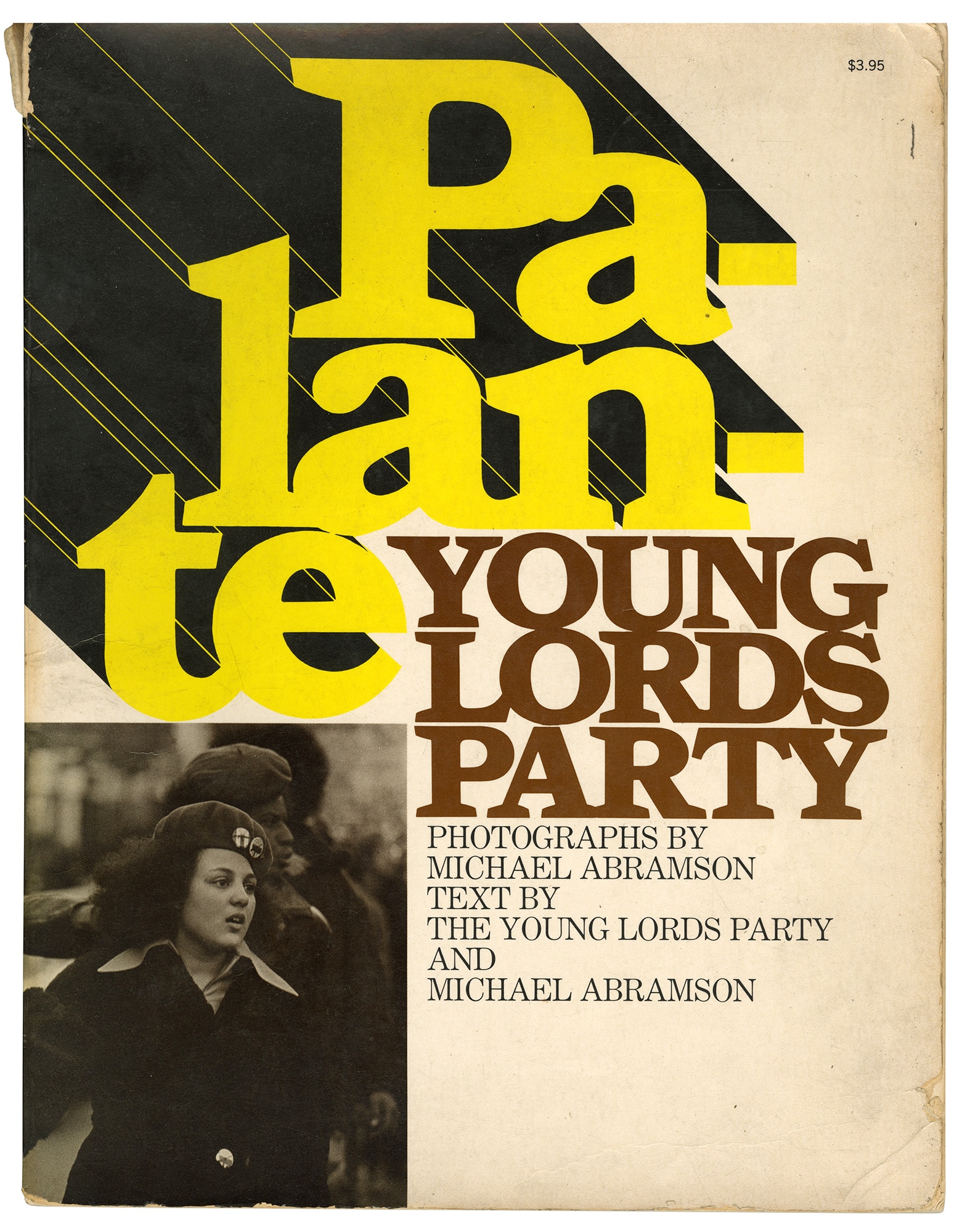
As historian Johanna Fernández has written, palante “is most often used in the colloquialism echar pa’lante, which means ‘to push forward,’ a figure of speech for the concept of advancing in struggle, usually of a personal kind, against the odds.”3 The Young Lords, the militant Puerto Rican organization aligned with the Black Panthers, deployed palante as a call to action in their bilingual newspaper. The Young Lords removed the apostrophe to unify the colloquialism. Notably, Luciano maintains the contraction but untethers the expression by breaking it up into three syllables, visualized in the same distinctive, bold font as the Young Lords’ newspaper masthead. Luciano’s morphological play appropriates the cover design of photographer Michael Abramson’s original 1971 edition of Palante: Young Lords Party, the first book by and about the radical organization.4 Pa-lan-te’s tripartite composition forms a visual echo with the three wheels of Double Phantom. Like many artists, Luciano capitalizes on customizable neon signs to create a loaded text. The politicized, luminescent sign trumpets movement even as Luciano semantically unhinges it and frustrates mobility with the stasis of the bikes.
Sharing a back wheel, the bicycles remain very much tethered to the ground but are simultaneously unmoored by their integration, dependent on one another, yet frustratingly static. Directions acquire no meaning in this work; there is no left, no right, no forward, no backward, just a stunted idea of movement that sharply contrasts with the “push forward” élan and militancy of the Young Lords’ motto. Puerto Rican flags adorn one side, U.S. flags the other. The dual bicycle creates visual, spatial, and cognitive discrepancies: neither here nor there, ni de aquí ni de allá, aptly conjuring the in-between cultural and political status of not just Nuyoricans but also many Latinxs and diasporic subjects. The artwork’s formal indeterminacy signifies an island population torn between statehood, independence, and “none of the above.”5 Would activation of the bicycles tear them apart? Reinforce unison? Or just keep making the wheels spin? Double Phantom leaves these weighty questions unanswered, engaging a sculptural language of ambiguity and a visual politics of joy that lead to elsewheres.
The nostalgia of the 1950s Schwinn arises from generational memories of childhood on the island where the bicycles were aspirational transport means for working classes and field laborers. With mass migration of Puerto Ricans in the 1950s, the bicycles proliferated in Nueva York. Soon afterward, Nuyoricans established bicycle clubs throughout the city, primarily in the Bushwick neighborhood of Brooklyn, where Luciano has maintained his studio for over twenty years. Julio Clavijo, who started the Puerto Rico Schwinn Club with his wife Marta, recalled that he and his siblings were not allowed to ride his father’s bicycle because their father “used it for transportation to ride from La Cantera (de Ponce) to the cane fields.”6 Julio later taught Luciano, whose work also includes painting, other forms of sculpture, and installation, how to restore vintage Schwinns. Like most club members, Luciano starts with a vintage bike frame and then obtains original parts through local networks.7 Every part needs to be stripped down and restored; some need to be cut, welded, seamlessly merged, repainted, re-chromed, and pinstriped. Double Phantom thus recognizes a specialized form of knowledge, labor, and craftsmanship dependent on networks, community, and handiwork. The act of restoring the bikes to glossy perfection becomes a process of reclamation for otherwise disenfranchised subjects and taps into the sociocultural impulses of recycling and resourcefulness animating many marginalized communities in the Americas. Luciano’s works employ the artistic languages of urban ingenuity and resilience mobilized in the Americas to grapple with colonial subject formation, conflictive notions of home, dispossession, and world making.
The Puerto Rican bicycle clubs organized the grassroots community culture of collecting, building, customizing, and most importantly, riding bicycles, especially en masse as in the Puerto Rican Day parade held in New York since 1958. They are built to be seen, admired, and heard. Armed with loud pump horns, the bicycles are sometimes retrofitted with homemade sound systems. Indeed, Luciano’s first “bicycle” work, Pimp My Piragua (2008), turned a shaved-ice street vendor’s pushcart into a hi-fi mobile public artwork that the artist activates by riding it in rapidly gentrifying New York Latinx communities.8 Double Phantom and other bikes from the BRIC Ride or Die exhibition are thus conceptual “portraits” of Puerto Rico’s battling political parties and colonial relations.9 While rooted in a specific community, they are not interactive public works and therefore implicitly reach distinct audiences. Specters of literal movement, they are simultaneously bound to place, yet formally undo it.
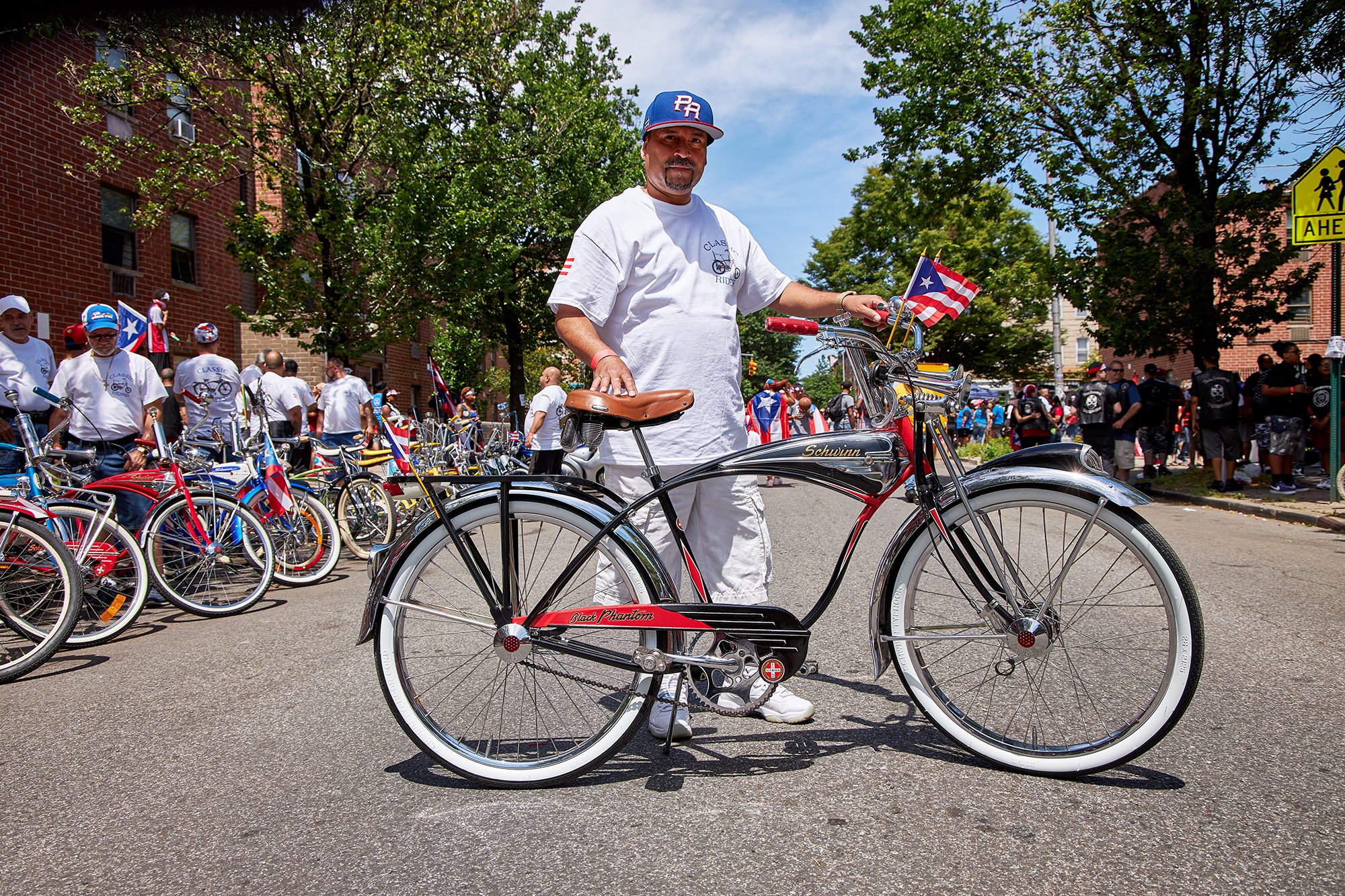
Photo: Argenis Apolinario
Estrangement and liberation signal the gender dynamics of Puerto Rican bicycle clubs, organizations dominated by men (mostly middle-aged or older). The clubs partake of the masculinity associated with cars and customization culture, generally speaking.10 Yet, Puerto Rican bicycle clubs sharply verge from the masculinist freedom and lawlessness of U.S. road culture epitomized, for example, by motorcycle clubs such as Hell’s Angels, famously portrayed by Hunter S. Thompson.11 Similarly, bicycle clubs are spaces for bonding among a marginalized group—in this case, older male diasporic colonized subjects who assert their rights to the public spaces of the city. Bicycle club members often embellish their bicycles with a profusion of flags creating over-the-top, ornamental tableaux.12 Such a decorative practice speaks to craft conventions historically gendered as female and therefore they disrupt normative gender norms. Cruising urban streets with adorned vintage childhood bicycles reinforces a Nuyorican spatial politics and a joyful, expressive vocabulary that the artist marshals to make politicized (and gendered) meditations on sovereignty.
Luciano intervenes into a long history in which artists have mobilized the readymade to conjure colonial subject formations and conflictive urban spatial relations.13 Keeping in mind that Duchamp’s Bicycle Wheel (1913) was the very first readymade, Double Phantom’s “uselessness” has distinct ends—to conjure the futility and irreconcilable tensions of colonial impositions. Moreover, Double Phantom’s coupling with the neon sign—its luminescence reverberating the high polish sheen of those lovingly restored chrome parts and painted frames—roots its playfulness within a quotidian lexicon of creativity describing the relationship between labor and life (échale ganitas, con to’ los hierros, dale duro: “giving it all you got” in distinct contexts in the Americas). While paying homage to these colloquialisms, Luciano scrutinizes their formulations and embraces the logics of failure emblematized by the “useless” bicycles. Futility and fracaso (failure), here, point to the entanglements and untethering of Puerto Rican/Nuyorican/diasporic experiences and the limits of colonialism just as the artist consistently examines the troubled relationship between Puerto Rico and the U.S. in his oeuvre.
Endnotes
- Double Phantom and EntroP.R. are separate artworks that have been shown together since Luciano made them for his solo exhibition at BRIC, Ride or Die: An Exhibition of Newly Commissioned Work by Miguel Luciano, curated by Elizabeth Ferrer. The exhibition featured six Schwinn bicycle sculptures (including Cotton Picker, made in 2011). Interview with the artist, June 11, 2025. ↩︎
- The title, Double Phantom, plays with language and the cognitive impossibilities of the island’s political status. Miguel Luciano, email communication to the author, June 29, 2025. ↩︎
- Johanna Fernández, The Young Lords: A Radical History (University of North Carolina Press, 2019), 223. ↩︎
- Michael Abramson, Palante: Young Lords Party (McGraw Hill, 1971); republished in 2011 as Palante: Voices and Photographs of the Young Lords, 1969–1971 (Haymarket Books). ↩︎
- “None of the above” references the results of a nonbinding 1998 plebiscite on Puerto Rico’s political status. See None of the Above: Puerto Ricans in the Global Era, ed. Frances Negrón-Muntaner (Palgrave Macmillan, 2008), and Deborah Cullen, None of The Above, Contemporary Work by Puerto Rican Artists, exhibition catalogue (Real Art Ways, 2004). ↩︎
- Luciano, interview with author; and “Arizonando by Ed Morales on Exhibit at Hunter College School of Social Work and Gallery on 119th,” Latino Faculty Initiative (CUNY), October 14, 2011. ↩︎
- Luciano, interview with author. Originally, parts were acquired through swap meets and informal exchanges; now eBay facilitates their acquisition. ↩︎
- On how Luciano’s Pimp My Piragua reflects “Latino ingenuity,” see E. Carmen Ramos, Our America: The Latino Presence in Latin American Art (Smithsonian American Art Museum, 2014). Regarding the range of Luciano’s exhibition settings and their critiques of the commodification of Puerto Rican and Latino culture, see Arlene Dávila, Culture Works: Space, Value, and Mobility Across the Neoliberal Americas (NYU Press, 2012), Chapter 5. My approach builds on their socio-historical analyses to show how form is tied directly to political critique in his work. ↩︎
- Double Phantom/EntroP.R. was the centerpiece of the exhibition. ↩︎
- Although the couple started the Puerto Rico Schwinn Club together, he is more well-known, and it primarily had male members. ↩︎
- Hunter S. Thompson, Hell’s Angels: The Strange and Terrible Saga of the Outlaw Motorcycle Gangs (Random House, 1967). ↩︎
- On Nuyorican decorative practices, see Anna Indych, “Nuyorican Baroque: Pepón Osorio’s Chucherías,” Art Journal 60, no. 1 (Spring 2001): 72–83. ↩︎
- For example, see David Hammons’s riff on Duchampian bicycles made from urban detritus, Central Park West (1990, National Gallery of Art), which appears like a deflated warrior pierced by the spear of an urban street sign bearing the name Central Park West. ↩︎
Cite as: Anna Indych-López, “Riding in Place: Miguel Luciano’s Double Phantom/EntroP.R., (Un)tethered Diasporas, and Anti-Colonialism,” in X as Intersection: Writing on Latinx Art, April 2, 2026, accessed [DATE], https://uslaf.org/essay/riding-in-place-miguel-lucianos-double-phantom-entrop-r-untethered-diasporas-and-anti-colonialism/.
Anna Indych-López is Professor of Art History at The Graduate Center & The City College at CUNY. She is the author of Judith F. Baca (2018) and Muralism without Walls: Rivera, Orozco, and Siqueiros in the United States, 1927–1940 (2009) and co-author of Diego Rivera: Murals for The Museum of Modern Art (2011). She is a 2024 Andy Warhol Foundation Arts Writer Grant recipient.