
(Un) tethered Materiality: The Fabric of a Fraught Landscape
I think the border doesn’t stop at the exact division that’s parting us,
but it spans further and absorbs and consumes everything.
It’s not necessarily even New Mexico; it could be out in Delaware.
Even in places where we’re not literally butting up against Mexico itself, we still are.— Daisy Quezada Ureña1
As Daisy Quezada Ureña prepared a show in Santa Fe, New Mexico, in 2012, she built a structure that held the delicate central artwork as it lay in its bony-dry stage in the high-temperature kiln. The installation Rosa (2012) became emblematic to this California-born artist as she navigated the emotional and physical landscapes of a familial diasporic experience and the paradoxical tension of an untethered existence with an ancestral history in Mexico. Her dislocations and relocations from Southern California through the borderlands to Jalisco; to New Mexico—where the family built their first house in Vado; to Arizona, where she attended high school; and her later years in Santa Fe, where she currently resides, have informed an ascendant international sculpture practice. Yet, it was not until her MFA at the University of Delaware under Abby Donovan that feminist theory seeped into her work to understand the complex existence in borderlands, defined by Gloria Anzaldúa as “a vague and undetermined place created by the emotional residue of an unnatural boundary.”2
The artist has embraced installation art, in which white porcelain, vitrified garments have a ubiquitous presence as signifiers of identity and as embodiments and imprints of the past owners’ selves and their fraught stories.3 A casual conversation on how to convert literature into art led to immersing a piece of paper in porcelain slip. The manipulation of the written textured paper, as it absorbed water and became enveloped in a thin layer of clay as it dried, was later fused permanently by fire, words and all, into a vitrified state.4 Porcelain’s materiality—whiteness, translucency, delicateness, toughness, and exceptional strength and resilience once fired to temperatures oscillating between 2,200–2,600 °F (1,200–1,400 °C), proved to be a significant factor in the artist’s creative intent. She fully adopted the medium consisting of naturally occurring minerals, primarily kaolin clay, feldspar, quartz, and water, which has millenary origins in China. Highly coveted porcelain objects became widely traded in the thirteenth century through the Silk Routes of Europe, Asia, and Africa, and, starting in the sixteenth century, in colonies in the Americas via transatlantic and transpacific crossings, not unlike a global itinerant migrant.
In her art, Quezada Ureña transforms garments into porcelain objects by dipping them in porcelain slip and refashioning them by fire to create what she calls “intimate installations that express culture.”5 She imbues them with a visual memory of place to effectuate a critique on gender-based violence, labor, and the bioprecarity of perilous journeys in the international geographic expanses of the militarized borderland’s ecoregion of the Sonoran Desert. Fabric to the artist invokes the absence of the wearer, and a rough terrain and place: “It is land, the pieces are land … I see ravines, I see hills, I see rivers and stuff in them.”6
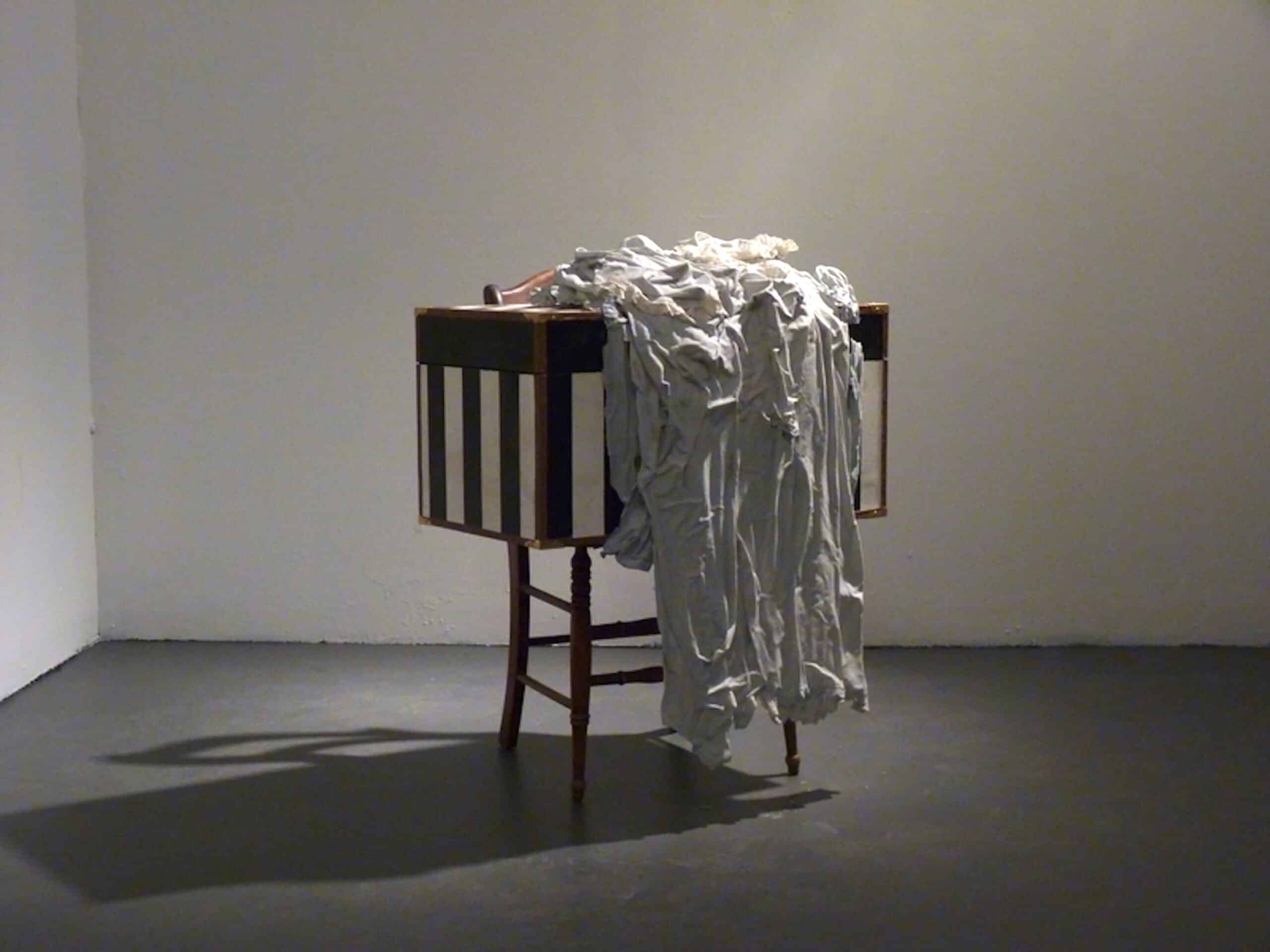
Rosa prefigures her feminist artistic practice and social art engagement. The artwork emerged from a visit by the artist with her mother to the abandoned and ransacked family home in Jalisco, Mexico. As they walked in, they encountered a container of memory—photographs scattered throughout and her mother’s old blue quinceañera dress resting atop a trunk.7 Faced with the emotions of the former dwelling, the family’s complex migratory experience, and ideas about childhood to womanhood, the scene left an indelible mark on her creative mind. Rather than using her mother’s original dress, which was her first item of clothing that was not a hand-me-down, Quezada Ureña intentionally designed and sewed a new version in her size.8 Submerging it in a batch of porcelain slip, she permanently altered it by fire, transforming it into the central art object of the installation. The dress lies on a brown-and-white striped trunk with a checkered surface atop a wooden chair, recalling the absence of past family sit-down gatherings and rich in semiotic signs of self, womanhood, and a borderland existence in an austere display of fabric as sculptural drapery and landscape.9
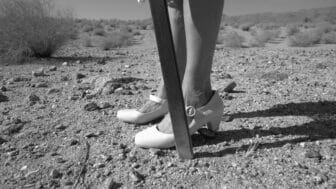
The complexity of displacement and crossings also animates Quezada Ureña’s art practice. She engages with the fraught history of sexual assaults and feminicides, the unsettling physical and emotional borders of imported labor and human commodification, and the alienation experienced in an untethered existence.10 Her series Árbol de Violencia (2015) directly intervenes in the Sonoran Desert to bring attention to a silenced violence. The trees and thriving vegetation become the harsh setting for porcelain undergarments, with originals donated to the artist as amplified statements of heinous acts, resilience, and restoration. Women and girls have been separated from their migrant groups by coyotes (smugglers), who, in acts of hypermasculine aggression, sexually assault them and hang their underwear in the Sonoran trees or “Rape Tree” as trophies.11 The sculptural pieces are rehung as a testament to the unspoken stories and the societal indifference to misogynistic acts. The artist interprets the heinous act aftermath “as an additional claim over their body, their undergarments are taken and hung as signifiers of this violence.”12 With her intervention, victims can “reclaim the rape trees in a sort of still action of protest.”13
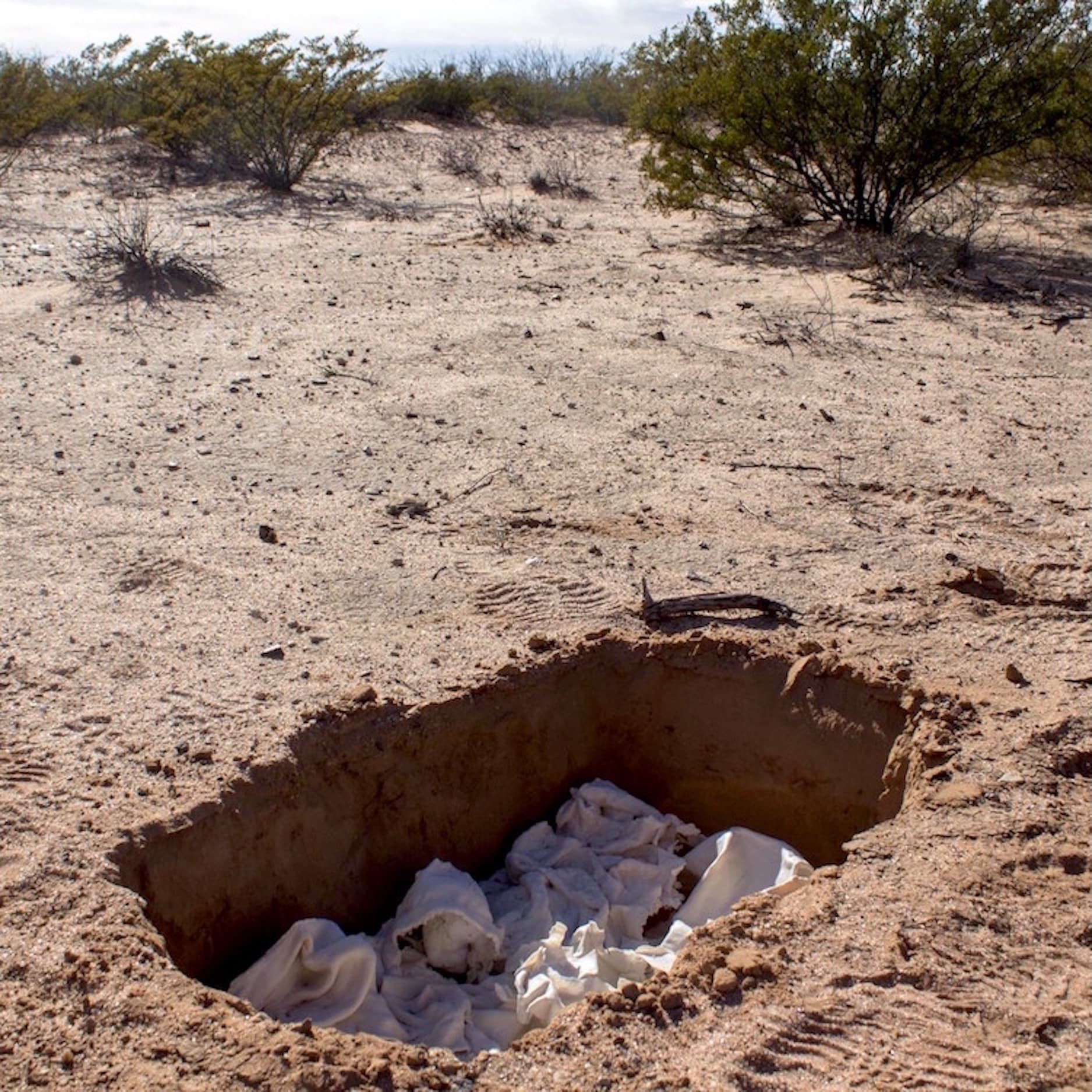
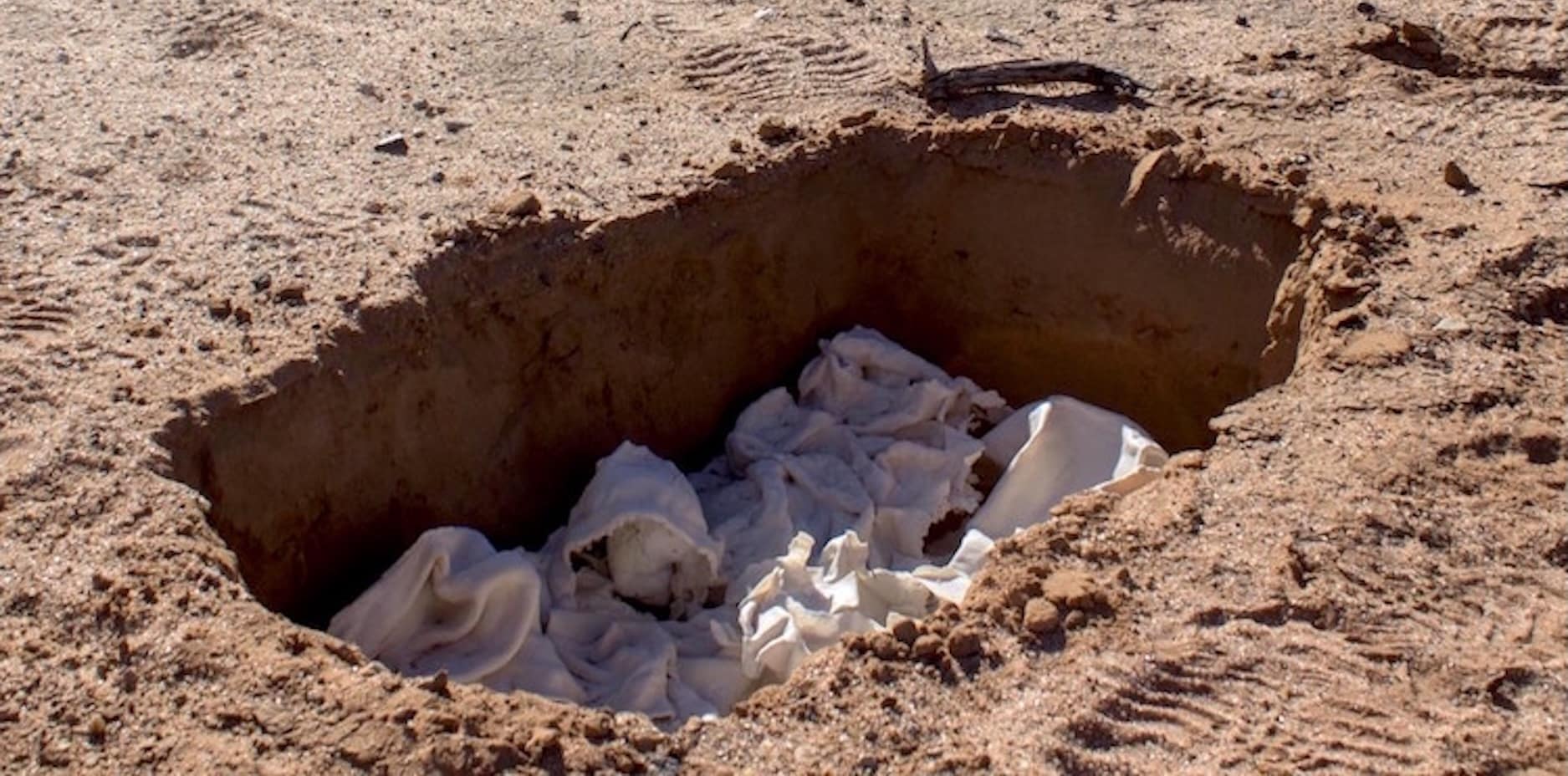
In the same desert, Quezada Ureña also completed site-specific land art works in 2016, where she altered the natural strata by digging open graves and filling them with porcelain undergarment remains, which stood in stark contrast to the earthy landscape. The artist’s intent forced people not to walk over these graves but to engage in unsettling conversations about the abduction and femicides of mostly maquila (factory) workers in Ciudad Juárez, the abandonment of bodies, and the impunity of perpetrators in an abject failure of international law and human rights. Thus, she underscores the reality of deserts as migration corridors of violence and atrocities elsewhere.
In the gallery, her installation work intentionally alters the space by critiquing structural foundations that resist change. To influence emotion and sway viewer perceptions, she has incorporated soil sourced from the U.S.-Mexico borderlands to ground her narrative in artworks such as Desplazamiento | Contención (2017; Displacement | Containment), where she alludes to references in U.S. immigration history, such as the 2014 climate refugee crisis from the Northern Triangle. The artist worked with migrant and first-generation middle school children and youth in New Mexico and Colorado, transforming their donated garments into the permanent porcelain objects featured in the installation.14 Moreover, to delve into their unsettledness of family displacement and precarity, the artist engaged them in testimonio and critical pláticas as methods to elicit memories and storytelling. Their spoken inconvenient truths became the installation’s soundscape of the border region, in a multisensory aural and visual experience.15

Presented at the Denver Museum of Art in 2017, Desplazamiento | Contención creates a visual minimalist and formal dialogue with light and space in a raw exploration of immigration policies, detainment, and separation. The tension reflected in the title, wherein the words desplazamiento and contención are separated by a vertical slash, just like a border wall securing a territory, also performs exclusion and containment in immigrant communities. Amplifying the artwork are two conjoint spaces visually divided by concrete and wood flooring and an open path for visitors. In one, the displacement segment, an actual border fence serves as the backdrop to a large pallet cardboard box marked with names of the then-North American Free Trade Agreement (NAFTA) members: USA, Canada, and Mexico. NAFTA allowed the unrestricted mobility of goods and produce, yet constrained human mobility, except for professional classes under the NAFTA Professional (TN) visa. The box, filled with the porcelain garments, becomes the holder of the youth’s memories and dreams in danger of never becoming realized as their voices permeate the gallery space. On the opposite side, the containment segment, two large rectangular concrete blocks become the signifier for earth and the United States—a symbol of mid-century modernity, skyscrapers, cities, and development, and an affluent society. Here, the blocks are deterrents, a contention to their climate-related migration, and a critical call to attention to contradictory U.S. refugee policies and responses.
Quezada Ureña’s artistic practice, addressing timeless and complex topics, contributes to a rich conversation of the social, political, and economic global, fraught landscape. The incorporation of porcelain garments in her artwork illuminates the fragility and precarity of our times, while calling attention to the individuals and their humanity—women, youth, and migrants—in a diasporic untethering.
Endnotes
- Jordan Eddy, “Studio Visit with Daisy Quezada,” Southwest Contemporary, July 30, 2018, https://southwestcontemporary.com/daisy-quezada/. ↩︎
- Gloria Anzaldúa, Borderlands/La Frontera: The New Mestiza (Aunt Lute Books, 1987), 3. Quezada Ureña was also influenced by the book Talking Visions: Multicultural Feminism in a Transnational Age edited by Ella Shohat (MIT Press, 2001) and other of Anzaldúa’s writings framing Mexican American life and experience in the borderlands. Daisy Quezada Ureña, interview with author, May 30, 2025 ↩︎
- First encountering sculptural ceramic art at the College of Santa Fe (later Santa Fe University of Art and Design), which she attended with a tennis scholarship, Quezada Ureña was inspired by Susan York, a minimalist Cranbrook-trained sculpture faculty, to adopt the medium, experimenting with various techniques. ↩︎
- Quezada Ureña, interview with author, May 30, 2025. ↩︎
- Communication with the artist, November 10, 2025. ↩︎
- Daisy Quezada Ureña in Lena Astilli, “Porcelain Bridges for Cement Borders: Artist Interview with Daisy Quezada Ureña,” ARID Fine Art (2020), https://aridart.com/2020/02/05/artist-interview-with-daisy-quezada-urena/. ↩︎
- Eddy, “Studio Visit.” ↩︎
- In creating a new dress, the artist emphasized the need of the original to be left in its own historical context—she did not feel she had the “right to take it out of that space.” Eddy, “Studio Visit. ↩︎
- As an artist of social engagement, she finds her own rootedness in a strong sense of family and an expanded community as evident in projects like Terrenos | Borderland Linguistics and bosque brotante with the global collective Present Cartographers, which she cofounded with Sylvia Arthur and Lois Klassen, to address border zones. ↩︎
- Gloria Anzaldúa also underscores gender-based violence, and the unimaginable risks women run in crossing the border with coyotes. See Anzaldúa, Borderlands/La Frontera, 12. ↩︎
- The artist recalls activists’ visits to her Tucson high school to raise awareness of femicides in Ciudad Juárez. Eddy, “Studio Visit.” ↩︎
- Daisy Quezada Ureña, “X as Intersection: The Art of Research,” November 15, 2023, Virtual Public Panel co-hosted by the National Museum of Mexican Art and the US Latinx Art Forum, 1:32:09, https://youtu.be/q1Y5ciUnDK0?si=xkoU0_LIlt6Mu8VS. ↩︎
- Quezada Ureña, “X as Intersection.” ↩︎
- As part of the exhibition Mi Tierra: Contemporary Artists Explore Place, Quezada Ureña engaged middle school children attending Monte del Sol Charter School in Santa Fe, New Mexico, and students enrolled in the Downtown Aurora Visual Arts in Aurora, Colorado. See Madeleine Sardina, “Dizplazamiento [sic] Contención,” The Jackalope, February 13, 2017,https://jackalopemagazine.com/2017/02/13/displazamiento-contencion-by-daisy-quezada/. ↩︎
- The artist returned photos of the original items and the porcelain sculptural pieces and fragments to their young owners. Astilli, “Porcelain Bridges. ↩︎
Cite as: Olga U. Herrera, “(Un) tethered Materiality: The Fabric of a Fraught Landscape,” in X as Intersection: Writing on Latinx Art, April 2, 2026, accessed [DATE], https://uslaf.org/essay/2-un-tethered-materiality-the-fabric-of-a-fraught-landscape/.
Olga U. Herrera is an art historian, scholar, independent curator, and currently Managing Director of the Crossing Latinidades Humanities Research Initiative at UIC. Her research focuses on the intersections of globalization, networks of cultural production, and the circulation of modern and contemporary art of the Americas.