
Presence in Absence: Verónica Gaona’s Spanning Worlds

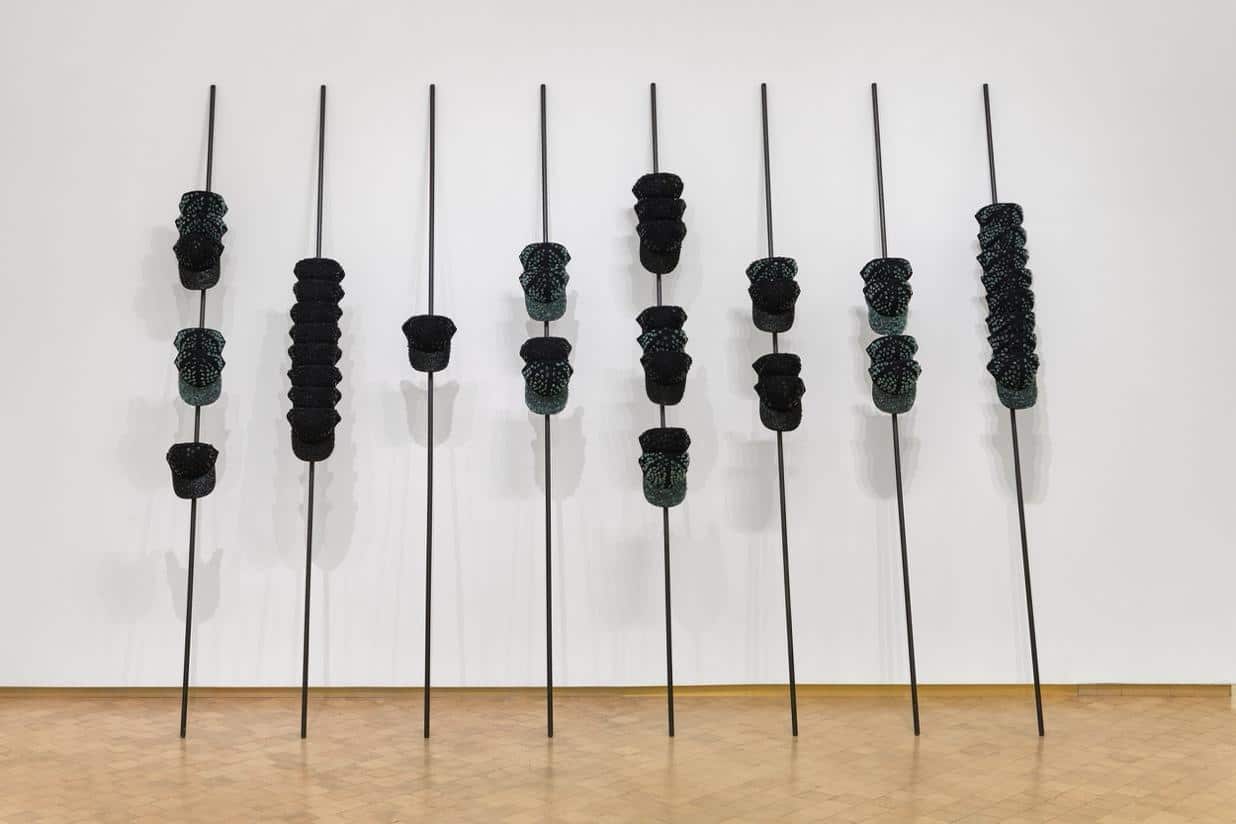
Verónica Gaona’s Spanning Worlds (2024) is a multimedia sculpture series consisting of several black caps studded with tinted and transparent glass shards salvaged from a Ford F-150 truck. The caps are pierced and held together by steel rods and showcased resting vertically against the wall. When exhibited, the rods holding the black studded headpieces in place are displayed either individually reclined in the corner of gallery spaces, or as a grouping of rods whose narrow and elongated form is eased with the horizontal punctuation of caps that once belonged to migrants. This arrangement of punctuated rods visually evokes the non-traditional music notation found in graphic scores. While not graphic scores, the sculptural compositions of Spanning Worlds provide a glimpse towards the listening practices and sonic engagements of Gaona and those whom she is in communion with.1 She takes sculpture—an artistic medium with a rich history and tradition of engaging the living human body as an embodied subject—to attune audiences to sensorial possibilities that are not readily recognizable, such as the possibility to recall and imagine sonic environments through visual cues and without the presentation of sound.2 Additionally, Spanning Worlds‘s title echoes the core philosophical concept attributed to the Ejército Zapatista de Liberación Nacional (Zapatista Army of National Liberation, EZLN by its Spanish initials) of seeking “a world where many worlds fit.”3 I allude to this concept not to suggest that this is Gaona’s direct citation, but rather to emphasize that Spanning Worlds invokes a necessary and desired environment that recognizes and welcomes, rather than annihilates, the other.4 It does this through poesy and form as sculptural means and sonic allusions. I am also led to recall Antonio Gramsci’s concept of hegemony as it reminds us that the nefarious desire to do away with the other is established through a complex “process of moral, philosophical, and political leadership that a social group attains only with the active consent of other important social groups.”5 I situate Gaona’s Spanning Worlds in conversation with the Zapatista and Gramscian philosophical traditions to further draw attention to our individual role in contending with the hierarchical relationships and vetted interests that have come to shape our experienced environments.
Gaona’s usage of studded caps and rebar in Spanning Worlds can be read as a call to a manifestation of physical and nonphysical spaces (i.e. environments), and to communal solidarities predicated on shared lived experiences.6 In this case, her choice of materials signals to labor and fashion respectively: two industries through which the process of racializing individual lives and Latinx communities takes place such as at construction sites and garment textile mills. These workplaces reinforce discriminatory practices by categorizing laborers through nationality-based profiling and weaponize xenophobic policies that heighten vulnerability to systemic abuse and labor rights violations. Yet, Gaona’s sculptural approach for this multimedia piece and others, such as the individual glass-studded black caps that constitute Each Head Is a World (2024), evoke labor and fashion without giving way to representations of racialized life that under the capitalist entrepreneurial logic and guise of hard work and sacrifice is continuously exploited for profit with the false promise of granting basic human dignity in return.7 Rather than reproducing clear visual or auditory representations of harm carried out against migrants, Gaona employs narrative restraints that see her selectively and pointedly signal to the correlation between labor and hope found in concepts of desire and disillusion that accord to the affective register which scholar Alicia Schmidt Camacho has described as a state of migrant melancholia. 8
Gaona evokes the “melancholic aspect of the journey north” through the reworking of materials—caps, tinted glass and rods—that are associated with labor, self-stylizing, and auto customization.9 The steel rods that support the caps of Spanning Worlds allude to the architectural infrastructure found in single-family homes and paved roads that are funded by immigrant remittances and fueled by the desire to bridge both emotional and physical distances from the land and people who have nurtured them. The black, glass-studded caps for Spanning Worlds are clearly designated as the belongings of migrants in both her portfolio description and the exhibition labels that provide audiences information of the materials used for the construction of this specific artwork.10 Furthermore, Gaona demarcates the hat as migrant belongings through this simple gesture of categorization leading us to account for the migrant body in Spanning Worlds without reintroducing their corporeality in exhibition settings. Similarly, by only using the salvaged glass shards and black cap, she takes an austere approach at signaling to paisa/cartel/ranchero aesthetics which favor lavish modes of self-stylizing that often blend Western attire with visually striking qualities such as the ornate motifs found in Gianni Versace’s Summer 1992 collection and the studded and red-bottom designs by Christian Louboutin. This mode of self-stylizing with which Gaona became familiar in the Rio Grande Valley region of South Texas and the northeastern side of Tamaulipas, Mexico, demarcates a modality transcending across and beyond the territorial and legislative boundaries associated with governmental bodies across the Mexico–U.S. border. In short, through these traces of corporeal absence in Spanning Worlds, Gaona asserts the migrant presence through strategies of visual obscuration and denial.
However, the migrant presence, evoked in Spanning Worlds through allusions to the trokiando and buchón subcultures, pertains to a broad category of people who find intimacy among rural and decadent sensibilities that are often perceived as being incompatible to one another and as obstructing adequate modes of civility. Here I’d like to return to the sonic allusions of Gaona’s work given that the regional and urban music traditions and scenes which inform her artwork and the migrant and immigrant modalities she references have been constantly criminalized and made subject to restrictive measures. This persecution of everyday life has resulted in concert and visa bans, as well as threats of censorship enforced by both Mexican and U.S. government officials who situate sonic narrative art forms, like that of the corrido in all its various subgenre iterations including the corrido tumbado, as putrefying extensions of criminal modalities and regimes while failing to account for inquisitive or critical listening practices. These last ones often deprioritize rigid social conventions and actively partake in the celebration of narratives that cite personal intimacies, such as overcoming poverty and facing racialized violence.11 Listeners of these genres partake in exercises that affirm dignity as a basic human right regardless of the social or criminal status of individuals, but perhaps more crucially, they signal to the desire for new life possibilities and attest to an understanding that legal and civic mechanisms have the capacity to produce harm unjustifiably.
Informed by this context of persecution of life, Gaona gives way to new zones of possibilities in Spanning Worlds that assert the dignity sought in modalities of difference through the assertion of plurality and multiplicity. This is accomplished conceptually through the physical objects and language that render environments and people legible through the clear designation of the caps as migrant belongings, but also by the volume and shadows that the sculptural work casts. That is, Spanning Worlds’s nonmaterial qualities—the shadows it casts and the sonic or music tradition it evokes—produce immaterial and transmutable volumes and forms that reconfigure according to the particularities of its exhibited setting. Through this reconstitution of space via the immaterial, the artist reminds us of the capacity to account for the materially absent to serve as the catalyst for change. The artist’s play with the concepts of time and space through sculpture allows registers of identity to move beyond the minimizing forces that see life rendered as fixed, categorical units from which to extract profit.
Endnotes
- Some of the artists who constitute the musical tradition engaged in this text include Junior H, Natanael Cano, Fuerza Régida, Peso Pluma, Netón Vega, Marca MP, Ariel Camacho, Officialalex425, Ivan Cornejo, Grupo Firme, Eslabón Armado, Danny Lux, Marca Registrada, T3R Elemento, Los Del Limit, Los Cadetes de Linares, Chalino Sanchez, Carlos y José, Valentín Elizalde, Julión Álvarez y su Norteño Banda, Ariel Camacho, and more. ↩︎
- Ingvild Torsen, “The Persistence of the Body in Sculpture after Abstraction,” in Philosophy of Sculpture: Historical Problems, Contemporary Approaches, ed. Kristin Gjesdal, Fred Rush, and Ingvild Torsen (Abingdon: Routledge, 2020), 111-129, https://research-ebsco-com.stanford.idm.oclc.org/linkprocessor/plink?id=e9d884d1-fcc1-3931-9057-2d7aa8800c91. ↩︎
- Luis Gómez Romero, “‘A World Where Many Worlds Fit’: On the Zapatista Model of a Just Society,” Law Text Culture 27, no. 1 (2023): 154–203, https://doi.org/10.14453/ltc.508. ↩︎
- By the “other” I mean that which is deemed foreign or different by the ruling class. ↩︎
- Lee Artz and Bren Ortega Murphy, Cultural Hegemony in the United States (SAGE Publications, 2000). ↩︎
- A distinguished audiovisual example that gives way to sights and sounds of communal solidarities that transcend geographical and temporal boundaries, like those I perceive unfolding in Verónica Gaona’s Spanning Worlds, is Juan Sánchez (b. 1954; Brooklyn NY), Unknown Boricua Streaming: Nuyorican State of Mind (2011), single-channel HD video, 8 minutes 9 seconds. For more, see Arlene Dávila, “Juan Sánchez’s Nuyorican State of Mind,” Hyperallergic, accessed June 18, 2025, https://hyperallergic.com/772248/juan-sanchez-nuyorican-state-of-mind/. ↩︎
- Aída Hurtado and Norma E. Cantú, MeXicana Fashions: Politics, Self-Adornment, and Identity Construction (University of Texas Press, 2020), https://doi.org/10.7560/319581. ↩︎
- Alicia Schmidt Camacho, “Migrant Melancholia: Emergent Discourses of Mexican Migrant Traffic in Transnational Space,” South Atlantic Quarterly 105, no. 4 (October 2006): 831–61, https://doi.org/10.1215/00382876-2006-007. ↩︎
- Schmidt Camacho, “Migrant Melancholia,” 832. ↩︎
- Verónica Goana, “Spanning Worlds,” accessed April 27, 2024, https://www.gaonaveronica.com/spanningworlds. ↩︎
- Corridos with these thematic lyrics include, but are not limited to, the following: Joan Sebastian, La venganza de Tina (1992); Los Originales Cadetes de Linares, El muchacho y el potro (1994); Bajo Perfil, Si me piden un paro (2020); Los Chavalos De California, El cambio de vida (2019); Zexta Alianza & Javier Olguín, Don nadie (2023); Los Dos de Tamaulipas, El humilde (2020); Grupo Marca Registrada, Empatía, (2024); Beto Quintanilla, Corrido de la consecuencia (2025). ↩︎
Cite as: Javier Arellano Vences, “Presence in Absence: Verónica Gaona’s Spanning Worlds,” in X as Intersection: Writing on Latinx Art, January 13, 2026, accessed [DATE], https://uslaf.org/essay/presence-in-absence-veronica-gaonas-spanning-worlds.
Javier Arellano Vences is a curator and scholar of modern and contemporary art. His research on the arts of U.S. Latinx and Latin American diasporas engages with discourses of race, identity, vernacular art, and conceptual art. He is a Ph.D. candidate in Art History at Stanford University.