
Las Nietas de Nonó: Ilustraciones de la Mecánica and Spaces of Refusal
At the Root
There is a weight in the way we carry our hair. In every twist, knot, and strand, there are stories—some inherited, some imposed, others still coming loose. For Black women, hair is more than appearance; it is geography, archive, labor, and, at times, battleground. In their performance, Ilustraciones de la Mecánica (2019), afro-diasporic siblings mulowayi and mapenzi Nonó—Las Nietas de Nonó—allude to and expand that battleground. Under colonial racial capitalism: a system in which capitalism and racism emerged together and became mutually constitutive, hair becomes a site where survival and resistance take form. Racial difference is fundamental to capitalism, produced and exploited for economic gain through dispossession of Indigenous lands and enslaved labor.1 Practices of hair, community, and care are acts of endurance, self-definition, and collective memory. In their performance, they resist colonial extraction—of labor, culture, and bodies— by transforming clinical spaces of exploitation into domestic and cultural zones of reciprocal care, refusal, and memory. What emerges is a geography of resistance grounded in Black Puerto Rican life, where sovereignty is claimed through the very materials and rituals that the empire tries to erase.
Ilustraciones de la Mecánica
Ilustraciones de la Mecánica, performed at the Whitney Biennial in New York City, opens with a metal examination table, covered in a sterile white sheet. One sister lies across it, her lower half exposed except for white hospital-grade underwear, the rest of her body draped in a soft yellow skirt. The other sister, cloaked in a white lab coat and a translucent facial veil, moves around her with quiet intent. She sets a metal bucket down with a sharp thud that cuts through the drone of flickering screens and humming machines. The inspection that follows evokes a gynecological surgery but using beets and fruit. Their juices run deep red, seeping into the fabric and staining the sheet and the underwear beneath. Afterward, the reclining sister rises slowly. Her once-white garments are now soaked in red. She clutches a clinical folder against her chest and lifts a rubber mask of a man’s face over her own. One hand scratches anxiously at her exposed thigh. She stares forward, directly into the audience, who remain still, unable—unwilling—to look away.
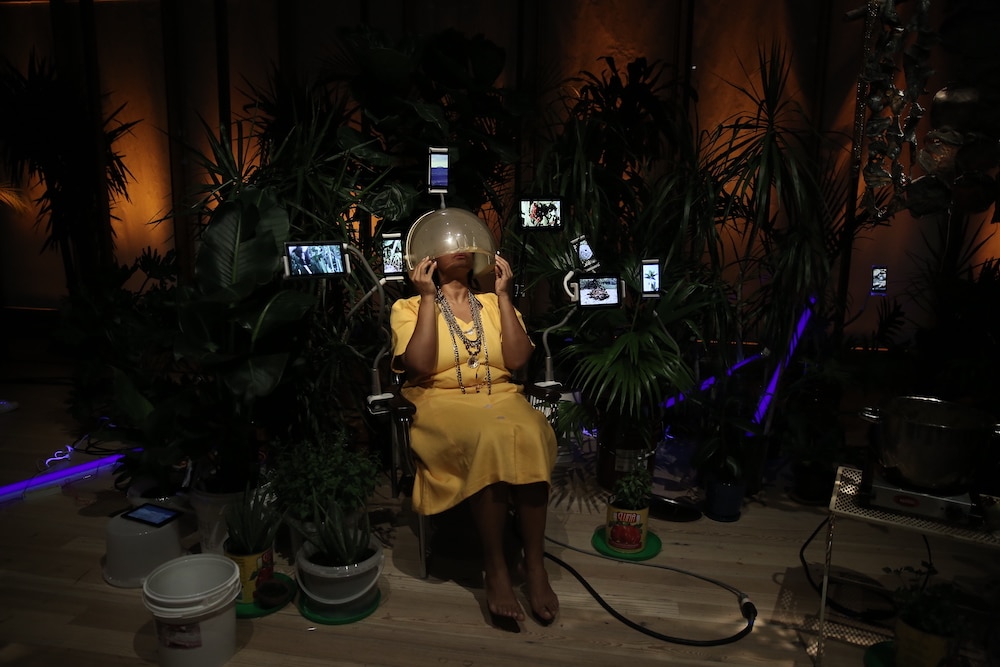
The sisters transition to what resembles a classroom. The masked sister takes a seat at a small desk, still facing the crowd. The other, now gloved in yellow rubber, walks toward a blackboard and begins to write: Ilustraciones de la Mecánica. The chalk squeaks, loud, deliberate, slicing through the low pulse of surrounding electronics. As she hangs strips of leather-like material along a line, the masked sister begins to punch the air. Her gestures are sharp but misaligned. The sound shifts—a heart now beats through the speakers, heavy and arrhythmic. Her fists and the thuds never sync. The lights dim until only the masked figure remains seated and shaking maracas. The other sister’s face is now covered in a stitched leather mask; the mood shifts from clinical to spectral. Then, a new space appears: a makeshift forest glowing with soft green light. Screens flicker at the edges. At its center, a vintage salon hair dryer lamp stands like a strange altar. The sister who once wore the lab coat now appears in a bright yellow housedress, the kind many Caribbean grandmothers wear. She stirs a pot of thick yellow stew as her sibling, now unmasked, takes a seat beneath the dryer, eyes closed. The mechanical hum never ceases. In the final moments, the roles reverse once more. The sister who once lay on the table now tends the pot. But she does not stop there. She fills a small plastic bowl, steps forward, and hands it to an audience member—meeting their gaze and offering the soup not as a performance, but as a gesture that reaches across the gallery space.
Medical Industrial Complex
Las Nietas de Nonó evoke multiple spaces, including the laboratory of medical and labor extraction alluding to the medical industrial complex. The performance begins with a scalpel’s aura: one sister as doctor, the other as patient, lying on a metal table. In silence, they prepare for surgery with grated beets and leather-like sheets—organic materials that stand in for blood and flesh. The reenactment summons the very real history of Puerto Rico as a laboratory for the United States’ colonial capitalist experiments. For decades, pharmaceutical companies and medical researchers used the archipelago as a testing ground, exploiting its colonial status to bypass regulations and ethics boards. Puerto Rican women’s bodies were subjected to invasive procedures—mass sterilizations carried out under the gentle-sounding lies of population control and modernization.2
The siblings move slowly, deliberately, trading places in a rhythm of their own—disrupting the churn of market time, a tempo not tuned to the body, but to the hunger of a system that never stops asking for more. Under colonial racial capitalism, labor, whether on the plantation, in the factory, in the salon, is expected to be efficient–– extractive and unceasing. By refusing that tempo, the performance breaks the spell. In the salon setting, for instance, the hands do not rush to flatten, curl, or finish. Instead, the work unfolds in its own rhythm, unsettling the expectation that Black and Brown bodies must always conform and produce at the pace of profit. In that refusal, Las Nietas create a space that is humanized, where care is measured not by speed or yield but by presence, intimacy, and resistance.3 This resistance extends outward, into land, neighborhood, and cultural memory.
Barrio San Antón
Las Nietas’ work is steeped in the soil of Barrio San Antón in Carolina, Puerto Rico, a historically Black neighborhood reshaped by the slow violence of urban redevelopment. San Antón itself has been a site of extraction and displacement.4 Once dismissed by developers as a zone of blight, it was strategically devalued—its properties cheapened, its infrastructures neglected—only to be rebranded as an attractive frontier for investment.5 The same plants, tools, and stories that once anchored community life become props in glossy redevelopment brochures. In this economy, even healing becomes a marketable aesthetic, stripped of the people and histories that gave it form.
In Ilustraciones de la Mecánica, Las Nietas refuse that stripping away. Their gallery transforms into a living composite of San Antón itself, plants potted in paint buckets, tools that have passed through generations, gestures inherited from healers who worked without clinics or state sanction. This act of tending—of turning the gallery into a forest-clinic-salon—renders the audience witnesses to a performance and to a living archive of resistance. It is San Antón’s refusal embodied: the insistence that what has been devalued holds its own value, that care can move at its own pace, and that memory can outlast the speculative clock.
The Salon
Resistance is not only rooted in place—it’s also felt in the body, where memory settles into muscle, into scalp, into strand. If the forest-clinic of Ilustraciones de la Mecánica roots itself in San Antón’s soil, then the salon hum anchors it in the textures of Black Puerto Rican life. Beneath the dryer, an archive turns quietly: hair as record, hair as witness. Each strand carries the memory of salt air and chemical burn, of the patient weight of braiding hands, of the days it was allowed to rest untouched. The dryer’s dome is a paradox: shelter and restraint. It shields from the draft while holding the head still, fixing the sitter in place. When the sisters exchange seats, the change is more than choreography—it shifts the structure of care itself. Giving and receiving, touching and being touched, exposure and protection move in equal measure.6
This is where Ilustraciones de la Mecánica names the extractive logics without speaking to them. Colonial racial capitalism feeds on Black women’s labor and style, branding our textures “unprofessional” when natural but “cutting-edge” when reimagined for white consumption.7 The salon in Mecánica becomes a counter-archive: the same tools that once disciplined hair into acceptable forms are turned toward sustenance, toward the preservation of texture and relation.
Spaces of Refusal
Through Ilustraciones de la Mecánica, Las Nietas de Nonó address a larger spatial logic of violence and resistance, where care remaps the very terrain that extraction sought to erase—a geography shaped by displacement yet remade through ritual care.8 Indeed, colonial racial capitalism affirms how Puerto Rico, as a colonial setting, is positioned for low-cost extraction: of labor, of culture, of bodies. But in Ilustraciones de la Mecánica, the clock of capital is slowed. Beats aren’t in sync. Movements linger. Care is cyclical rather than linear. Value accrues not in profit but in breath, scent, texture, and connection—a refusal to let beauty labor be severed from the community and histories that sustain it, just as the food is shared.
Nonetheless, even in that surgical space, the ghosts of colonial racial capitalism linger. They haunt the metal table, the clinical folder, the blood-red stain of beets where flesh once bled. The scene mimics care, but echoes control—the choreography of inspection, exposure, and sterile order. It recalls the long history of gynecological violence on Black and Brown bodies, performed under the banner of science. In Ilustraciones de la Mecánica, surgery is reenactment and rupture: it reenacts the logics of bodily extraction while refusing to resolve into cure. The body sits up, stained and masked, holding the archive of what was done to it. That doubleness—care and violation—runs through the entire work. These are not closed rooms but porous ones, where fluids, gestures, and memory circulate like an underground economy, untaxed, uncounted, beyond the metrics of neoliberal development. Their aesthetic is not one of resolution, but of accumulation: oil, sweat, wire, scar, story. In these residues lies a wealth that cannot be extracted: kinship, embodied knowledge, refusal. Here, care is not a return to order. It is a staying-with disorder, what cannot be sterilized, what insists on surviving anyway.
Return to the Root
At its core, Ilustraciones de la Mecánica is about sovereignty—over flesh, over time, over the stories mapped onto Black and Brown bodies without consent. It is about naming what was taken: land, labor, memory—imagining what can be rewoven in its place. From the rituals whispered in kitchens to the sterile rituals of surgical theater, Las Nietas de Nonó’s work signals how every incision carries a counter-memory, every scar a strategy for survival. To return to the scalp as a site of possibility. What was cut does not disappear; it remembers. And what remembers can return—coiled, unruly, and free.
Endnotes
- Cedric J. Robinson, Black Marxism: The Making of the Black Radical Tradition (University of North Carolina Press, 1983), 9–28. ↩︎
- See: Laura Briggs, Reproducing Empire: Race, Sex, Science, and U.S. Imperialism in Puerto Rico (University of California Press, 2002). ↩︎
- Pepón Osorio, “Las Nietas de Nonó,” BOMB Magazine, December 5, 2018, https://bombmagazine.org/articles/2018/12/05/las-nietas-de-non%C3%B3/. ↩︎
- Rafael Picó, Zayda Buitrago de Santiago, and Héctor H. Berrios, Nueva geografía de Puerto Rico: física, económica, y social (Editorial Universitaria, Universidad de Puerto Rico, 1969). ↩︎
- See: Keeanga-Yamahtta Taylor, Race for Profit: How Banks and the Real Estate Industry Undermined Black Homeownership (University of North Carolina Press, 2019). ↩︎
- See: Inés Katzenstein, “Las Nietas de Nonó: Healing, Resistance, and Performance,” MoMA Magazine, Museum of Modern Art, 2020, https://www.moma.org/magazine/articles/716. ↩︎
- See: Shirley Anne Tate, Black Beauty: Aesthetics, Stylization, Politics (Ashgate, 2009). ↩︎
- See: Katherine McKittrick, Demonic Grounds: Black Women and the Cartographies of Struggle (University of Minnesota Press, 2006). ↩︎
Cite as: Estefanía jojo Santiago, “Las Nietas de Nonó: Ilustraciones de la Mecánica and Spaces of Refusal,” in X as Intersection: Writing on Latinx Art, January 13, 2026, accessed [DATE], https://uslaf.org/essay/las-nietas-de-nono-ilustraciones-de-la-mecanica-and-spaces-of-refusal/.
estefanía vallejo santiago is a Puerto Rican artist-scholar whose research focuses on modern and contemporary Puerto Rican art. Through decolonial theory, Caribbean feminist thought, and critical race methodologies, she examines how visual and performative practices foster collective memory, resist colonial structures, and assert communal identities through site-specific, Afro-Diasporic interventions.