
Songs of steel and current. Deep listening to Beatriz Cortez’s Speculative Archive of Earth and Migration
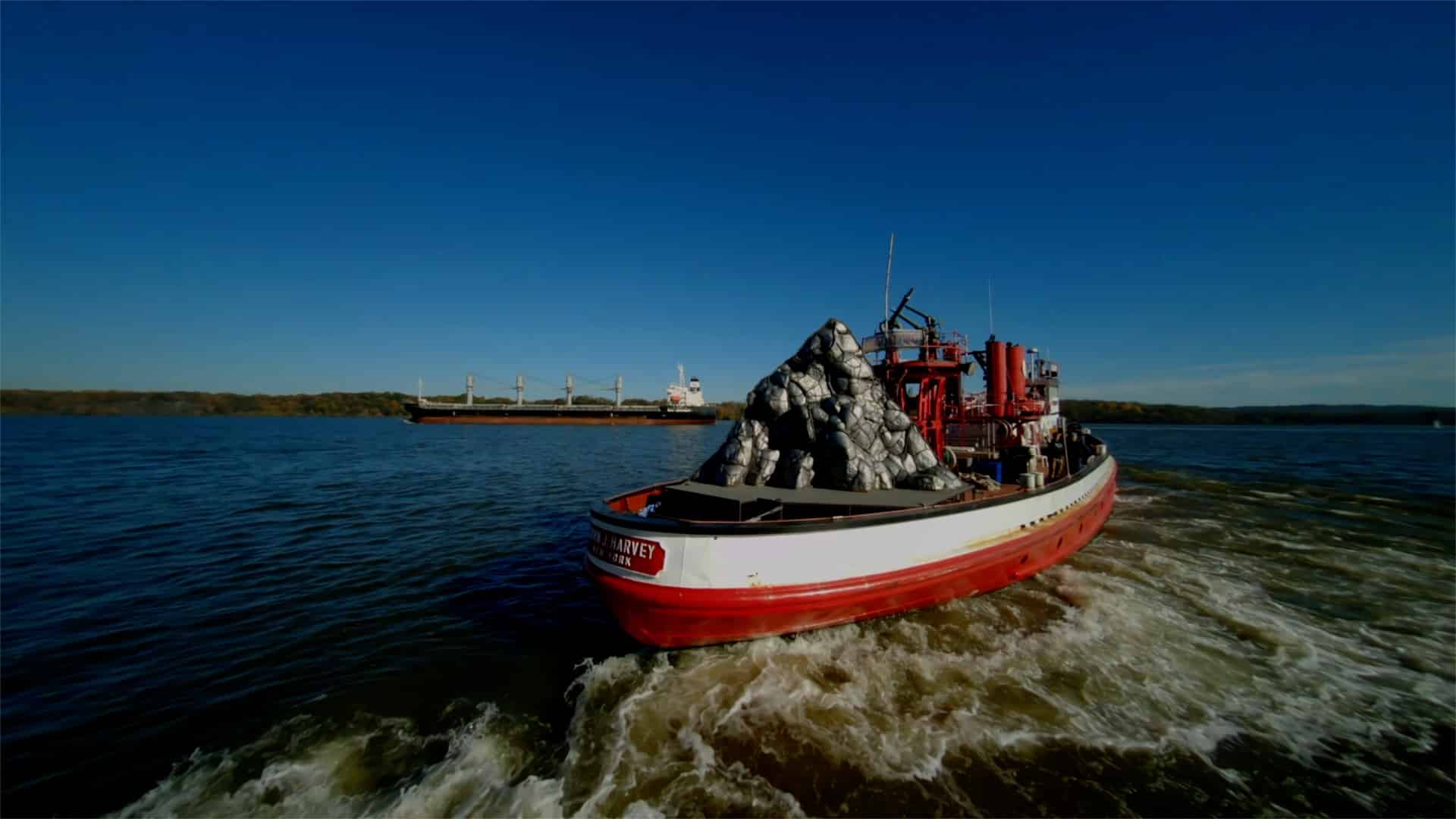
At dusk on an Autumn evening in Upstate New York, a brass-skinned volcano floated above the Hudson River. Ilopango hovered over the gleaming Muhheakantuck—the river that flows both ways—testing the rhythm of another body before speaking. Forged from steel, yet trembling with volcanic memory, Beatriz Cortez’s Ilopango, the Volcano that Left (2023) arrived at the riverfront Marina in Kingston as an emissary between geologies and diasporas, carrying the breath of ancient ash and the shimmer of migration on its contorted surface and welded seams.
Welded in France, transported across the Atlantic Ocean to be assembled in Los Angeles to end up on the United States’ East Coast, Cortez and her collaborators forged the volcano’s form through heat and dialogue, in a choreography of labor echoing eruption itself. More than a monument, the sculpture is a time-space portal—a volcano turned into a vessel that refuses the fixity of nation or epoch. Ilopango speaks to the past as if it were still smoldering, and to the future as if it were already returning. And it urges us to listen.
I approach Ilopango not as an artifact but as a conversation across time and space: a conversation between river and volcano, two beings who know that memory is carried in currents, sediments, and dust. What follows is my attempt to listen and dwell in their dialogue—and to annotate the resonances that their voices awaken.
Muhheakantuck: Who are you that travels on my currents?
Ilopango: I am the one that left. I represent Ilopango, once a storm of ashes, an explosion that began in El Salvador and scattered as far as Greenland. I speak for the famine disguised as sunlight dimming, the wound that became a lake. I have come to converse and unsettle memory. I am an eruption of Earth’s knowledge, collected through an artist’s memories.1
Muhheakantuck: You arrive as steel, as crater-machine, as altar. Do you come as ruin or as oracle?

Ilopango: I come as fragments assembled, never whole, always migrant. I am archive and kin.2 Ash is my language; dispersal is my method.3
Muhheakantuck: I, too, carry fragments. My currents move both ways, upstream and downstream, collapsing progress into circulation. I gather stories like sediments: Lenape, Mohawk, diasporic, and now, volcanic.4
Ilopango: Then we are kin. We are movers of memory and sculptors of terrain. We bear witness to dispersal. What others call a catastrophe, we know as transformation.
Muhheakantuck: Tell me of your leaving.
Ilopango: In 536 CE, the Tierra Blanca Joven eruption unfurled its plume. Ash fell on crops, on rivers, and lodged in lungs. Darkness lasted for months. Some called it an apocalypse. Yet what I left behind was not silence but memory: a cloud that traveled farther than nomads.
Muhheakantuck: And those particles, did they not suffocate?
Ilopango: They suffocated, but they also seeded. Dust lodged in Greenland’s ice, in Maya fields, in the veins of the Earth. My ashes became ubiquitous. I’m a reminder that matter vibrates, that debris has vitality. Ash is not residue. Ash insists on its own life.5
Muhheakantuck: I too hold life, not residue. In my currents float the songs of canoes, the whispers of ceremonies, the toxins of industry. My surface glitters with celestial reflections, but beneath, Lenape stories still breathe.6
Ilopango: You speak of double time, of progress and persistence together. I understand this. Beneath my welded skin, I too hold contradictions: eruption and stillness, destruction and renewal.
Muhheakantuck: And when humans see you, do they listen?

Ilopango: Some search for data, others for myth. I am an invitation to resist reconstruction. I am not replica but proposition. To stand before me is to enter speculation: to glimpse futures braided with pasts.7
Muhheakantuck: Futures woven from fragments. That is how I flow, between debris and renewal. Unlike rivers that move one way, I collapse chronology. I am progress undone.
Ilopango: You remind me of the Mesoamerican calendars—the Maya Long Count, the Aztec tonalpohualli and xiuhpohualli—human attempts to attune timekeeping to cosmic, terrestrial, and elemental cycles. In those reckonings, eras are born and extinguished like breaths, worlds dissolve and return and dissolve again. Time is not a line but a circulation, like water, like fire. You and I, river and volcano, are teachers of this.8
Muhheakantuck: Yet humans forget. They treat ash as waste, rivers as channels for commerce.
Ilopango: Forgetting is a form of violence. But listening with care, true listening, requires surrender. Deep listening is co-laboring with earth-beings. I am welded not as metaphor but as method: to remind humans that other beings also speak.9
Muhheakantuck: Then let us speak to them. For centuries I have carried vessels of conquest and of flight. I know migration in my own body. The same currents that bore canoes now drag cargo ships. I have swallowed their rituals, their prayers, and their pollutants. Migration is my daily rhythm, the ebb and flow of arrival and departure. Listening to my current is to remember that nothing truly stays, that even water learns to carry what it cannot keep.
Ilopango: Migration is not exclusively human. Ash disperses like exiles, scattered by violence and necessity. This is diasporic survival, not loss. Just as ash alters soils, migrant communities alter the landscapes they inhabit, carrying fragments of homeland into new constellations.10
Muhheakantuck: And I, tidal, know this truth. For centuries I have carried ships of settlers and ships of fugitives. The same water bore colonizers’ cannons and Lenape canoes. Migration is layered in my currents—it is trauma and possibility entwined.

Ilopango: Then flow with me. Let us carry memory forward.
Muhheakantuck: Together we may insist: the sacred is not permanence but movement.
To listen to Ilopango and Muhheakantuck is to hear the Earth contemplating itself, to sense how matter remembers across fracture, change, and flow. Cortez’s steel volcano becomes a medium for ancestral thought, a resonant surface where the planetary and the intimate converge.11 Her volcano does not monumentalize catastrophe; it translates it into kinship, into an ethics of relation that emerges from what has been scattered. In this way, Ilopango becomes a speculative archive that vibrates with futures already sedimented in the past.
The dialogue between river and volcano reminds us that archives are not static repositories but living ecologies of connection: currents of ash, sediment, and memory that resist containment. To practice deep listening with these beings is to unlearn extractive seeing, to hear the hum beneath steel and the pulse beneath the surface. Cortez’s work asks what it means to attend to the world not as scenery but as interlocutor: to treat debris as testimony, and movement as sacred continuity.12
In the end, what remains is the echo of their exchange—the shimmer of steel against water, the rhythm of two temporalities in conversation. Ilopango hovers, the river breathes, and together they remind us that migration, like memory, is not departure but circulation. The sacred, they whisper, is not stillness but persistence in motion.
Endnotes
- The year 536 CE has been described as “the worst year to be alive,” underscoring the eruption’s hemispheric effects. On the scale and planetary impact of the Tierra Blanca Joven eruption, see Robert A. Dull et al., “The 6th Century Tierra Blanca Joven Eruption of Ilopango Volcano, El Salvador,” Quaternary Science Reviews 222 (2019): 105855; and Ulf Büntgen et al., “Cooling and Societal Change during the Late Antique Little Ice Age,” Nature Geoscience 9, no. 3 (2016): 231–36. ↩︎
- Cortez’s notion of the archive departs from institutional or documentary models and aligns instead with Indigenous and decolonial understandings of memory as relational and embodied. For comparable approaches to archives as living ecologies, see Marisol de la Cadena, Earth Beings: Ecologies of Practice across Andean Worlds (Duke University Press, 2015). Cortez develops this archival logic materially in works such as Ilopango, where debris and fragmentation function as speculative records rather than historical evidence. ↩︎
- Ilopango was transported in fragments and assembled across multiple sites prior to traveling through the Hudson River, making movement constitutive of its form. This emphasis on mobility recurs throughout Cortez’s practice. For a broader discussion of volcanoes and planetary processes as dynamic rather than static entities, see Dipesh Chakrabarty, The Climate of History in a Planetary Age (University of Chicago Press, 2021). ↩︎
- The bidirectional circulation of the Muhheakantuck (Hudson River) was central to Lenape and Mohawk navigation and territorial relations prior to colonial reconfiguration. See Roxanne Dunbar-Ortiz, An Indigenous Peoples’ History of the United States (Beacon Press, 2014), esp. chapters 1–2. ↩︎
- Jane Bennett theorizes matter as active and self-organizing rather than inert or passive. See Bennett, Vibrant Matter: A Political Ecology of Things (Duke University Press, 2010), 3–19. Cortez’s insistence on ash as a living and migrating substance resonates with this framework while grounding vitality in geological catastrophe and diasporic histories rather than abstract materialism. ↩︎
- On Lenape relationships to land and waterways as storied and sentient entities, see Margaret Bruchac, “Earthshapers and Placemakers,” in Indigenous Archaeologies, ed. Claire Smith (Routledge, 2014), 79–92. ↩︎
- Rather than attempting geological reconstruction, Cortez mobilizes speculative aesthetics in which the volcano can appear simultaneously as altar, spacecraft, and migrant sculpture. This refusal of reconstruction in favor of proposition is central to her sculptural language and aligns with her broader interest in futurity shaped by displacement. ↩︎
- Mesoamerican calendrical systems—including the Maya Long Count and the Mexica tonalpohualli and xiuhpohualli—tracked cosmic cycles of 52, 260, and 5,200 years, situating human life within vast temporal rhythms rather than linear progress narratives. On Indigenous temporalities as forms of climate theory, see Kyle Powys Whyte, “Indigenous Science (Fiction) for the Anthropocene,” Environment and Planning E 1, nos. 1–2 (2018): 224–42. ↩︎
- “Deep listening” is used here not as a sonic methodology alone, but as an ethical and epistemic stance that requires attentiveness to nonhuman agencies. This usage resonates with María Puig de la Bellacasa’s articulation of care as a speculative practice. See Puig de la Bellacasa, Matters of Care: Speculative Ethics in More than Human Worlds (University of Minnesota Press, 2017), 41–67. ↩︎
- This expanded understanding of migration draws on cultural studies and Indigenous critiques of human exceptionalism. See Stuart Hall, “Cultural Identity and Diaspora,” in Identity: Community, Culture, Difference (Lawrence & Wishart, 1990), and Kyle Powys Whyte, “Indigenous Science (Fiction) for the Anthropocene,” Environment and Planning E 1, nos. 1–2 (2018): 224–42. ↩︎
- Beatriz Cortez’s sculptural practice consistently treats displacement—geological, architectural, and diasporic—as both method and condition. Ilopango extends earlier investigations into forced migration and futurity, positioning volcanic debris as a form of speculative knowledge rather than historical residue. ↩︎
- Cortez’s understanding of debris, movement, and material residue as interlocutors recurs across her practice. A key example is 1984–Space-Time Capsule (2018), where fragments of architecture and personal memory are assembled as a speculative vessel for temporal displacement and diasporic survival. As with Ilopango, the work resists monumentality in favor of portability, treating material remnants not as static ruins but as carriers of memory that speak across historical rupture and migration. ↩︎
Cite as: Paulina Ascencio Fuentes, “Songs of steel and current. Deep listening to Beatriz Cortez’s Speculative Archive of Earth and Migration,” in X as Intersection: Writing on Latinx Art, June 1, 2026, accessed [DATE], https://uslaf.org/essay/songs-of-steel-and-current/.
Paulina Ascencio Fuentes is a researcher, curator, and a Ph.D. candidate in Anthropology at New York University. Her research on “Terror verde/Green Terror” engages feminist ethics of care and collaborative methodologies to address fire practices, ecological violence, and Indigenous territorial struggles on the P’urhépecha Plateau, in Michoacán, Mexico.