The Border as Sacred Entity in the Work of Celia Álvarez Muñoz
The Border as Sacred Duality
In Petrocuatl (1988) and El Río Habla (2002), artist Celia Álvarez Muñoz constructs the border as a space of duality: a terrain where identities, languages, and memories intersect in both generative and destructive ways. The Rio Grande, historically crossed by countless people seeking survival, becomes a sanctified current of migration, memory, and exploitation. Many of these migrants found work in oil industries on either side of the border, entering systems that both sustained their families and exploited their labor. Álvarez Muñoz’s work surfaces this contradiction: the river as life-giving passage and the oil economy as destructive exploitation. By merging storytelling with critiques of colonial capitalism, she reframes the border not as a site of rupture but as a life-changing space shaped through contradictions. Sacredness is something that transforms, and in this context, the border is a liminal site that becomes a witness of constant change, making it a sacred space where transitions occur.
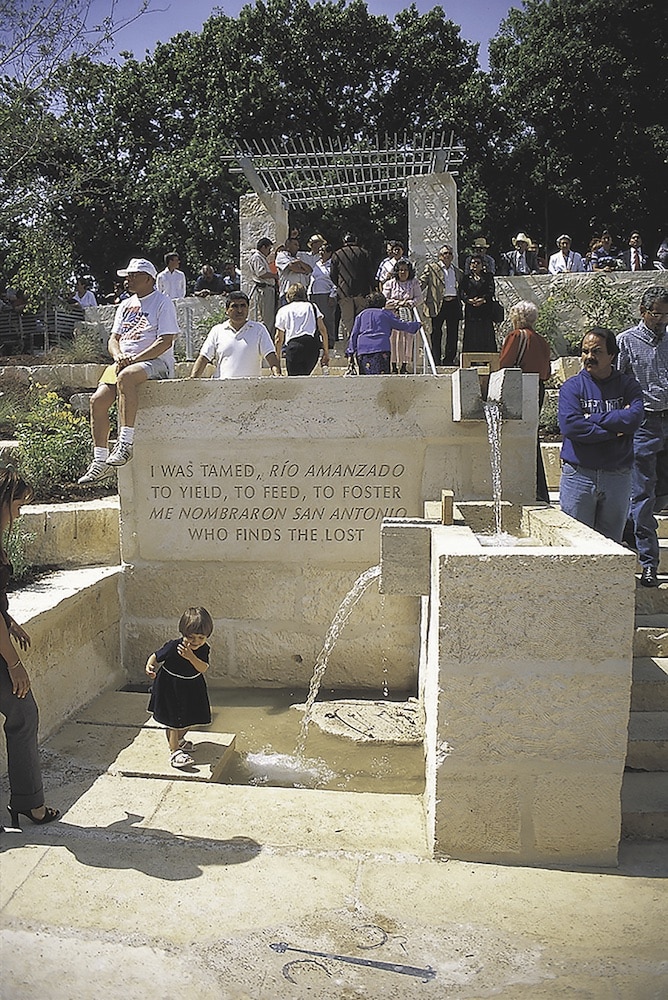
River Speaks, (2002). One of six landings
designed by the artist for the Historic
Civic Center River Link Project, San
Antonio, Texas. Courtesy of the artist.
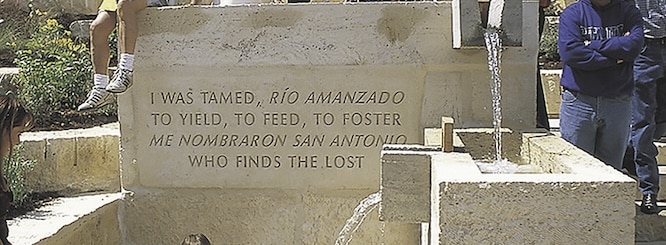
El Río Habla functions as a public artwork by embedding itself directly within the social, historical, and geographic realities of the Rio Grande as both a physical border and a lived space. Installed along the river that divides Mexico and the United States, the work activates the landscape itself as an interlocutor rather than a backdrop. Through bilingual text presented in public space, Álvarez Muñoz transforms the river into a speaking subject. One that addresses viewers as they encounter it within the very site it references. The work’s public nature is essential: it resists containment within the gallery and instead situates memory and labor history within everyday encounters. By locating the piece at the border, Álvarez Muñoz collapses distinctions between art, land, and lived experience, allowing the Río Grande to become an archive, as it simultaneously functions as witness and communal voice. The work’s accessibility and use of Spanish and English foreground the borderlands as a shared yet contested space, emphasizing that the histories carried by the river belong to those who depend on it.
The sacred emerges here not through traditional iconography but through bilingual poetics and oral histories. The people who cruzaron el río (crossed the river) carried stories, languages, and rituals across borders, embedding sacredness into daily acts of survival. Álvarez Muñoz foregrounds this in her linguistic play: shifting between Spanish and English to embody what Anzaldúa calls nepantla, an in-between space of contradiction and becoming.1 This linguistic hybridity itself becomes liminal, preserving identity across generations while also marking the wounds of displacement and assimilation.
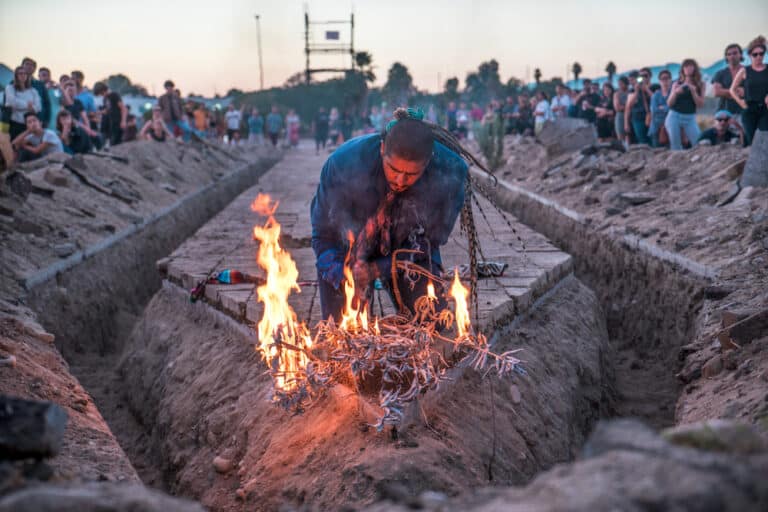
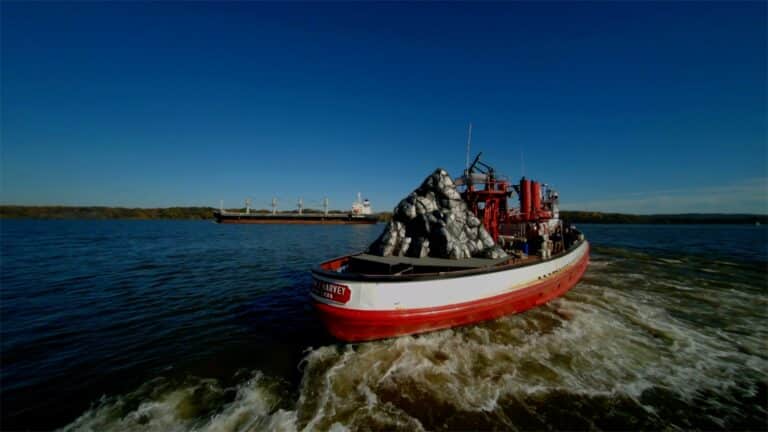
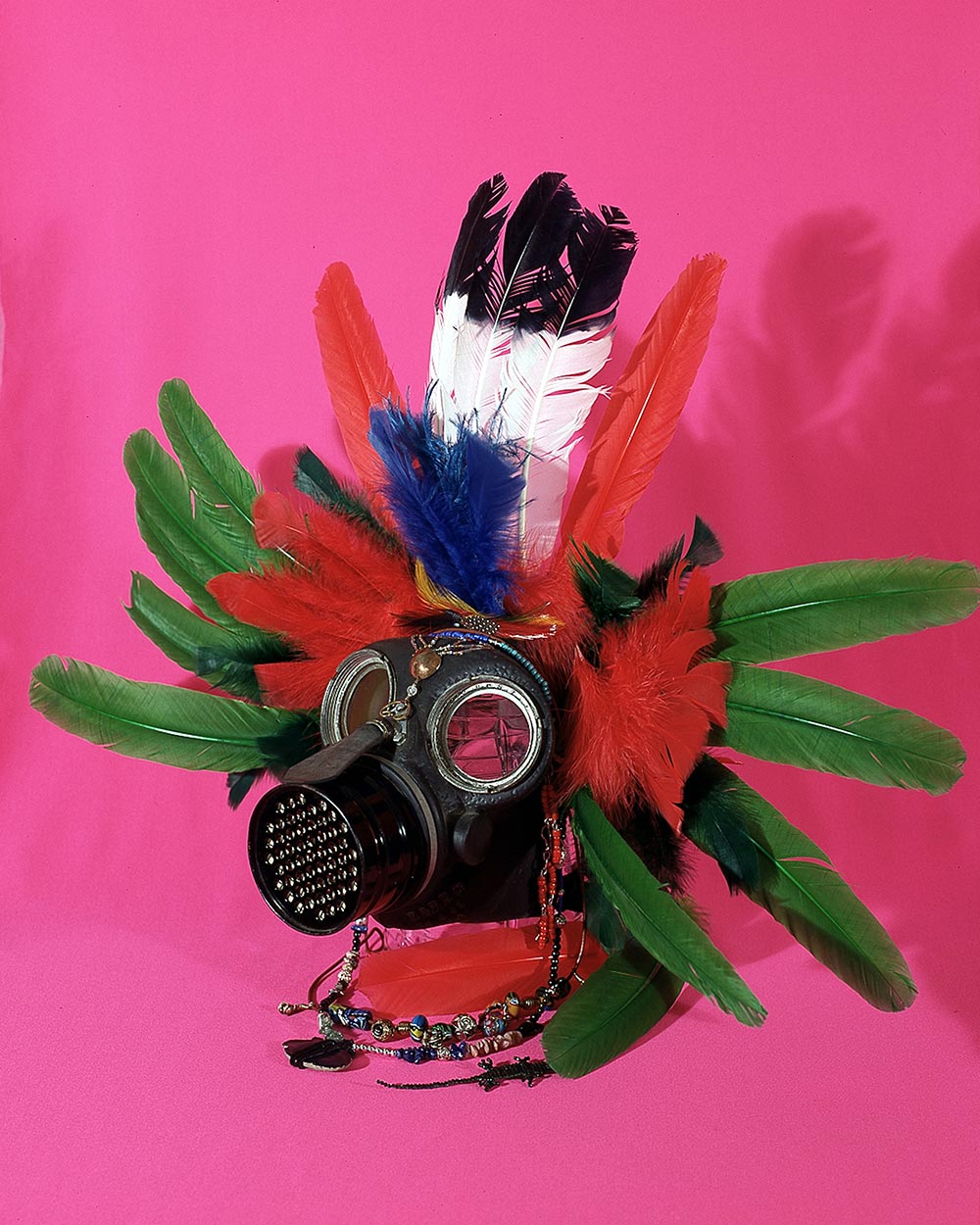
Both works illuminate how labor and land exploitation intertwine with memory and sacredness. In Petrocuatl, the hybrid figure fuses petróleo (oil) with Quetzalcoatl, the feathered Aztec serpent deity, symbolizing how indigenous cosmologies have been distorted by industrial capitalism.2 By invoking oil as a literal substance and as a linguistic and conceptual element, Álvarez Muñoz exposes the violence embedded in Mexico’s oil economy, particularly its entanglement with corruption, environmental destruction, and the exploitation of indigenous land and labor. The choice of materials and imagery underscores this tension. Oil, celebrated as a modern promise from Mexico and Texas, produced immense profits through corruption while devastating indigenous land and labor.3 Families who migrated north often entered the same cycle of exploitation, working for oil companies that capitalized on their displacement. Through performance, Álvarez Muñoz activates the body as a site where these contradictions collide. Thus, transforming the serpent of renewal becomes Petrocuatl, a symbol of both resilience and dispossession. The duality here is stark: oil as nourishment for families and simultaneously as an instrument of destruction.
In El Río Habla, the Rio Grande speaks in the first person, bearing testimony to histories of migration, industry, and change. The poem recalls:
“I gave mills
comercio, industria
and invited imigrantes
de a montón
I put people to work
during the hardest of times
la depresión, la guerra
mano a mano.”
Here the river itself acknowledges its role in sustaining migrant labor economies, particularly oil and industry, while also marking its exploitation. By personifying the river, Álvarez Muñoz disrupts the reduction of it to a resource or border. Instead, it is a witness, asking: “how will you care for me now / viejo y seco?” The question resonates with both ecological precarity and the ethical demand to preserve the powerful role of land and memory.
Taken together, these works demonstrate how labor exploitation and environmental degradation are not merely historical footnotes but struggles that represent a space of liminality. They reveal that the sacred is not lost under colonial or capitalist pressures; it is redefined through survival, storytelling, and resistance. El Río Habla and Petrocuatl are deeply anchored in specific sites, yet they engage place in markedly different ways that ultimately inform one another within Álvarez Muñoz’s broader practice. In El Río Habla, the site is the contemporary border itself. The Rio Grande as a dividing line between Mexico and the United States and as a living entity shaped by migration, labor, and environmental change. In contrast, Petrocuatl references the layered site of ancient Tenochtitlán and modern Mexico, collapsing preconquest cosmology with twentieth-century extraction. While El Río Habla addresses a present-tense geography of movement and testimony, Petrocuatl excavates historical and mythological ground to reveal how colonial and capitalist forces have overwritten indigenous worldviews. Together, these works demonstrate how Álvarez Muñoz moves fluidly between geographic and temporal sites, using place not as a static location but as a palimpsest where histories of exploitation, survival, and regeneration accumulate.
Language functions as one of the most critical dualities in Álvarez Muñoz’s work. In both Petrocuatl and El Río Habla, bilingualism does not merely reflect cultural hybridity but actively produces significant meaning that symbolizes that nepantla state. As Anzaldúa reminds us, “Ethnic identity is twin skin to linguistic identity—I am my language.”4 For migrants who crossed the river, maintaining Spanish while navigating English was not only a necessity but an important ritual of memory and continuity.5 Álvarez Muñoz’s use of bilingual text enacts this survival. The shifting between languages creates a third linguistic space that resists assimilation and preserves multiplicity.6
This linguistic play also mirrors the experience of dual identities shaped by migration. Families displaced by oil exploitation and drawn into industrial labor economies preserved their sacredness by maintaining bilingual ways of knowing.7 In El Río Habla, the river’s voice moves seamlessly between English and Spanish, embodying this dual consciousness. In Petrocuatl, the fusion of Indigenous and capitalist lexicons dramatizes how sacred cosmologies survive, even as they are co-opted by corruption.
Thus, Álvarez Muñoz’s bilingualism is not descriptive but transformative. It constructs the border as a radically transformational linguistic site where survival itself is sanctified.8 The sacredness of Álvarez Muñoz’s works is also grounded in their site-specific engagement with the border. El Río Habla emerges from the Rio Grande itself, a river that has functioned as lifeline, boundary, and site of crossing. By impersonating the river, Álvarez Muñoz reclaims it as a living archive of migration and memory. Similarly, Petrocuatl emerges from Mexico’s oil history, a story intimately tied to border economies and labor migration. Both works root their sacredness in the specificity of place: the river and the oil fields, both terrains of struggle and survival.
Sacredness here is inseparable from preservation. Álvarez Muñoz does not present the sacred as fixed or timeless; instead, she frames it as fragile and in need of care. The river’s question: “how will you care for me now / viejo y seco?” is not only ecological but cultural. How will memory, identity, and language be preserved in the face of ongoing exploitation? Petrocuatl raises a parallel concern: how can Indigenous cosmologies survive amid corruption and capitalist co-option? Both works suggest that sacramental preservation is possible through storytelling, bilingualism, and collective memory.
Through the lenses of Anzaldúa’s Borderlands/La Frontera and decolonial thought, Álvarez Muñoz’s works can be read as strategies of resistance and futurity. By reanimating the river and indigenous deities, she disrupts colonial epistemologies that reduce land and people to resources. Her art enacts what Walter Mignolo calls “epistemic disobedience”: the refusal to let colonial frameworks dictate meaning.9 Simultaneously, her linguistic hybridity reflects Derrida’s différance, where meaning is produced through deferral, contradiction, and play.10 This theoretical interplay highlights how sacredness persists within contradiction.
Sacredness in Álvarez Muñoz’s work is not nostalgic; it is forward-looking. By layering past, present, and future in El Río Habla and by reimagining Quetzalcoatl as Petrocuatl, she positions sacredness as a site of regeneration. Migration, labor, and exploitation are not erased, but integrated into a sacred futurity where survival itself is divine.
Petrocuatl and El Río Habla reveal how the border, marked by oil exploitation, migration, and environmental precarity, is simultaneously a site of transformative preservation and renewal. Migrants who cruzaron el río embody this permanent state of “in-between”: crossing into survival while entering into systems of exploitation. By personifying the river and fusing indigenous cosmologies with capitalist critique, Álvarez Muñoz shows that the sacred persists in contradiction. Through bilingualism, site-specificity, and historical memory, she reframes the border not as a wound to be mourned but as a transformative space to be preserved and reimagined.
Ultimately, Álvarez Muñoz’s works insist that the Rio Grande and the histories it carries are not only reminders of erasure but also sources of resilient imagination.11 Sacredness is preserved through language, through memory, and through acts of resistance that keep the borderlands alive as a site of spiritual hybridity and cultural regeneration.12
Endnotes
- Gloria Anzaldúa, Borderlands/La Frontera: The New Mestiza (Aunt Lute Books, 1987). ↩︎
- Alexandro Segade, “Celia Álvarez Muñoz: Breaking the Binding,” Panorama: Journal of the Association of Historians of American Art 9, no. 2 (Fall 2023). ↩︎
- Inbar Michael, “Localized Voices Within the Mexican Oil Industry (1900–1938),” The Macksey Journal 2 (2021). ↩︎
- Gloria Anzaldúa, Borderlands/La Frontera: The New Mestiza (Aunt Lute Books, 1987), 81. ↩︎
- Anzaldúa, Borderlands/La Frontera, 80-83. ↩︎
- Zalfa Feghali and Gillia Roberts, hosts. “Reading and Rereading Gloria Anzaldúa’s Borderlands/La Frontera with Guest Stephanie Lewthwaite,” Borders Talk: Dots, Dashes & the Stories They Tell, July 25, 2024, Podcast. ↩︎
- Cassidy Petrazzi, “Border Towns, Unbound Stories, Irreverent Gods: A Celia Álvarez Muñoz Retrospective,” Midbrow, June 9, 2024, https://midbrow.org/border_towns_unbound_stories_irreverent_gods_a_celia_alvarez_munoz_retrospective/. ↩︎
- Rebecca Romani, “The Buzz: The Museum of Contemporary Art Reaffirms Its Commitment to the Latinx Community with Compelling Shows by Griselda Rosas and Celia Álvarez Muñoz,” Vanguard Culture: Advancing San Diego’s Creative Industries, July 12, 2023, https://vanguardculture.com/the-buzz-the-museum-of-contemporary-art-reaffirms-its-commitment-to-the-latinx-community-with-compelling-shows-by-griselda-rosas-and-celia-alvarez-munoz/. ↩︎
- Walter Mignolo, “Epistemic Disobedience, Independent Thought and De-Colonial Freedom,” Theory Culture and Society (2009). ↩︎
- A.T. Nuyen, “Derrida’s Deconstruction: Wholeness and Différance,” The Journal of Speculative Philosophy 3, no.1 (1989). ↩︎
- Sofía Virginia Retta, “The Public Poetics of Celia Álvarez Muñoz” (MA thesis, University of Texas at Austin, 2019). ↩︎
- Celia Álvarez Muñoz, interview by Cary Cordova, February 2004, transcript and recording, Archives of American Art, Smithsonian Institution. ↩︎
Cite as: Itayecxi Álvarez, “The Border as Sacred Entity in the Work of Celia Álvarez Muñoz,” in X as Intersection: Writing on Latinx Art, June 1, 2026, accessed [DATE], https://uslaf.org/essay/the-border-as-sacred-entity-in-the-work-of-celia-alvarez-munoz/.
Itayecxi Álvarez is a multidisciplinary artist and museum professional based in Washington, DC, with an MA in Museum Studies. Born and raised on the El Paso, Texas/Juárez, Mexico border, she draws inspiration from the cultural richness of the southwest and the stories of fronteriza communities. Passionate about storytelling and the representation of Latinx art and culture in the United States, her work spans research, writing, curatorial practice, and collaborative art projects.