
With All Her Belongings: The Diasporic Middle Ground in Maria Cristina (Tina) Tavera’s Zozobra

In a dark room, projected onto a wall, is a pair of legs. Dressed in a vintage-looking white skirt and high heels, the lower half of a woman, holding a long wooden post, exits a door, turns left and walks steadily and purposefully, the board trailing behind. She walks across various landscapes, never arriving at a specific destination. Entitled Zozobra (2021), the Spanish word for anxiety and distress, the video represents the artist’s mother’s migration from Mexico to Minnesota, embodied by the artist, Maria Cristina (Tina) Tavera, herself.
Zozobra is in many ways a doubled memory, visualizing first-hand and second-hand experiences, those of first-generation and second-generation diasporic subjects. There are three central visual elements of the video, each of which is essential to the remembrance of migration: the landscape, the wooden post, and the woman, which are literally and symbolically layered throughout the video. While figuratively foregrounding the mobility of the subject, it is the interplay between the three elements that impresses upon the viewer the personal significance of the video and the ways in which it engages with broader themes of migration and visual culture. The journey in Zozobra evokes what Alicia Gaspar de Alba calls “diasporic aesthetics,” which explore “the reality of being uprooted, the act of cultural migration from a native homeland to a foreign country, and the perpetual desire of returning.”1 While this framework implies a homeland/hostland dichotomy, the author emphasizes the activity of migration itself, the “existential process of staying and leaving, simultaneously.”2 In doing so, the video positions the woman in a constant intermediate space between her points of origin and arrival. A close reading of Zozobra allows for an exploration of this third space and the ways in which her process of migration implicates a discourse on cultural belonging.3
The video begins as the woman exits a simple door, identified by the artist as her grandmother’s house, located in the same neighborhood where her mother was raised.4 Taken from a low vantage point, the film emphasizes the legs of the woman, but she does not aggressively dominate the background landscape; instead, it is afforded a coequal presence. The video periodically transitions to mark the passage of time, subtly overlaying one scene for the next; the walking is continuous. She moves through a myriad of places, beginning in an urban streetscape. She walks the uneven grounds of a worn stone sidewalk, sidestepping grates, stairs, and ramps, passing in front of closed doors, gates, and roll-up store fronts. Faint noises can be heard in the background, such as the movement of a bus and a few cars. The woman is alone on the sidewalk; the scene reads as early morning, an apparent launch to her expedition. The fluid medium causes the audience to anticipate its uncertain ending point.
We next see her walking near a train track, a ground that is rocky but firm. A train of commercial boxcars speeds from left to right. In the background are industrial buildings, tall telephone poles, and palm trees. The landscape moves from there to a desert of scrub bushes and tumbleweed. Her steps are challenged here by larger stones and rocks that she walks over and around, forced to take smaller steps to keep her pace. Her heels are swallowed by the sand in some areas and her effort to walk forward is noticeable. However, she soon finds herself on solid ground as the video transitions into the unmistakable landscape of Midwestern farmlands. She walks on the road shoulder, beside a stretch of low-lying crops and scattered wheatgrass. The video ends on the concrete sidewalk of a neighborhood, lined with a white picket fence, the artist’s own neighborhood, before it fades to black as the woman walks on.5 Although the video shifts terrain, it nevertheless visualizes the landscape as a continuous entity, unmarred by borders and boundaries. This ten-minute, black-and-white video continuously loops, documenting a passage that forever restarts and yet, never ends.
It is the constant looping that emphasizes the act of movement, rather than the starting and end points, which are respectively imaged and implied. The woman occupies a middle ground, tethered in these moments of attachment yet untethered in her expedition, a synchronism that suggests the aesthetics of diaspora. According to Gaspar de Alba, diasporic aesthetics visualizes the “implied negotiations of coming and going, of taking and leaving behind, of borrowing and inventing that … artists of immigrant origins … must engage in on a daily basis.”6 The simultaneity of her coming and going is visualized by the movement of the woman through the land. While walking forward, at the same time she walks against the dominant Western left-to-right directional flow, implying movement counter to leading modes of reading, writing, and spatial awareness. This further contrasts the directionality of the speeding train, the vehicle in which she traveled to the United States.7 The subject’s concurrent looking forward/looking back suggests “the interaction between homes and abroads which cannot be reduced to one place or another.”8
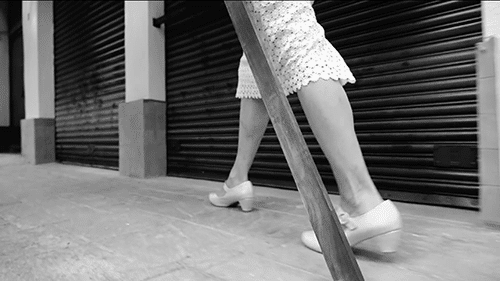
Beside her for her entire journey is the long wooden plank. While the plank is persistently pulled behind the artist, it suggests a stake marking time and distance. Crossing in front of both the landscape and the body of the woman, the post is visually foregrounded. It is also the most dominant sound as the board scrapes varying surfaces and relentlessly reminds the viewer of its presence. This element of the video calls attention to the fact that this hefty piece of timber is all that she carries; she holds no possessions that would tie her to her home.
Unbeknownst to the viewer, the board references an Ojo de Dios that hung on the wall of the artist’s childhood home, a present from her uncle on the occasion of her parents’ wedding that her mother carried to her new home.9 It stood beside the projected video when it was displayed in 2021.10 For the artist, the familial Ojo occupied a significant place in her memory, as captured by the monumentality of the gallery recreation. That its identity in the video is kept from the viewer suggests an intimacy associated with the object. The protective eye is for family recognition only. As the beam is pulled across the ground, Tavera’s Ojo de Protección (2021), made of yarn and construction lumber, symbolizes a thread to her family home in Mexico yet draws a literal line throughout the entire video. Rather than representing a “one-way yearning” for a home or an arrival, it evidences the “mutual reaching out—a push-pull dynamic from both sides—between a nation-state homeland and its diaspora” often seen amongst contemporary Chicana/o diasporic communities.11
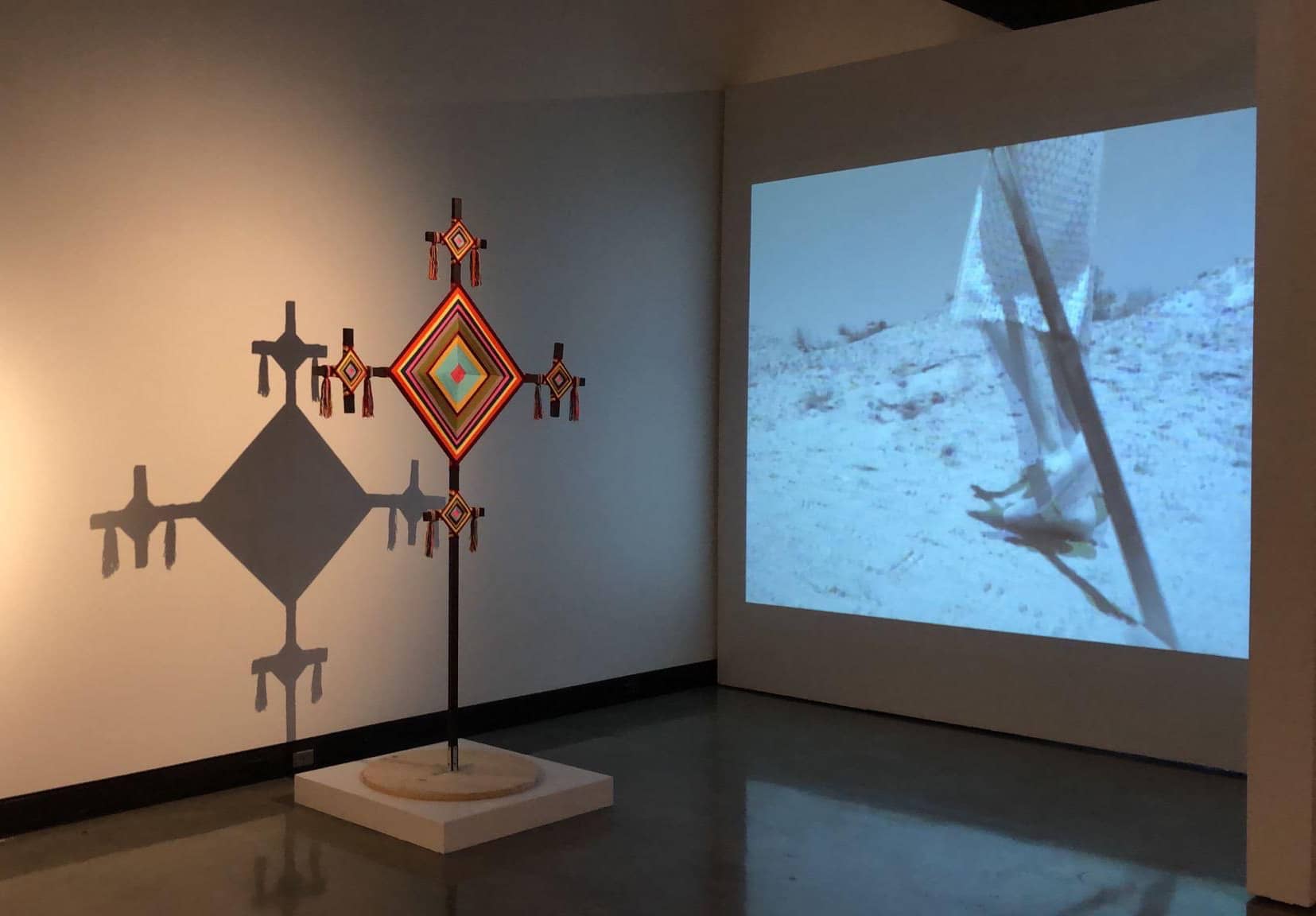
The third subject of the video is the woman herself, the artist who metaphorically retraces her mother’s migration from Mexico to the United States, which also communicates this two-way condition.12 Behind the plank yet in front of the land, she inhabits a literal and figurative middle ground, an in-between space that matches the artist’s positioning as the subject between places of origin and arrival, indicative of the place where her identity is constructed. For Tavera, Zozobra calls upon Gloria Anzaldúa’s notion of nepantla as a third space represented by the journey.13 As described by Anzaldúa, Nepantla is “the space between two worlds … a limited space, a space where you are not this or that but where you are changing.”14
This third space, Anzaldúa’s borderlands, of “multiple subjectivities” and their production, not only involve aspects of identity but reflect power relations as well.15 In the video, the precarity of belonging is reflected in the expected interior domestic spaces of the implicated homes and the unpredictability of the open space in which she finds herself. The title Zozobra “represents this space between belonging and exclusion, the in-between marked by the anxiety and distress of uncertainty.”16 According to the artist, this mirrors her mother’s early experiences in Minnesota and the isolation that she felt, as seen through the solitary nature of the video; the work is about “survival” in the face of diaspora’s challenges and trials.17
The artist, however, lends her body to the representation of her mother, which carries with it her own sense of belonging and safety amidst her strong local, Latinx community.18 The video gives voice to her mother’s plight as she, and the audience by extension, bear witness to her lived experiences. Occupying her mother’s form, Tavera conveys how her mother’s experiences have directly shaped her own and how acts of migration—even those of the past—retain contemporary relevance. In doing so, she opens a conceptual space between mother and daughter, across generations and geographies, where an aesthetics of diaspora takes shape.
Endnotes
- Alicia Gaspar de Alba, “There’s no place like Aztlán: Embodied Aesthetics in Chicana Art,” CR: The New Centennial Review 4, no. 2 (Fall 2004): 111. Diasporic aesthetics is just one of Gaspar de Alba’s seven place-based aesthetics in this source, one of which is Aztlán aesthetics. While the idea of Aztlán will be discussed below, Aztlán aesthetics involves the territorial dispossession and social and political reclamation of a mythical homeland located in the U.S. Southwest. This type of aesthetics is not applicable when speaking of the Midwest, where a nativity to the land is not imagined and where a diaspora is more appropriately distinguished. For an expanded discussion of Aztlán aesthetics, see Gaspar de Alba, [Un]Framing the “Bad Woman”: Sor Juana, Malinche, Coyolxauqui and Other Rebels with a Cause (University of Texas Press, 2014), 91–112. ↩︎
- Gaspar de Alba, “There is no place like Aztlán,” 111. ↩︎
- Patria Roman-Velazquez and Jessica Retis, Narratives of Migration, Relocation, and Belonging (Spring International Publishing/Palgrave Macmillan, 2020), 13. ↩︎
- Maria Cristina “Tina” Tavera, correspondence with the author, March 21, 2025. ↩︎
- Tavera, correspondence with the author, March 21, 2025. ↩︎
- Gaspar de Alba, “There’s no place like Aztlán,” 111.
↩︎ - Tavera, correspondence with the author, March 21, 2025. ↩︎
- Virinder S. Kalra, Raminder Kaur, and John Hutnyk, Diaspora and Hybridity (Sage Publications, 2005), 17. ↩︎
- Maria Cristina “Tina” Tavera, interview with the author, June 19, 2025. ↩︎
- The eight-foot tall, colorful thread cross, or Tsikúri, is a replica of a traditional Huichol ritual object that signals protection, more commonly known as an Ojo de Dios. Peter T. Furst, Visions of a Huichol Shaman (University of Pennsylvania Museum of Archaeology, 2003), 28. ↩︎
- Susana Rinderle, “The Mexican Diaspora: A Critical Examination of Signifiers,” Journal of Communication Inquiry 29, no. 4 (October 2005): 299. ↩︎
- The embodiment of her mother’s journey brings to mind Christina Fernandez’s María’s Great Expedition, a series of black-and-white, sepia, and color photographs of the artist similarly embodying her great-grandmother’s journey from Mexico to the United States. See Gallun and Fernandez, “Christina Fernandez’s María’s Great Expedition: The artist uses family lore to examine the meaning of migration,” MoMA Magazine (2019), https://www.moma.org/magazine/articles/75. ↩︎
- “Zozobra,” Maria Cristina “Tina” Tavera’s website,https://www.mariacristinatavera.com/installations/zozobra. ↩︎
- Gloria Anzaldúa, Borderlands/La Frontera: The New Mestiza, 3rd ed. (Aunt Lute Book Company, 2007), 237. ↩︎
- Rafael Pérez-Torres, “Refiguring Aztlán,” Aztlán: A Journal of Chicano Studies 22, no. 2 (Fall 1997): 17; Nira Yuval-Davis, “Belonging and the politics of belonging,” Patterns of Prejudice 40, no. 3 (2006): 199. ↩︎
- Tavera, artist’s website. ↩︎
- Tavera, interview with the author, June 19, 2025. ↩︎
- Tavera, interview with the author, June 19, 2025. ↩︎
Cite as: Jamie L. Ratliff, “With All Her Belongings: The Diasporic Middle Ground in Maria Cristina (Tina) Tavera’s Zozobra,” in X as Intersection: Writing on Latinx Art, April 2, 2026, accessed [DATE], https://uslaf.org/essay/with-all-her-belongings-the-diasporic-middle-ground-in-maria-cristina-tina-taveras-zozobra/.
Jamie L. Ratliff is an associate professor of Art History in the department of Art & Design at the University of Minnesota Duluth. Her research interests include feminist art, gender and representation, social activism, and visualizations of nationalism, citizenship, and belonging in Latin American and Latinx art.