To Breathe Full and Free: Abstraction and Reprieve in María Magdalena Campos-Pons’ The Rise of the Butterflies

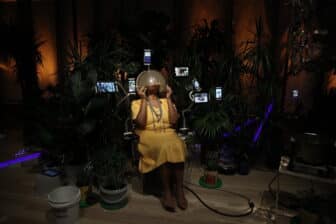
Cuban-born American citizen, María Magdalena Campos-Pons was born in Matanzas, Cuba in 1959, in the town of La Vega, and emigrated to Boston, Massachusetts in 1991. In October 2017, she received the endowed Cornelius Vanderbilt Chair (Professor of Fine Arts) at Vanderbilt University in Nashville, Tennessee—a prestigious position she still holds. Spanning over forty years, her prolific oeuvre boldly moves between photography, painting, sculpture, performance, video, installation, and pedagogy.
Growing up on the site of a former sugar plantation, Campos-Pons’ life and artistic trajectory are inextricably bound with the legacies of the Transatlantic slave trade—understood here as the still-unfolding “transnational histories of enslavement, indentured labor, domestic labor, and advocacy for bodily autonomy.”1 In consequence, they have been also shaped by the contours of colonial racial capitalism.2 Her art practice interweaves strands of history, memory, and mythology to provide powerful meditations on the afterlives of coloniality—both personal and collective—and her works reflect a complex cultural landscape centered on questions of racialization, forced migration, gender, labor, and identity. This essay looks specifically at Campos-Pons’ sculptural installation The Rise of the Butterflies (2021) to explore how abstraction can act as a space of refusal, protection, and reprieve in the face of colonial racial capitalism. In an era of rapidly escalating anti-Blackness, historical revisionism, and artistic censorship, Campos-Pons’ The Rise of the Butterflies offers valuable pathways for liberatory imagining.
Campos-Pons’ familial history is deeply entangled with transnational histories of racialized capitalism. In interviews and in her work, she frequently articulates (and activates) kinship ties through this ancestral network, tracing her current residence in the U.S. back to her roots in Cuba, looking further back across the long Middle Passage, and following that ancestral line through to various locations in Africa and Asia. Matanzas province, where she was born, operated as an epicenter of enslaved labor and sugar production during the colonial period in Cuba, and today bears a history marked heavily by the lived realities and ongoing racialized violences derived from said conditions. In a 1997 interview, Campos-Pons spoke on the impact of this relationship in her artworks: “I’m thinking about myself looking at Cuban history and looking from the outside … azúcar was what this town produced, azúcar was the reason [enslaved people] were brought to Cuba; azúcar [squeezed] the blood of my whole family.”3
In many ways, Campos-Pons’ personal trajectory also mirrors a larger historical story of contemporary U.S. and Latin American entanglements. Born in 1959 (the year Fidel Castro came to power in Cuba), Campos-Pons was raised and educated in the island during a period of post-revolution potentialities. As her artistic practice began to reach maturity, the self-proclaimed goals of the revolution began to age and to calcify, in part spurred on by a failure to achieve a working relationship with most of the global capitalist order. Campos-Pons migrated to the United States in 1991 at the start of the so-called Special Period—or período especial en tiempos de paz—and was unable to return to Cuba for many years due to a politically-fraught climate and closed borders between the neighboring countries.4 These historical and personal realities come together in Campos-Pons’ practice to illustrate a powerful landscape of absence and presence, of loss and remembrance.
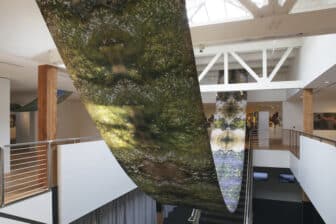
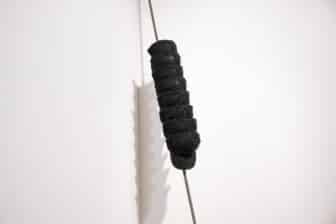
For her 2021 exhibition, The Rise of the Butterflies, which took place at the Barbara Thumm Gallery in Berlin, Campos-Pons collaborated with Berengo Studio—an innovative glass production company based in Venice, Italy—to produce a series of five original glass mobiles. The glass mobiles were made using traditional Murano glass techniques—a specific, and storied, practice of Venetian glassblowing that has been in use in the region since at least the eighth century. Each mobile is one-of-a-kind, brought into being in varied tones of yellow ochre, burnt umber, and cerulean blues; and inspired by the inimitable pigmentation patterns of butterfly wings and other natural designs. The teardrop shape of the mobiles’ elements suggests a space for mourning and care. Standing in a space dominated by their presence, viewers may recall mobiles as decorative elements in children’s nurseries. Paired with other protective symbols, such as the Nazar amulet (in many Near Eastern cultures, these blue eye amulets protect against the evil eye), the mobiles create a nonfigurative space where the body is not pictured but rather embodied—remembered but reprieved from the totalizing gaze of the viewer, of the gallery, of colonial (art) history.
The sculptures were complemented in their installation by a series of large-scale photographs and watercolor paintings of brightly colored flowers, collaged together in a fragmented but whole framing technique characteristic of Campos-Pons’ practice. She is known for her use of interrelated diptychs and triptychs, with intentional “space in-between” panels to convey otherwise contiguous pictorial scenes.5 Glass work is not new to Campos-Pons—she has been working with it since the 1980s—but The Rise of the Butterflies offers a stark departure from earlier cast glass works such as Spoken Softly with Mama (1993–98), Threads of Memory (2004), Sugar/Bittersweet (2010), and Alchemy of the Soul, Elixir for the Spirits (2015), which are all rooted in (and routed through) her own familial history in Cuba.6 More and more frequently, and perhaps due to her time in Tennessee, Campos-Pons’ recent work highlights the connective tissue of colonial violence that threads throughout the Caribbean and into the United States. It is this explicit history that Campos-Pons engaged in The Rise of the Butterflies, which is dedicated by the artist to the memory of Breonna Taylor, a twenty-six-year-old Black woman and medical worker who was shot and killed by police officers in her Louisville, Kentucky, apartment in 2020 during an illegal raid. Breonna Taylor’s death, like so many others, is reflective of Saidiya Hartman’s articulation that the afterlives of slavery—of colonial racial capitalism—show up as “skewed life chances, limited access to health and education, premature death, incarceration, and impoverishment.”7
In the wake of her murder and in honor of her memory, Taylor’s sister released monarch butterflies, allowing them to fly freely into the air on September 25, 2020. The monarch butterfly is well known for its migratory route to breeding grounds in Mexico from late October to early November, coinciding with the Día de los Muertos (Day of the Dead) celebrations. In general, butterflies are mythologized for the capacity for their metamorphosis—for hatching and rebirth, death and resurrection. Migrating yearly from the United States to Mexico, the monarch’s annual pilgrimage defies the demarcation of enforced borders—a longstanding tool of colonial racial capitalism which seeks to limit the movement of people based on approximate relation to perceived rights and claims to citizenship. This act of migratory defiance resonates with extra significance in the current political climate of the United States, where ICE raids are occurring on a mass scale and unlawful deportations (also known as disappearances) are being recorded at almost unprecedented rates. Campos-Pons was inspired by this memorial act by Breonna Taylor’s sister, and the poetics of her act echoed consistent themes in Campos-Pons’ artistic career—themes such as constant transformation, unbounded movement, and transformative healing.
Breonna Taylor’s murder was widely publicized, sparking widespread demonstrations and adding to the cultural pitch of sharp criticism against police brutality, racialized inequity, and anti-Black violence. In many ways, Taylor’s death pushed her into a space of hypervisibility; it is counted among the primary contemporary incidents which spurred the Black Lives Matter movement. Taylor’s image was shared, seen, and reposted by millions of people during the tumultuous summer of 2020 and is still routinely brought to public attention—a pattern of hyperconsumption and visual extractivism which is inseparable from the ongoing afterlives of colonial racial capitalism. Those closest to her were (and are) forced to live and relive her death in a public way, replayed over and over again in the constant echo chamber of news cycles and social media. Campos-Pons’ decision to create a series of hanging mobile sculptures dedicated explicitly to her memory but intentionally void of her actual likeness, or of images of the violences done unto her, provides a space for grief and remembering, for protection and care. In Campos-Pons’ installation, Taylor’s memory is given room to breathe full and free, released, finally, from the violent grip of police brutality, coloniality, and racialized capitalism.
Refusing to fold to the demands of representation—that ever-consumptive gaze of colonial and racialized capitalism—the use of abstraction and unfiguration in The Rise of the Butterflies becomes stretched from a purely formal device to include the abstraction of individual into the collective, and the transformation of personal and collective memories into the potential for rebirth and regeneration. Within this installation, allowances are made for what grows in the space of release. In general, Campos-Pons’ artistic cosmology is fueled by refusal: refusal to be tied down, to be named in full, to be defined by the legacies of colonial racial capitalism, to be made into something stable and static. Unbounded by the demands and demarcations of figurative representation, The Rise of the Butterflies offers the possibility of a more transgressive Latinx and Caribbean future rooted in continuous becoming.
Endnotes
- The Transatlantic slave trade was a massive and systemic operation of forced displacement and enslaved labor which violently kidnapped and relocated over 12.5 million individuals from the African coast to the Americas and to the Caribbean. In operation for over 350 years, legal slavery was not abolished in Cuba until 1886. As prominent art historian Eddie Chambers points out, “It was of course the Atlantic Slave Trade, taking place between the sixteenth and late nineteenth centuries, that saw the forging and honing of globalization, of the commodification of people as units of labor, of the embedding of capitalism in pretty much all aspects of the ways in which we live.” Chambers astutely points out the Caribbean as a “laboratory for globalization.” For more, see Eddie Chambers, “María Magdalena Campos-Pons: Some Considerations,” in María Magdalena Campos-Pons: Notes on Sugar / Like the Lonely Traveler (exhibition catalogue, Neon Queen Collective and Wendy Norris Gallery, 2018), 2; Carmen Hermo, “Preface: The Calling,” in María Magdalena Campos-Pons: Behold, ed. Carmen Hermo (Getty Museum and Brooklyn Museum, 2023), 11. ↩︎
- Foundationally articulated by Cedric Robinson in 1983, the term racial capitalism refers to the inseparability of racism and capitalism. For more, see Cedric J. Robinson, Black Marxism: The Making of the Black Radical Tradition, 3rd. ed. (University of North Carolina Press, 2021); Robin D.G. Kelley, “What Did Cedric Robinson Mean by Racial Capitalism,” Boston Review, January 12, 2017, https://www.bostonreview.net/articles/robin-d-g-kelley-introduction-race-capitalism-justice/; and Robin D. G. Kelley, “Preface: Why Black Marxism? Why Now?” in Robinson, Black Marxism, xi-xxxiv. The term colonial racial capitalism extends this definition to encompass the vast network of colonial systems and relations which accompany its ongoing development. For more see Susan Koshy, Lisa Marie Cacho, Jodi A. Byrd, and Brian Jordan Jefferson, eds., Colonial Racial Capitalism (Duke University Press, 2022). ↩︎
- Linda Wong, “Estoy allá: Sculptor María Magdalena Campos-Pons on the Question of Color and Race in Cuba,” Sojourner: The Women’s Forum 23, no. 1 (September 1997): 26. The “deep presence” of Africa in Cuba is noted frequently by Campos-Pons in this interview with Wong, and is additionally noted in Adriana Zavala, “Blackness Distilled, Sugar and Rum,” Latin American and Latinx Visual Culture 1, no. 2 (2019): 8-32. ↩︎
- The so-called periodo especial en tiempos de paz (or “special period in the time of peace”) was an extended period of economic crisis in Cuba that began in 1991 with the collapse of the Soviet Union and dissolution of COMECON (The Council for Mutual Economic Assistance). The socioeconomic ramifications of the “special period” were felt most severely in Cuba during the early to mid-1990s, before being slightly alleviated towards the latter end of the decade when Hugo Chávez came into power in Venezuela and began to resupply subsidized oil to the island. This period was defined by extreme reductions in state-sanctioned food, gasoline, diesel, and other petroleum products. This period also saw a marked increase in unsanctioned, and deeply dangerous, migratory crossings attempted by Cubans who left the island in makeshift rafts, often referred to as balseros, in an attempt to reach Florida. To the best of this author’s knowledge, no comprehensive account has been made of the number of lives lost in this attempt. For more, see Michael H. Erisman, Cuba’s Foreign Relations in a Post-Soviet World (University of Florida Press, 2000). ↩︎
- For more on Campos-Pons’ use of “space in-between” to think through absence and presence, see Elizabeth DeLoughrey, “Inner Space: The Depth Imagination,” in The Routledge Companion to Decolonizing Art History, ed. Florencia San Martín, Tatiana Flores, and Charlene Villaseñor Black (Routledge, 2024), 519–30. See also DeLoughrey, “Blue Ocean Being: The Space In-Between,” in María Magdalena Campos Pons: Sea and Self (Haggerty Museum of Art, 2021), 24-31. ↩︎
- This language on “roots” and “routes” borrows heavily from various writings on Campos-Pons’ work, as well as Caribbean art and literature. For more, see Elizabeth DeLoughrey, Routes and Roots: Navigating Caribbean and Pacific Island Literatures (University of Hawai’i Press, 2007). See also the exhibition catalogue essay for Maria Magdalena Campos-Pons: Everything Is Separated by Water (Indianapolis Museum of Art, 2007), where curator Okwui Enwezor describes the artist’s work as a “series of conjunctions—roots and routes, origin, and displacement.” ↩︎
- Saidiya Hartman, Lose Your Mother: A Journey Along the Atlantic Slave Route (Farrar, Straus, and Giroux, 2007), 4. ↩︎
Cite as: Kaillee Coleman, “To Breathe Full and Free: Abstraction and Reprieve in María Magdalena Campos-Pons’ The Rise of the Butterflies,” in X as Intersection: Writing on Latinx Art, January 13, 2026, accessed [DATE], https://uslaf.org/essay/to-breathe-full-and-freeabstraction-and-reprieve-in-maria-magdalena-campos-pons-the-rise-of-the-butterflies/.
Kaillee Coleman is a PhD candidate in Latin American Studies and Art History at Tulane University. She holds an MA in Latin American Studies and BA degrees in Art History and Interdisciplinary Art. Kaillee works as an Associate Editor for Keywords for Black Louisiana and as a curatorial assistant at the Newcomb Art Museum in New Orleans, LA, where she recently curated the exhibition Poetic Gaps: Opacity in the Photographic Imprint.