The Four Elements and Restorative Balance in Guadalupe Maravilla’s Disease Throwers
Colonial racial capitalism targets the worlds of Indigenous, Black, Asian, and Latinx people with the goal of ending those worlds in service of capital accumulation. Contemporary nation-states and multinational corporations carry out this world ending project established during the colonization of the Americas by creating imbalances in society through the technologies of race, class, and gender. Scholars have theorized this ongoing project of violence and dispossession as the “coloniality of power,” “coloniality of gender,” the “coloniality of being” and most recently as iterative “invasions.”1 I discuss Guadalupe Maravilla’s sculpture for Planeta Abuelx (2021), a public art installation at Socrates Sculpture Park in New York City, as a worldmaking gesture—an opening to a different understanding of and way of being—guided by the coexistence of the four elements: fire, earth, wind, and water. This sculptural worldmaking gesture proposes a restorative balance that counters the colonial racial capitalist structures and promotes “sonic healing.”2
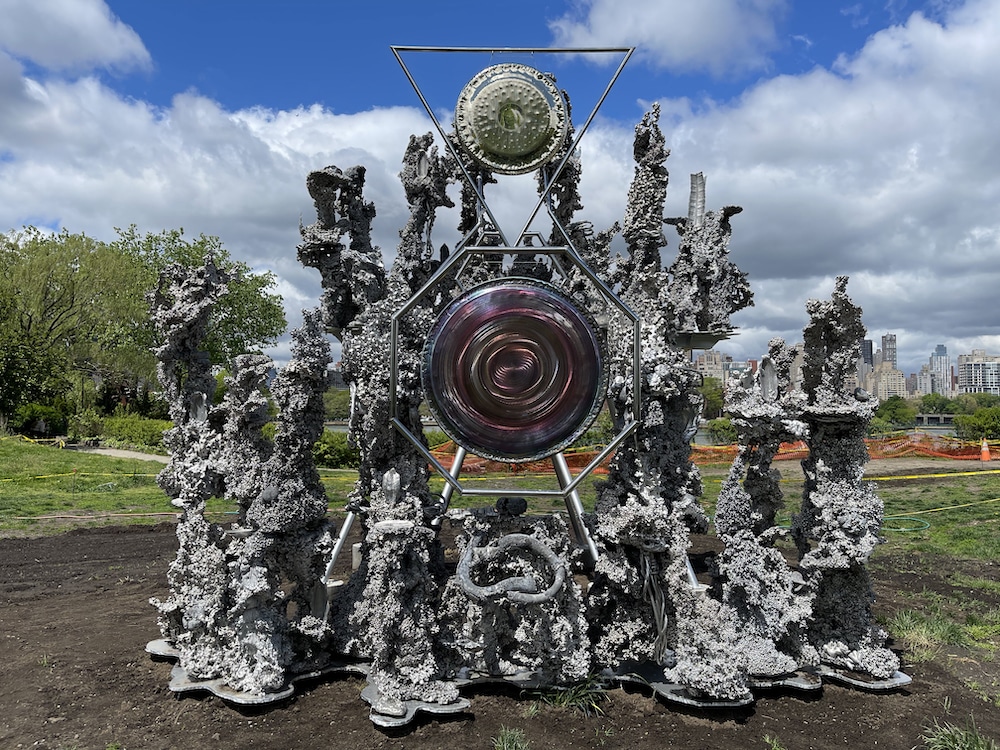
The sculpture consisted of Disease Throwers #13 and #14, intertwined to create a single metal structure. Staggered and held together by steel tubing, the shiny, textured aluminum structure rises to a height of more than twice the length of a human body. Two gongs are suspended from the steel-tube triangular and octagonal frames on the upper and lower levels of the sculpture, which Maravilla and his collaborators played during sound bath sessions to the public. The disk-shaped percussion instruments emphasize that the sculpture functions as an active work of art that demands more than passive looking from its audiences. A series of organic reef-like pillars growing toward the sky—some crowned with metal casts of leaves and corn husks—frame the two gongs and their respective stages. The process of production, its materiality, the embedded references to land, and its activation together convene the presence of all four of the elements.
The coexistence of the four elements in Maravilla’s works point us toward a balanced way of living that counteracts our current condition of disparity caused by colonial racial capitalist structures. COVID-19 revealed an unevenness in access to care and resources, and made evident the inability of the U.S. government to forgo the interests of capital for the sake of human well-being.3 Salvadoran Americans, especially those in Maravilla’s generation, have experienced similar forms of social, economic, and political instability before. As a child, he was separated from his parents who fled El Salvador due to the increasing violence caused by a U.S.-sponsored and -funded civil war (1980–1992).4 He later migrated through multiple countries in order to reunite with his family in New York City, where he would grow up as an undocumented person. Each of these world ending moments—war, family separation, forced migration, and becoming undocumented—create an imbalance in the life of an individual, which manifests as illness, in the case of Maravilla, cancer. 5 In other words, the chaos in the world created by colonial racial capitalism proliferates in the bodily well-being of marginalized communities. If colonial racial capitalism ends worlds, how does a turn towards Indigenous world views that emphasize balance and coexistence provide avenues for counteracting such imbalances at the societal and individual level?
Indigenous communities throughout the hemisphere exercise worldviews predicated on a balance that prioritizes the interdependent well-being of the environment and people. The Medicine Wheel in North American Native communities, for instance, offers a comparable understanding of a balanced life that promotes well-being.6 In its most simplified visual representation, the Medicine Wheel consists of a circle subdivided into four sectors with each of the segments standing in for a cardinal direction, natural element, stage of life, or season. This visualization of North American Native ways of understanding our place in the world emphasizes an interconnection between the human and nonhuman. The Maya Ixil in Guatemala, as Giovanni Batz documents, follow Tiichajil, a way of being in the world that emphasizes “equilibrium, balance, health, community, harmony, well-being, and life.” 7 Tiichajil counters the value systems of colonial racial capitalism, which prioritize profits by hydroelectric plants owned by transnational corporations over the health of rivers and their surrounding Maya communities, as Batz’s work shows. Governments throughout Central America have responded with unmeasured violence when Indigenous communities resist capitalist extraction of their lands and bodies, and their subsequent chaos.8
I align the interrelation of the four elements—fire, earth, wind, and water—in Maravilla’s work with Indigenous world views, epistemologies, and ontologies, which allow for him to create momentary spaces of healing from the chaos of colonial racial capitalism.9 In what follows I discuss each of the elements as they present in the process or final work and how they propose an alternative way of being that links our well-being with that of the planet and environment.
Fire forged Disease Throwers #13 and #14 and marks the shift away from the extractive economies of colonial racial capitalism.10 Maravilla used fire—along with earth and water— to create an otherworldly sculpture installation that activates wind (sound) as a healing mechanism. The shiny aluminum surface riddled with indentations, its towering scale, and organic form that appears to be in the process of growing suggest a contradictory material state not possible under our way of understanding the world. A live, growing organism made of aluminum disrupts our worldview that precludes metals from having a life source. Fire played an important role in the process of production. Maravilla melted the aluminum, restoring it to a hypermalleable physical state. He then freepoured it into metal barrels filled with self-expanding water beads, allowing the metallic liquid to cast organic forms as it cooled in the crevices. By melting aluminum, a ubiquitous metal in our capitalist culture, and allowing it to freeform into the pillars for a sculpture of individual and communal healing, Maravilla proposes the earth and its metals as living. Yet, arriving at this proposal is only possible when leveraging the power of fire to transform an industrial metal. The process ruptures the extractive relationship we have as humans with the earth by wresting a metal away from circulation within a capitalist economy. This extractive relationship with the land underlies the dispossession of Indigenous lands in the American hemisphere, which results in the mass migration of people from their homelands, and their subsequent persecution by U.S. immigration enforcement. A colonial racial capitalist worldview directly impacts the lived experience of immigrant communities in the U.S. In his material choice, Maravilla’s sculpture implies that healing from the terror of immigration enforcement involves moving away from extraction and towards an understanding that entangles us and the land.
Items related to his migration journey and references to land on the surface of his work critique extractive relationships with the earth and propose a reverential engagement with land. Ears of corn cast in metal sit at the top of and within the body of Disease Throwers #13 and #14. Neat impressions of corn kernels against the oblong shape of the husk recalls the shape of the Virgen de Guadalupe and her mandorla, interjecting a spiritual connection to land predicated on Indigenous cosmovisions. Scholars have analyzed the legend behind the image of the Virgen de Guadalupe, its colonial uses in Mexico, and, most importantly, its counternarrative potential by highlighting the parallels between the Virgen and Nahuatl earth deities like Tonantzin and Coatlicue.11 These welded elements on the sculpture’s surface also reference a central crop for Indigenous and rural communities throughout the hemisphere. With this reference to land, Maravilla links the struggle over land sovereignty in Latin America, migration, and colonial racial capitalist intervention through economic policy. Colonial racial capitalism—in its expression as neoliberal economic policy—has pushed the production of corn towards a monoculture, threatening the diversity of the plant throughout Latin America and the sustenance and sustainable model of farming practiced by Indigenous people, especially in Central America and Mexico.12
Wind carries the intense sonic vibrations generated by the gongs on Maravilla’s Disease Throwers, creating a collective experience that blankets audiences and participants. Each bang wrests audiences away from the surrounding environment and transports one into another sonic space shared by everyone in attendance. Sound suspends time—capitalist time, that is. Deep, low, and elongated sound waves emanating from the gongs counteracts the fast-paced sonic environment of capitalism, which bombards us every day with breaking news, advertisements, and reminders that we are either behind time or out of time. The slowness of the sound created by the gongs asks us to be in time. As a collective experience, the sound baths provide an example of the need for our bodies to lay still and defy the expectations of productivity. While this experience of sonic respite offers a mode of stillness that promotes healing, the sound waves also activate water as an element crucial to our healing from the traumas of colonial racial capitalism.
While the agitation of water molecules through sound to release the trauma we carry in our bodies functions as the primary mechanism for healing in Maravilla’s work, other references to water in his works link the imbalances in our bodies with that of the planet. Guadalupe understands that the human body consists primarily of water, an understanding supported by science. During his cancer healing journey, doctors advised Maravilla to replenish the water in his body to mitigate the painful side effects of radiation therapy. In other words, doctors emphasized that maintaining a balanced level of water was crucial to his healing.13 The self-expanding water beads that imprinted an organic texture of round indentations on the sculptures’ surface during the casting process connect the water in our bodies with that of the planet. Round, protruding growths on the surface of the sculpture—along with its overall shape—recall the coral reef formations, which serve as live health indicators for the planet. By referencing these live, diverse, and crucial organic formations, Maravilla emphasizes that water sustains life at varying scales, from cells to the oceans.
Maravilla’s work offers a vision of what healing from the structure of colonial racial capitalism can look like. Illness, as his work proposes, results from imbalances. Maravilla asks us to consider how immigration, war, extractive industries, racism, and climate change are driven by a violent chaos that disrupts the balance in the lives of marginalized communities throughout the Americas (and the world). Disease Thrower #13 and #14 counteract the imbalances—ideological and physical—created by colonial racial capitalist structures by bridging fire, earth, wind, and water in his production of healing instruments. When activated, his work links personal healing with that of the planet.
Endnotes
- Aníbal Quijano, “Coloniality of Power, Eurocentrism, and Latin America,” trans. Michael Ennis, Nepantla: Views from South 1, no. 3 (2000): 533–80; María Lugones, “Toward a Decolonial Feminism,” Hypatia 25, no. 4 (2010): 742–59, https://doi.org/10.1111/j.1527-2001.2010.01137.x; Nelson Maldonado-Torres, “On the Coloniality of Being: Contributions to the Development of a Concept,” Cultural Studies 21, no. 2–3 (2007): 240–70, https://doi.org/10.1080/09502380601162548; Giovanni Batz, The Fourth Invasion: Decolonizing Histories, Extractivism, and Maya Resistance in Guatemala (University of California Press, 2024). ↩︎
- Kency Cornejo, “Sonic Healing in the Age of Border Imperialism: The Art of Guadalupe Maravilla,” in Guadalupe Maravilla: Portals, ed. Gean Moreno (ICA, Institute of Contemporary Art, Miami, 2021), 10–25. ↩︎
- Planeta Abuelx was created under the context of the COVID-19 pandemic. ↩︎
- Karina O. Alvarado, Alicia Ivonne Estrada, and Ester E. Hernández, eds., “U.S. Central American (Un)Belongings,” in U.S. Central Americans: Reconstructing Memories, Struggles, and Communities of Resistance (University of Arizona Press, 2017), 5-21. ↩︎
- Guadalupe Maravilla, interview by Janine Antoni, January 5, 2021, https://bombmagazine.org/articles/guadalupe-maravilla/. ↩︎
- Jennifer Grenz, Medicine Wheel for the Planet: A Journey Toward Personal and Ecological Healing (Vintage Canada, 2025), 12-13. ↩︎
- Batz, The Fourth Invasion, 114. ↩︎
- In 1932, the Salvadoran state murdered 30,000 indigenous and working class people who demanded their lands, in what is now known as La Matanza. For a broader recount and other examples of state violence against Indigenous people see Alvarado, Estrada, and Hernández, “U.S. Central American (Un)Belongings,” 6-11; Jorge E. Cuéllar, “Elimination/Deracination: Colonial Terror, La Matanza, and the 1930s Race Laws in El Salvador,” American Indian Culture and Research Journal 42, no. 2 (2018), https://doi.org/10.17953/aicrj.42.2.cuellar, 42-46; and Nina Lakhani, Who Killed Berta Cáceres?: Dams, Death Squads, and an Indigenous Defender’s Battle for the Planet (Verso Books, 2020). ↩︎
- For a similar analysis see John Kennedy Godoy, “Healing in Transdisciplinary Art by Guadalupe Maravilla: Disease Throwers, Jun Winaq’, and Acompañamiento,” Aztlán 48, no. 2 (2023): 195–212, https://doi.org/10.1525/azt.2023.48.2.195. ↩︎
- Guadalupe Maravilla & the Sound of Healing (Art21, 2021), https://art21.org/watch/new-york-close-up/guadalupe-maravilla-the-sound-of-healing/. ↩︎
- Jeanette Favrot Peterson, “The Virgin of Guadalupe: Symbol of Conquest or Liberation?,” Art Journal 51, no. 4 (1992): 39 and 46, https://doi.org/10.2307/777283; Karen Mary Davalos, “Guadalupe as Feminist Proposal,” in Yolanda M. López, A Ver: Revisioning Art History (UCLA Chicano Studies Research Center Press, 2008), 95-96. ↩︎
- David Harvey, “Uneven Geographical Developments,” in A Brief History of Neoliberalism (Oxford University Press, 2005), 101-103. ↩︎
- Guadalupe Maravilla & the Sound of Healing, Art21. ↩︎
Cite as: Kevin Cruz Amaya, “The Four Elements and Restorative Balance in Guadalupe Maravilla’s Disease Throwers,” in X as Intersection: Writing on Latinx Art, January 13, 2026, accessed [DATE], https://uslaf.org/essay/the-four-elements-and-restorative-balance-in-guadalupe-maravillas-disease-throwers/.
Kevin W. Cruz Amaya is an Assistant Professor of Latina/o Studies at Williams College, whose research and teaching focuses on Latina/o art. His current book project focuses on the intellectual and artistic contributions of Chicano artist Gilbert “Magu” Luján (1940-2011).