
Redefining Maintenance Art through Migrant Imaginaries: Jay Lynn Gomez’s Aesthetics of Labor

To visibilize is to unearth the unseen, to summon what has been disappeared, and to “bring the sedimented layers of the social into view,” in the words of visual cultural theorist Nicholas Mirzoeff.1 Artist Jay Lynn Gomez enacts this process through painting, sculpture, and assemblage, giving form and face to the forgotten and erased, rendering presence where absence has long been rehearsed. Gomez’s practice functions as a visual act of repair, reclaiming immigrant workers’ presence, dignity, and identity against the backdrop of a capitalist spectacle of whiteness and privilege.2 As Gomez explains, the insertion of the person (the workers) in the images of wealthy lifestyles is a response to the “intentional erasure” of immigrant labor, which she experienced firsthand as a child of immigrant parents, a live-in nanny in her early career, and a queer Chicana artist.3 By depicting these landscapes of American domesticity as sites of expropriated labor where immigrant workers can no longer be ignored, Gomez compels viewers to reckon with their complicity in the structures of invisibility that devalue and obscure the contributions of those who maintain everyday life.
Gomez’s work can be read as a decolonial feminist continuation—and necessary complication—of Mierle Laderman Ukeles’ “maintenance art.” Ukeles, a New York City-based artist, coined the term in her MANIFESTO FOR MAINTENANCE ART, 1969!, advocating for recognizing the invisible, life-sustaining, repetitive, and mundane tasks as art.4 In her work, Ukeles powerfully elevated the status of this kind of work by asking, “The sourball of every revolution, after the revolution: who will pick up the garbage on Monday morning?,” a contemplation on who, behind the scenes, performs the essential tasks that keep society functioning. While her work remains profoundly relevant in revealing the often-invisible operations of capital, the modes of visibility she constructed through collaborations with workers fall short of addressing the racial and gender hierarchies that shape social reproduction and sustenance labor. Gomez extends Ukeles’ radical gesture by rearticulating maintenance work through a decolonial feminist perspective, transforming the landscapes and visual economies of racial capitalism—the systems that mediate who is rendered visible or invisible in the service of capital extraction and accumulation—into sites of political refusal, memory, and visible realities.
Drawing from her experience as a live-in nanny in the Hollywood Hills of Los Angeles, Gomez renders the embodied condition of invisibility as a borderland between presence and erasure. The affective labor of immigrant workers is absorbed into the comfort of others, as they navigate intimate spaces, cleaning, tending, and transforming them into polished sanctuaries, all while remaining unacknowledged, spectral figures within the very spaces they care for. In her paintings, immigrant workers’ vague bodies and blurred facial features evoke a haunting absence that validates their presence without fully revealing their identity. Much like the work of cultural theorist Avery Gordon in Ghostly Matters, which explores the haunting presence of marginalized histories and bodies, Gomez’s artwork can be understood as an intentional haunting of the visual landscape. It draws critical attention to the enduring impact of immigrant labor and the mechanisms of extraction and exploitation that keep such labor out of focus, marginalized within both the social fabric and the visual art world.5
Furthermore, by rendering the workers in this spectral form against the aspirational visual narratives of American wealth, sophistication, and exclusivity that are frequently idealized in advertising, popular culture, and art, Gomez’s work reimagines geographic spaces of exploitation as central sites of visual activism against the dominant, colonial mappings of space.6 As a decolonial gesture to unfix these mappings, Gomez engages in guerrilla art practices by placing life-sized, painted cardboard cutouts of maintenance and domestic workers along the streets of opulent mansions and within the public spaces of affluent neighborhoods, where manicured parks and amenity-rich greenways stand as markers of these landscapes of privilege.
Through the strategic placement of the cardboard cutouts in these elite spaces, Gomez materializes the palpable presence of laboring bodies long rendered invisible, confronting the systemic mechanisms that regulate visibility and spatial belonging. Her interventions disrupt the geographies of surveillance and exclusion central to racial colonial capitalism, exposing how these spaces are controlled to police who is seen, where, and under what terms.7 Disrupting these spatial regimes is an insurgent reclaim of visibility for marginalized workers, an enactment of visual justice and social recognition.
Moreover, in capturing the spectral presence of migrant workers within these landscapes through photography, Gomez, like Ukeles, asserts that maintenance work embodies a profound kind of beauty: that of the labor that upholds life, community, and space despite its historical devaluation and disavowal. Like the small fugitive acts of beauty that Christina Sharpe and Saidiya Hartman refer to as everyday expressions of creativity, pleasure, and survival that emerge in spaces of oppression and violence, Gomez’s paintings of workers on castoff cardboard, embody a kind of beauty that is entangled with precarity, care, and the unending afterlife of colonial racial capitalism.8 Furthermore, her engagement with nonconventional materials (disposable, recycled, or repurposed) invokes the sensibilities and resourcefulness of rasquachismo, transforming an ephemeral material into an artistic act of recognition of the workers’ humanity and enduring presence.9

The Gardener (2012), a series of such publicly displayed work, offers an example of how beauty is complex, interwoven with the violence of inequality, dispossession, and exploitation embedded in the work performed by immigrant workers in the land violently appropriated through colonization and settler expansion. The contrast between the cardboard figure and the riotous color of the flowers underscores the disparity between visibility and value, between what is celebrated as a symbol of prosperity and wealth, and what is concealed. The figure of the gardener anchors the scene, reminding us of who cultivates beauty into being, and whose skills and knowledge of horticulture, landscape design, and care nurture and shape the pristine environments of the wealthy. Therefore, by inserting this fragile form into the working landscape, Gomez transforms an everyday sight into a critical site, one through which to interrogate the commodification of both land and labor, and to consider how immigrant connections to the land persist beyond the violences of border regimes and capitalist territorialization. In this way, the artwork reclaims visibility for the worker and the histories of care, displacement, and survival he carries, echoing those already inscribed in the soil itself.
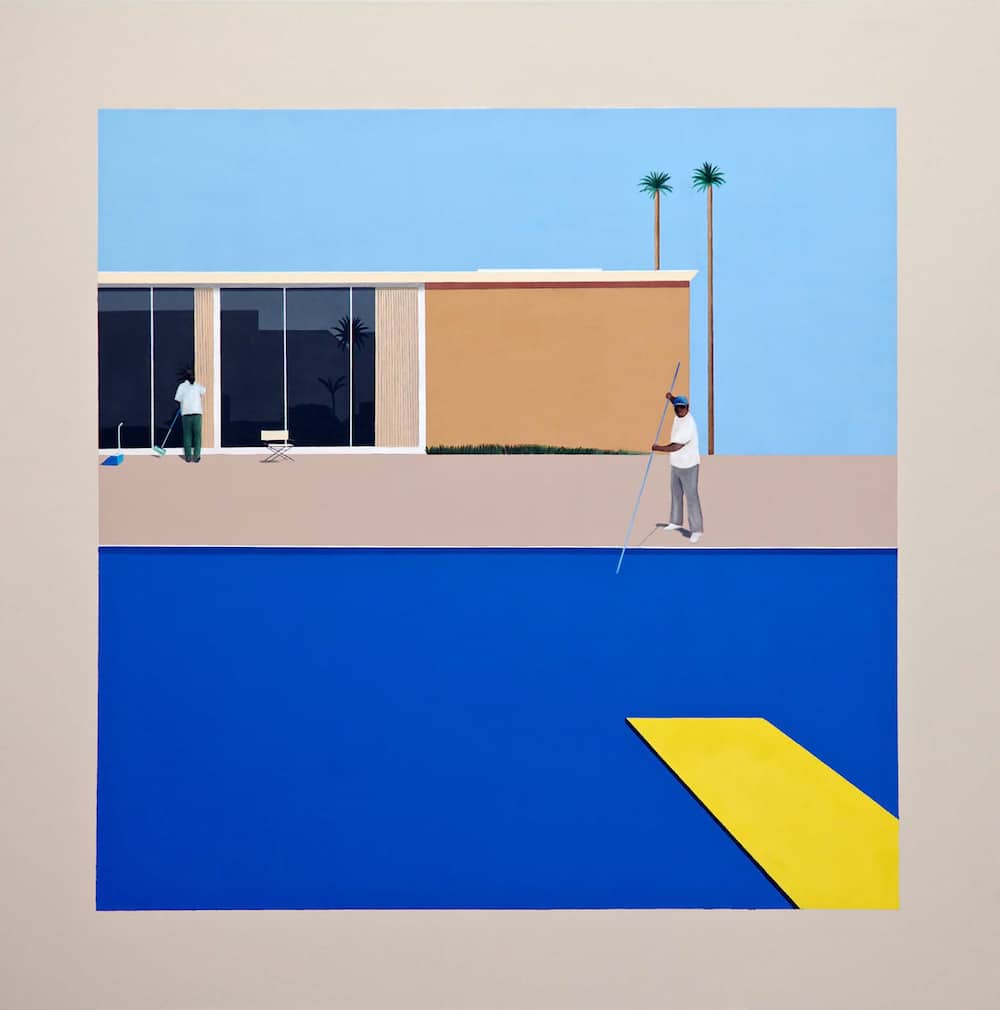
Gomez’s oeuvre intervenes in the spatial and racialized logics that underpin capitalist urban environments and the visual imaginaries of the American Dream, in which white affluence and leisure are aestheticized as aspirational ideals. The invisibility of the domestic workers is crucial to sustaining the illusion of American domesticity and progress, particularly through visualizing the home as a protected site where whiteness must remain central, normative, and unmarked. In No Splash (after David Hockney’s A Bigger Splash, 1967) (2013), Gomez enacts what she describes as an “interruption” to the fulfillment of the American dream, crystallized in David Hockney’s A Bigger Splash (1967).10 Closely mirroring Hockney’s geometric precision, flat color, and minimalist composition, Gomez adopts the sanitized visual codes of mid-century pop art to expose how an aesthetic form can reveal the structures of racial capitalism. In Hockney’s idyllic Southern California scene, the apex is the absence of the human figure in the splash, inviting the viewer to imagine an anonymous subject enjoying the fruits of wealth and ease, living the Californian dream life. This dreamscape, devoid of the labor of preservation, renewal, care, and repair, reifies what Toni Morrison calls a “racial fantasy,” one that depends on the erasure of racialized bodies to uphold whiteness as the implicit condition for attaining the promises of freedom, success, and belonging.11 By drawing attention to the domestic worker’s presence, Gomez confronts the viewer with the structural inequalities that underpin the fantasy of leisure, cleanliness, and control. Hockney’s elusive splash is replaced by the quiet repetition of maintenance work, unsettling an idealized notion of leisure-time and revealing how, under racial colonial capitalism, ease and security are selectively granted, commodified for some, while systematically denied to others.
As Mierle Laderman Ukeles powerfully demonstrated, maintenance work is not merely functional but a site of aesthetic, political, and cultural significance. Jay Lynn Gomez’s practice further deepens Ukeles’ theorization by examining the invisibility of labor as inextricably linked to processes of dispossession, capital accumulation, and archival erasure. In her work, the viewer understands private homes, galleries, public spaces, and cultural institutions as “extractive zones,” exposing the cartographies of dispossession and extraction that shape urban environments and sustain liberal fantasies of inclusion and progress.12 Gomez reclaims the visibility of migrant/immigrant workers within these zones of racial and economic exploitation, redefining domestic work not only as an artistic and essential act of survival, but also as an act of resistance and political presence. The migrant and immigrant workers in Gomez’s work are not merely reinscribed into capitalist spatial formations to be “seen” or reach uncompromised visibility under social recognition and inclusion. Instead, their presence is meant to identify them as carriers of alternative geographies and temporalities that transcend the life cycles of capitalism itself. In the face of an intensifying anti-immigrant fascist regime, the work of artists such as Jay Lynn Gomez becomes not only necessary but urgent. Through her lens, the migrant imaginary becomes a visual manifestation of how migrant life, memory, and futurity must be imagined beyond the state’s regimes of containment, criminalization, and forced disappearance. Her work stands as a testament to the political and creative force of the migrant imaginary as a tool of world-making, envisioning alternative spaces of visibility, belonging, and meaning, and the dignification of immigrant lives.
Endnotes
- Nicholas Mirzoeff, An Introduction to Visual Culture (Routledge, 2019), 15. ↩︎
- I utilize the concept of the act of repair formulated by Nicholas Mirzoeff in his recent writings White Sight: Visual Politics and Practices of Whiteness (The MIT Press, 2023) and The Right to Look: A Counterhistory of Visuality (Duke University Press, 2011). As Mirzoeff argues, repair involves a decolonial practice of unlearning dominant visualities and creating space for ways of seeing that refuse and resist the extractive gaze of whiteness and colonial modernity. The act of repair consists of not merely a restoration of what was rendered invisible as in the case of immigrant labor, but a reimagining of social, political, and economic landscapes that no longer rely on the erasure and disavowal of immigrant lives and labor. ↩︎
- See Jay Lynn Gomez, “Jay Lynn (formerly Ramiro),” in Venice Italian Virtual Pavilion of the 17th Venice Architecture Biennale, accessed April 27, 2025, https://www.youtube.com/watch?v=MpkZsXYwmbo. ↩︎
- Mierle Laderman Ukeles, MANIFESTO FOR MAINTENANCE ART, 1969! Proposal for an exhibition: “CARE” (1969), Ronald Feldman Gallery, accessed March 17, 2025, https://feldmangallery.com/exhibition/manifesto-for-maintenance-art-1969. ↩︎
- Avery F. Gordon, Ghostly Matters: Haunting and the Sociological Imagination (University of Minnesota Press, 1997). ↩︎
- Katherine McKittrick conceptualizes Black geographies as reimagined spaces that foreground the lived experience of those historically marginalized, revealing how sites marked by violence and oppression can also become loci of memory, presence, and epistemological disruption. See Demonic Grounds: Black Women and the Cartographies of Struggle (University of Minnesota Press, 2006). ↩︎
- Colonial racial capitalism highlights how settler and imperial projects secure land, labor, and resources by rendering certain peoples disposable, exploitable, and removable. As an analytic, it shows that capitalism actively depends on the ongoing production of racial difference, the extraction of value from marginalized groups, and the elimination and containment of bodies and collectivities whose existence threatens the terms of accumulation. Susan Koshy, Lisa Marie Cacho, Jodi A. Byrd, and Brian Jordan Jefferson, eds. Colonial Racial Capitalism (Duke University Press, 2022), 10. ↩︎
- Both Cristina Sharpe and Saidiya Hartman’s work think about small moments of “living otherwise” or the considered minor acts of resistance, through which enslaved people, and their descendants have created forms of life, care and expression, despite the of the conditions of violence of slavery and its afterlives. Christina Elizabeth Sharpe, In the wake: On blackness and being (Duke University Press, 2016); Saidiya V. Hartman, Wayward Lives, Beautiful Experiments: Intimate Histories of Social Upheaval (W.W. Norton & Company, 2019). ↩︎
- Rasquachismo is a Chicana/o/x aesthetic rooted in the ingenuity, resistance, and adaptability of working-class culture. It is characterized by the use of everyday materials—oftentimes disposable or reusable—to create works that are improvisational, excessive, and rebelliously expressive. As theorized by scholars Tomás Ybarra-Fausto and Amalia Mesa-Bains, rasquachismo embodies a sensibility shaped by the cultural, social, and material conditions of working-class communities, particularly within the Chicano/a/x experience where hybridity, scarcity, and everyday struggle give rise to creative practices marked by the defiant and subversive imagination of los de abajo (the underdog). ↩︎
- Jay Lynn Gomez, “Jay Lynn (formerly Ramiro) Gomez,” interview by Ren Weschler, Arts, Letters & Numbers, October 30, 2021, video 1:46:14, https://www.youtube.com/watch?v=MpkZsXYwmbo. ↩︎
- Toni Morrison, Playing in the Dark: Whiteness and the Literary Imagination (Harvard University Press, 1992), 10. ↩︎
- Macarena Gómez-Barris uses the term “extractive zone” to describe spaces structured by racialized violence, territorial dispossession, and environmental degradation, reducing Indigenous and local lifeworlds to extractable value. At the same time, she emphasizes the knowledge, resistance and relational practices that emerge from marginalized communities as they challenge and contest capitalist extraction. See The Extractive Zone: Social Ecologies and Decolonial Perspectives (Duke University Press, 2017). ↩︎
Cite as: María Eugenia López-García, “Redefining Maintenance Art through Migrant Imaginaries: Jay Lynn Gomez’s Aesthetics of Labor,” in X as Intersection: Writing on Latinx Art, January 13, 2026, accessed [DATE], https://uslaf.org/essay/redefining-maintenance-art-through-migrant-imaginaries-jay-lynn-gomezs-aesthetics-of-labor/.
María Eugenia López-García is an Assistant Professor in Museum Studies at the University of Illinois Chicago. Her scholarship explores domestic work’s aesthetics and cultural memory in the Americas. She has experience curating community exhibitions and participating in public history projects documenting immigrant labor histories and workers’ counter-representational practices.