
Rosemary Meza-DesPlas and Resistance
Rosemary Meza-DesPlas utilizes her hair as a drawing tool in her practice, serving as a medium through which she explores and reveals the complexities of her heritage and collective experiences. Her hair directly represents her age, and thus, her lived experiences; as well as her lineage, since hair contains DNA. Each strand of hair acts as a mark, like that of a pencil on paper. She creates imagery with line width and depth by layering the strands as she sews them into her chosen fabrics. Hair leaves a physical imprint of herself—her being—that will outlast her time in this physical space.1 Her hair engages questions of legacy, femininity, and the ways hair is perceived within heteropatriarchy, revealing feminist themes that address aging, beauty standards, and women’s roles in society, while also taking on an activist dimension. In this way, Meza-DesPlas confronts the political and sociocultural landscape, mobilizing her body as a site of resistance and protest across her works.
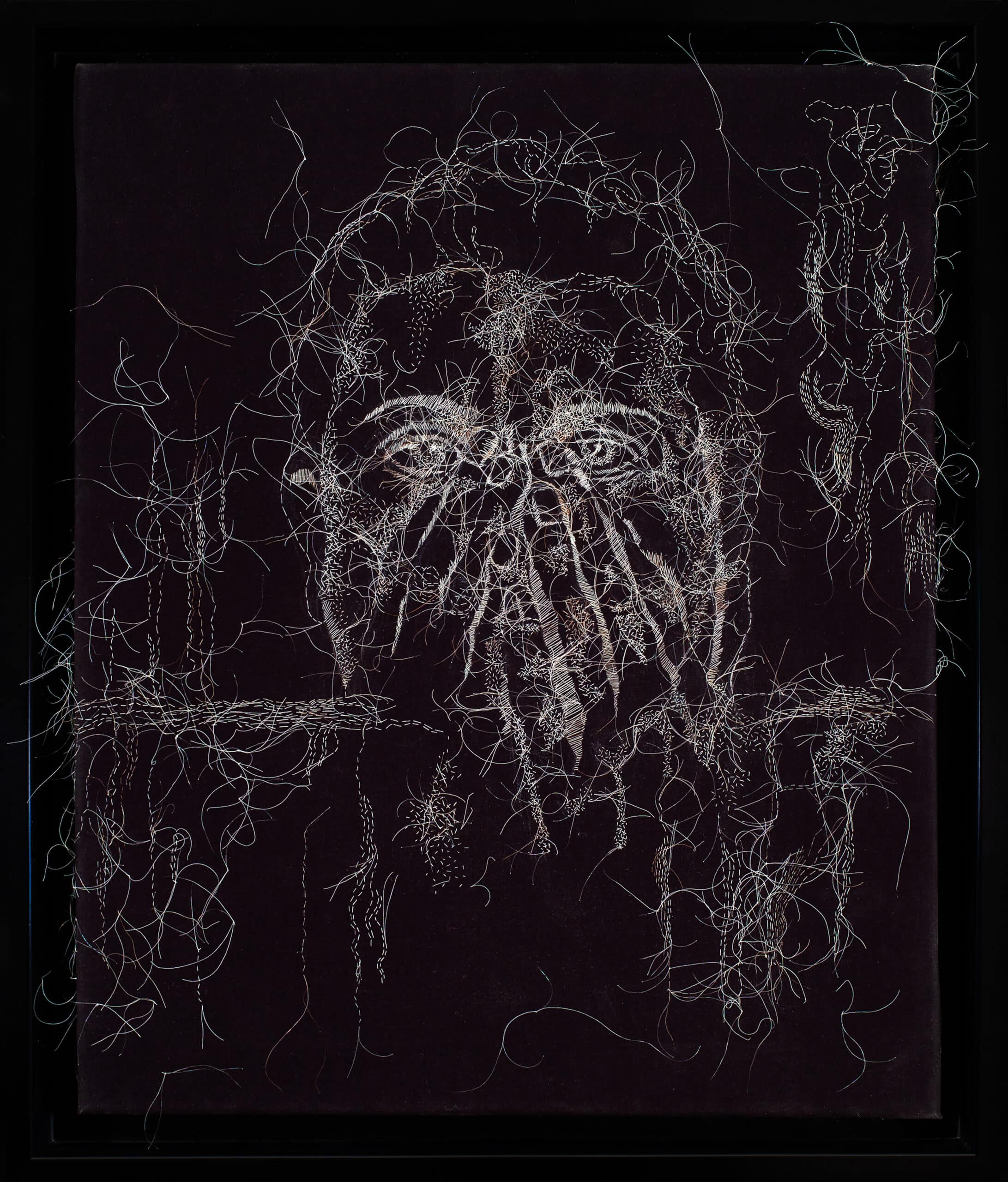
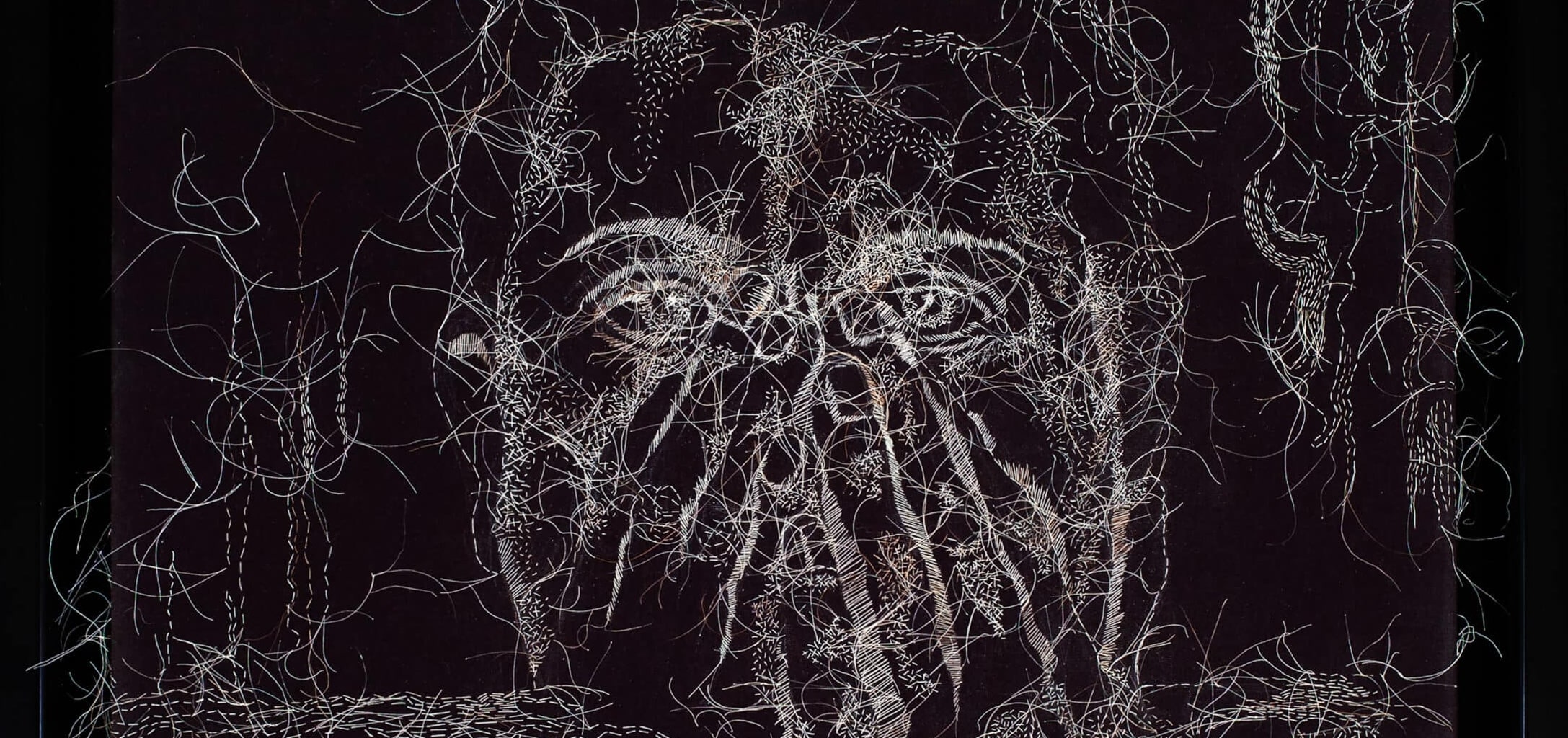
One work, Yo También (2018), gives a voice to those who have been silenced and those who feel they cannot speak. While the title is a direct translation of “Me Too,” in response to the #MeToo movement—which called out the systemic misogyny against women that protects male perpetrators—the piece offers much more. It depicts a woman covering her face with her hands, leaving only her eyes visible. The woman is on the brink of tears. Meza-DesPlas hand-stitched Yo También, initiating a larger series on black twill produced between 2018 and 2020, which portrays various images of women through surreal and realistic compositions of their bodies.2 Meza-DesPlas rendered each figure with an act of self-implantation through her hair, linking her body to the #MeToo movement. “Yo” directly translates to “Me,” with the use of Spanish over English, an implied textual reinforcement of the self-implementation through the use of her hair. Her hand-sewn human hair drawings provide a genetic and cultural foundation that builds upon feminist and decolonial ideas with every mark she makes. She is using herself to create images of women as the work conveys complex ideas about womanhood.
The deep black of the twill contrasts directly with her light grey hair, which intentionally emphasizes the passage of time. She threads her hair into twill because it does not wrinkle and can be quite rough or very soft to the touch. The cotton fabric is unrestricted as she works, and stretched when complete, playing into the textures of her hair: smooth and thick, but straight when manipulated. The portrait is intentionally incomplete, not becoming a full bust. We only see a glimpse of the hands with just the complete finger tips brushing against her tear ducts. In addition to hairs that form the figure, Meza-DesPlas also sews stray hairs across the surface, coating the fabric but not contributing to the portrait. These stray hairs restrict the viewer’s gaze, producing anxiety and unease, reinforcing the chaos and emotional toll that occurs when confronted with the purpose behind the #MeToo movement. Simultaneously, the stray hairs draw the viewer’s attention both to and away from the woman’s gaze, tracing the outlines of her hair, face, eyes, hands, the bridge of her nose, and fingernails, following and interlocking with each other across the surface of the fabric and off the picture plane. This creates a radiating effect that allows the woman to take up more physical space.
Through these compositional choices, Meza-DesPlas works in the space of nepantla, especially the ways this liminal site allows for multiplicity, complexity, and even contradictory, sexual, and political paths. Through Yo También, she tethers to resistance while untethering from heteropatriarchy. The art provides an active space for nepantla as proposed by Gloria Anzaldúa through frustration and contradiction, working through the complex emotions of #MeToo and heteropatriarchy, while also emphasizing womanhood and the perceived heteronormative notions of hair by turning it into a drawing medium.3
The stippling—achieved through making certain increments of hair visible, directional crosshatching, and outlining of the face and hands—showcases Meza-DesPlas’s mastery of drawing entirely with hair. There is a delicateness in the formation of the hands and face as loose hairs run parallel to their forms, even intersecting perpendicularly to reference a raising of the figure’s shoulders. Engaging nepantla’s complexities, this delicateness contrasts with the gravity of the sentiments surrounding the #MeToo movement. The complicated tangles of hair mirror this contrast in the composition of the drawing. The use of hair to illustrate the woman provides a deeper, interpersonal look at the effects of the movement. Meza-DesPlas is aware of the prevalent sexual violence and sexual objectification of women in Latino culture, and using her hair to engage these issues adds a layer of physicality: “The utilization of my gray hair is a nod to women and aging; thus, referencing societal expectations on beauty,” she explains.4
Her hair evokes ideas of being both “sexy” and “repulsive,” allowing us to think of this work beyond its surface.5 What was once sexy or alluring has become repulsive as it sits strewn across the twill, a subtle nod to beauty standards and purity culture as well. Hair is both repulsive and alluring, creating tension in the artworks and further placing the work in nepantla. She is both anchoring herself in her culture while removing herself from the patriarchy that is ever prevalent within it. These themes are intensified in the forms and figures of the women, reflecting a collective frustration that she has developed throughout the black twill series and connected through lived experiences, but intensely highlighted in Yo También.
The artist implants herself in the work through drawing with her own hair, which she has been collecting for over twenty-five years; over the past decade, this practice has expanded to include the collection of gray hair. By doing so—linking herself to the message, experiences, and activism of the #MeToo movement—Meza-DesPlas’s practice recalls another Anzaldúan concept, autohistoria-teoría, the combination of a maker’s lived experiences and their ancestral, cultural, and/or political influences.6 Meza-DesPlas’s art elicits her autohistoria-teoría, her ancestry, through her hair.
Meza-DesPlas is a Coahuiltecan/Mexican/Latina artist born and raised in Garland, Texas.7 Her mother is from Allende, Coahuila, Mexico, and her father is from Santa Maria, Texas, but grew up in Tampico, Tamaulipas, Mexico. Both parents lived in the wake of colonialism and postcolonialism that erased Indigenous heritage and affiliations. Meza-DesPlas brings this genetic makeup literally to her art when she creates from her hair. She introduces lives that would be rooted in Eurocentric, patriarchal societies upon assimilation.8 Her work both defies the expectations of patriarchy in her heritage and the normative expectations of heteropatriarchy in mainstream society. Still, her work remains heavily tethered to the women of her heritage by the use of her hair as a medium.
The earliest point of feminist inspiration for Meza-DesPlas was watching the women in her life—her mother and aunts—maintain order as they led their family through tragedies and economic challenges.9 The actions of women around her invoked a need for reflection on the female experience in a patriarchal society, whilst raised in a Mexican household. Meza-DesPlas’s mother and aunts personify different paths the artist could have taken in life and ways to approach situations and struggles.10 Yo También acts as a means to unpack the complexity of living in the U.S. but being culturally tethered to Mexico, dealing with two similar and unique forms of patriarchy and violence. Using her hair and technical skill, she provides an active space, in nepantla, to bring forth this contradiction and frustration through Yo También. Working in between the U.S. and Mexico, a nepantla space, gives her access to the “deep awareness” of her bicultural and binational context.11 It is from this space that she investigates the realities of #MeToo when braving the limitations and violence of the patriarchy. Her work acts as a form of resistance by untethering from heteropatriarchy. Her confrontation with the political landscape exhibits an explicit form of resistance and protest and shows a dedication to speaking up for herself and others. She gives voice to those who have been silenced by providing a face to their pain through Yo También. Meza-DesPlas works in a “psychological realm of unrest and a catalyst for creative acts.”12 Meza-DesPlas speaks to the place of women and gender in sociocultural spaces, and how women overcome challenges as they age, with the ever-changing color of her hair in each work, and especially the grey hair in Yo También, documenting her own aging. Meza-DesPlas transforms artistic practice into a site of critical dialogue and resistance.
Endnotes
- Rosemary Meza-DesPlas, interview with the author, July 10, 2025. ↩︎
- Rosemary Meza-DesPlas, “Rosemary Meza-DesPlas | Yo También,” KHÔRA, May 27, 2022, https://www.corporealkhora.com/issue/16/yo-tambien ↩︎
- According to Gloria Anzaldúa, nepantla is the space between worlds: a way to conceptualize beyond the binary. It is both “imagination and physical existence, between ordinary and nonordinary (spirit) realities” that encompasses gender, geography, linguistics, sexuality, spirituality, history, culture, politics, and society. Gloria Anzaldúa, “Preface,” Light in the Dark/Luz en lo Oscuro, ed. AnaLouise Keating (Duke University Press, 2015), 1–7, https://doi.org/10.1215/9780822375036. ↩︎
- Meza-DesPlas, “Yo También,” KHÔRA, 2022. ↩︎
- Jenn Shapland, “Rosemary Meza-DesPlas: 12 New Mexico Artists to Know Now 2019,” Southwest Contemporary, January 30, 2019, https://southwestcontemporary.com/12-new-mexico-artists-to-know-now-rosemary-meza-desplas/. ↩︎
- Kakali Bhattacharya and AnaLouise Keating, “Expanding Beyond Public and Private Realities: Evoking Anzaldúan Autohistoria-Teoría in Two Voices,” Qualitative Inquiry 24, no. 5 (2018): 345–54, https://doi.org/10.1177/1077800417741976. See also Christen S. García, Leslie C. Sotomayor, and Kimberly Sandoval, “Visual Pláticas: An Anzaldúan Art Praxis,” Chicana/Latina Studies: The Journal of Mujeres Activas en Letras y Cambio Social 24, no. 1 (2024): 94–119. ↩︎
- María Magdalena Campos-Pons, Lucia Hierro, and Rosemary Meza-DesPlas, “X as Intersection: Diasporic Legacies,” virtual conversation presented by the Museum of Fine Arts, Houston, and the U.S. Latinx Art Forum, April 19, 2023, https://www.youtube.com/watch?v=KAaX0a5r1yI. ↩︎
- Meza-DesPlas, interview. ↩︎
- Meza-DesPlas, interview. ↩︎
- Meza-DesPlas, interview. ↩︎
- Gloria Anzaldúa, “Let us be the healing of the wound,” in Light in the Dark/Luz en lo Oscuro: Rewriting Identity, Spirituality, Reality, ed. AnaLouise Keating (Duke University Press, 2015), 9–22, https://doi.org/10.1215/9780822375036. ↩︎
- Leslie C. Sotomayor and Christen S. García, “Nepantlando: A Borderlands Approach to Curating, Art Practice, and Teaching,” in The Routledge Companion to Decolonizing Art, Craft, and Visual Culture Education, 1st ed. (Routledge, 2023), 292–307, https://doi.org/10.4324/9781003190530-37. ↩︎
Cite as: Kimberly Sandoval, “Rosemary Meza-DesPlas and Resistance,” in X as Intersection: Writing on Latinx Art, April 2, 2026, accessed [DATE], https://uslaf.org/essay/rosemary-meza-desplas-and-resistance/.
Kimberly Sandoval is a Chicana scholar and multimedia artist. She explores her autohistoria-teoría while centering on and demystifying the South Texas Rio Grande Valley (RGV) borderlands. She chaired a panel discussion on Border Arte, highlighting the RGV, at the 2024 CAA Conference and received her MFA from the University of Texas, RGV that same year.